


Activists yesterday clashed with police during a protest outside Premier Jiang Yi-huah’s (江宜樺) residence, asking him to halt construction work at Losheng (Happy Life) Sanatorium and rebuild demolished buildings on the site.
“Premier Jiang, please save Losheng, halt the construction, rebuild the sanatorium,” dozens of members of the Youth Alliance for Losheng shouted as they clashed with police outside the premier’s residence in Taipei.
The activists arrived outside Jiang’s residence at about 6am without prior notice, hoping to see Jiang and deliver their petition to him before he left for work.
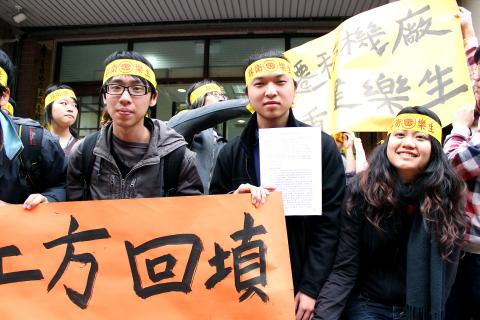
Photo: Hou Po-ching, Taipei Times
However, though the shouting attracted the attention of Jiang, who looked out from a second-floor window for a few seconds, he neither met with the students nor took their petition.
Police quickly removed the protesters by force and arrested 14.
Jiang made no comment on the protest when he left home at about 8am.
“We came here to see Jiang, because when we went to the Executive Yuan on Feb. 27, he simply ignored us,” Lin Ching (林沁), a National Taiwan University (NTU) student and a member of the alliance, told reporters. “In March last year, the government promised that construction at Losheng Sanatorium — suspended due to landslides — would not resume until they find a way to solve the landslide issue. However, construction resumed last week.”
“As a political science professor at NTU, Jiang visited Losheng in 2007 and signed a petition to support its preservation. We want to remind him of the promise he made, and ask him to host talks to resolve the issue,” Lin said.
Losheng Sanatorium, located in New Taipei City’s (新北市) Sinjhuang District (新莊), was built in the 1930s for people with leprosy.
A movement to preserve the sanatorium complex began in 2004 when it was selected as the site for a Mass Rapid Transit system maintenance depot and was to be completely demolished.
In 2007, a compromise plan allowed for the preservation of a small part of the complex, while the rest was to be demolished.
However, work has stopped several times due to landslides.
Another NTU student, Lin Hsiu-tung (林秀芃), accused Jiang of “not wanting to face the mistakes that the government made.”
“He saw us from his second-floor window, but would not meet us or speak with us,” Lin said.
Of the 14 students arrested, 13 were released soon after, while 21-year-old NTU student Kuo Kuan-chun (郭冠均) was charged with violations of the Social Order Maintenance Act (社會秩序維護法).
Several activists rallied outside the Taipei District Court in support of Kuo and accused the police of brutality as Kuo appeared in court.
At about 4:30pm, Kuo walked free as the judge cleared him of any wrongdoing.
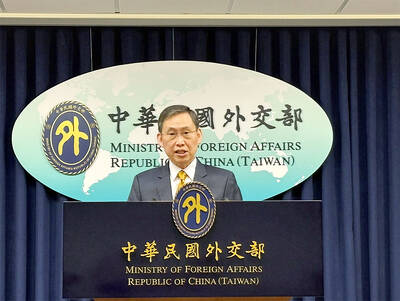
A Ministry of Foreign Affairs official yesterday said that a delegation that visited China for an APEC meeting did not receive any kind of treatment that downgraded Taiwan’s sovereignty. Department of International Organizations Director-General Jonathan Sun (孫儉元) said that he and a group of ministry officials visited Shenzhen, China, to attend the APEC Informal Senior Officials’ Meeting last month. The trip went “smoothly and safely” for all Taiwanese delegates, as the Chinese side arranged the trip in accordance with long-standing practices, Sun said at the ministry’s weekly briefing. The Taiwanese group did not encounter any political suppression, he said. Sun made the remarks when
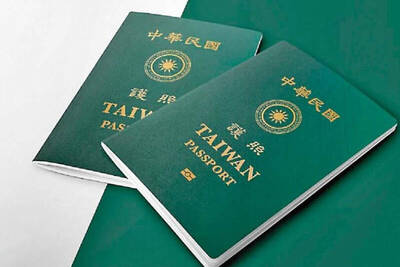
The Taiwanese passport ranked 33rd in a global listing of passports by convenience this month, rising three places from last month’s ranking, but matching its position in January last year. The Henley Passport Index, an international ranking of passports by the number of designations its holder can travel to without a visa, showed that the Taiwan passport enables holders to travel to 139 countries and territories without a visa. Singapore’s passport was ranked the most powerful with visa-free access to 192 destinations out of 227, according to the index published on Tuesday by UK-based migration investment consultancy firm Henley and Partners. Japan’s and
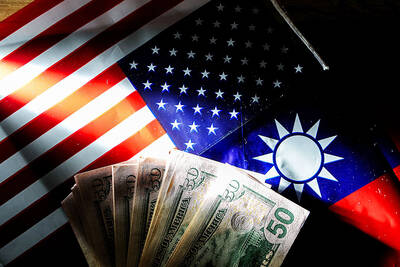
BROAD AGREEMENT: The two are nearing a trade deal to reduce Taiwan’s tariff to 15% and a commitment for TSMC to build five more fabs, a ‘New York Times’ report said Taiwan and the US have reached a broad consensus on a trade deal, the Executive Yuan’s Office of Trade Negotiations said yesterday, after a report said that Washington is set to reduce Taiwan’s tariff rate to 15 percent. The New York Times on Monday reported that the two nations are nearing a trade deal to reduce Taiwan’s tariff rate to 15 percent and commit Taiwan Semiconductor Manufacturing Co (TSMC, 台積電) to building at least five more facilities in the US. “The agreement, which has been under negotiation for months, is being legally scrubbed and could be announced this month,” the paper said,
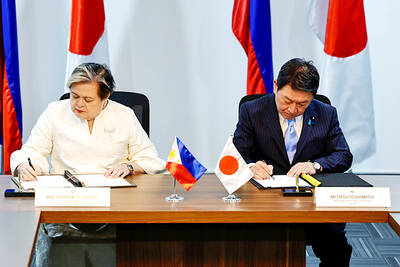
Japan and the Philippines yesterday signed a defense pact that would allow the tax-free provision of ammunition, fuel, food and other necessities when their forces stage joint training to boost deterrence against China’s growing aggression in the region and to bolster their preparation for natural disasters. Japan has faced increasing political, trade and security tensions with China, which was angered by Japanese Prime Minister Sanae Takaichi’s remark that a Chinese attack on Taiwan would be a survival-threatening situation for Japan, triggering a military response. Japan and the Philippines have also had separate territorial conflicts with Beijing in the East and South China


 RSS
RSS