


President Ma Ying-jeou’s (馬英九) demand that academics relaunch a study of the 228 Massacre in 1947 is part of his de-Taiwanization effort, and the president owes the victims and their families an apology, Democratic Progressive Party (DPP) lawmakers said yesterday.
Showing a document issued by the Presidential Office to Academia Sinica which recommended the institution’s Institute of Modern History revisit the controversial incident and uncover the “real facts,” DPP lawmakers told a press conference that it was part of Ma’s de-Taiwanization effort.
The document stemmed from a letter to Ma from Chinese Maritime Transport Ltd chairman John Peng’s (彭蔭剛) on Feb 21, which asked Ma to rehabilitate his late father, Peng Meng-chi (彭孟緝), a former commander at the Kaohsiung Fortress.
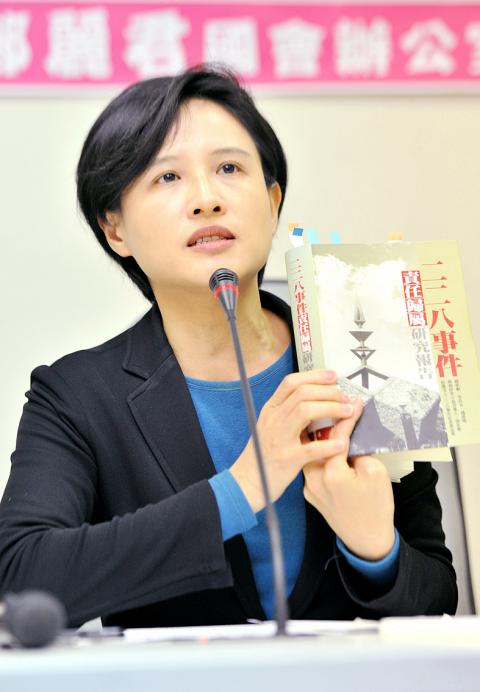
Photo: Chen Chih-chu, Taipei Times
Peng Meng-chi was named by a government investigation into the massacre, published in 2006, as one of the people responsible for the deaths of many innocent Taiwanese as he had ordered a massacre in Kaohsiung, which later earned him the nickname the “Kaohsiung Butcher.”
“It is likely the last piece of the puzzle for Ma’s de-Taiwanization effort after the president’s attempt to revise high-school history textbooks last year,” DPP Legislator Chen Chi-mai (陳其邁) said.
Ma, who accused the DPP of a “desinicization” attempt when the party was in power between 2000 and 2008, has been trying to distort Taiwan’s history into one based on a China-centric perspective, evidenced by his instruction to merge Taiwanese and Chinese history textbooks in July last year, Chen said.
Chen also condemned Peng for his description of Taiwanese who died in the massacre as “thugs” in his letter, saying that Peng and Ma should apologize for vilifying those who perished and their families.
Chen has proposed legislation to subject those who deny or tone down the 228 Incident to up to five years in prison, referencing a German law on pro-Nazi violations.
Ma should explain whether he agrees with Peng’s view of the massacre and should “face the tragedy with humility,” DPP Legislator Cheng Li-chiun (鄭麗君) said.
“Ma’s attempt to rewrite history would be unacceptable in any other democracy, especially when many victims’ families who witnessed the massacre are still alive,” said DPP Legislator Hsiao Bi-khim (蕭美琴), who recently urged the government to extend the period victims’ families can apply for compensation because some were not aware that their relatives were executed until after 1996 — the deadline for applications.
Ma should be ashamed of his “two-handed strategy” — offering sympathy to the victims and their families every year on one hand, while trying to distort history on the other, Hsiao said.
Chen Yi-shen (陳儀深), an assistant researcher at the Institute of Modern History and an expert on Taiwan’s modern history, said various studies showed that Peng Meng-chi’s responsibility for ordering the massacre in Kaohsiung was “indisputable.”
Peng Meng-chi’s role in history should be remembered as more than just a commander who ordered the brutal massacre, Chen said, as Peng was later promoted to commander of the Taiwan Garrison Command, which was responsible for suppressing and killing many democracy activists during the White Terror period.
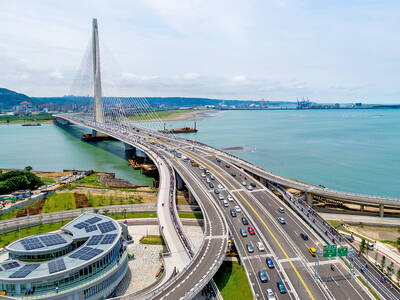
The Ministry of Transportation and Communications yesterday inaugurated the Danjiang Bridge across the Tamsui River in New Taipei City, saying that the structure would be an architectural icon and traffic artery for Taiwan. Feted as a major engineering achievement, the Danjiang Bridge is 920m long, 211m tall at the top of its pylon, and is the longest single-pylon asymmetric cable-stayed bridge in the world, the government’s Web site for the structure said. It was designed by late Iraqi-British architect Zaha Hadid. The structure, with a maximum deck of 70m, accommodates road and light rail traffic, and affords a 200m navigation channel for boats,
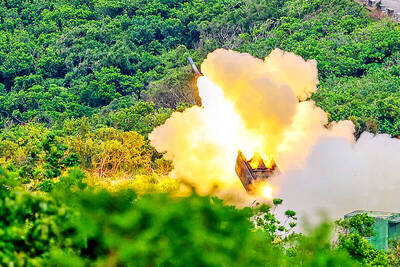
PRECISION STRIKES: The most significant reason to deploy HIMARS to outlying islands is to establish a ‘dead zone’ that the PLA would not dare enter, a source said A High Mobility Artillery Rocket System (HIMARS) would be deployed to Penghu County and Dongyin Island (東引) in Lienchiang County (Matsu) to force the Chinese military to retreat at least 100km from the coastline, a military source said yesterday. Taiwan has been procuring HIMARS and Army Tactical Missile Systems (ATACMS) from the US in batches. Once all batches have been delivered, Taiwan would possess 111 HIMARS units and 504 ATACMS, which have a range of 300km. Considering that “offense is the best defense,” the military plans to forward-deploy the systems to outlying islands such as Penghu and Dongyin so that
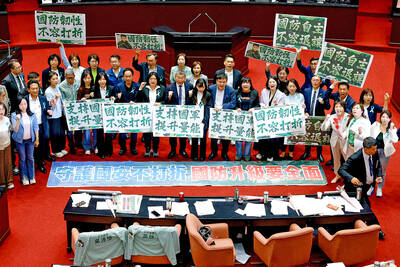
WHAT WAS ALL THAT FOR? Jaw Shaw-kong said that Cheng Li-wen had pushed for more drastic cuts and attacked him, just for the outcome to be nearly identical to his bill The legislature yesterday passed a supplementary budget bill to fund the purchase of separate packages of US military equipment, with the combined amount of spending capped at NT$780 billion (US$24.8 billion). The Chinese Nationalist Party (KMT) and Taiwan People’s Party (TPP) used their legislative majority to pass the bill, which runs until 2033 and has two main funding provisions. One was for NT$300 billion of arms sales already approved by the US for Taiwan on Dec. 17 last year, the other was for NT$480 billion for another arms package expected to be announced by Washington. The bill, which fell short of the NT$1.25

‘CLEAR MESSAGE’: The bill would set up an interagency ‘tiger team’ to review sanctions tools and other economic options to help deter any Chinese aggression toward Taiwan US Representative Young Kim has introduced a bill to deter Chinese aggression against Taiwan, calling for an interagency “tiger team” to preplan coordinated sanctions and economic measures in response to possible Chinese military or political action against Taiwan. “[Chinese President] Xi Jinping [習近平] has directed the People’s Liberation Army to be ready to invade Taiwan by 2027. China has a plan. America should have one too,” Kim said in a news release on Thursday last week. She introduced the “Deter PRC [People’s Republic of China] aggression against Taiwan act” to “ensure the US has a coordinated sanctions strategy ready should


 RSS
RSS