


Priceless artifacts and works of art at museums such as the National Palace Museum are at high risk of being damaged when earthquakes strike, lawmakers and researchers warned yesterday, urging the authorities and organizations to allocate budgets for earthquake-resistant equipment designed to protect museum exhibits.
“Thirteen years after the Sept. 21 earthquake hit [Taiwan], we have invested plenty of resources in the development of earthquake-resistant buildings and infrastructures, but very little has been done to protect invaluable relics and objects on display. Many museums have no budget for protecting their collections from earthquakes,” Chinese Nationalist Party (KMT) Legislator Apollo Chen (陳學聖) said at a press conference jointly organized with KMT Legislator Lu Yu-ling (呂玉玲).
Chen was referring to the magnitude-7.3 quake that hit the nation on Sept. 21, 1999, which left 2,415 dead, 11,305 injured and 400,000 homeless.
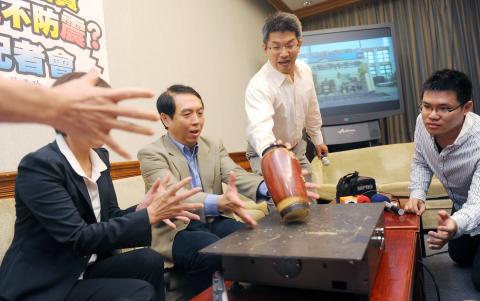
Photo: Lo Pei-der, Taipei Times
According to information compiled by Chen’s team, among the nine national museums surveyed, only the Museum of the Institute of History and Philology at Academia Sinica and the National Taiwan Museum of Fine Arts have installed systems used to safeguard exhibits against seismic impacts. The National Palace Museum and the National Museum of History use materials such as nylon strings to keep artifacts in fixed positions, while others, such as the National Taiwan Museum and the National Museum of Prehistory, have no protective measures in place.
Researchers from the National Center for Research on Earthquake Engineering showed a video that demonstrated the efficiency of earthquake-resistant designs. In the video, articles of furniture at a sample living room without earthquake protectors fall on the floor within minutes in a simulated earthquake measuring 7 on the Richter scale, whereas in a room equipped with protection facilities, a vase and water bottle are seen remaining in the same position.
“The earthquake-resistant system is made up of isolation units that are soft and enable objects to withstand the force of an earthquake,” researcher Chien Wen-yu (簡文郁) said. “These techniques have been used to protect buildings such as hospitals.”
Chien added that in private homes, large pieces of furniture like bookshelves and large-screen televisions should be anchored to walls to provide protection against seismic impacts.
Chen Tung-he (陳東和), an assistant researcher at the National Palace Museum, said the museum uses multiple measures to protect artifacts on display.
“We use strings, nails or wires to prevent artifacts from sliding. Weights are placed inside taller objects to make them more balanced,” Chen said. “But it is definitely worth the effort to develop new methods to protect artifacts from being destroyed in case of an earthquake.”
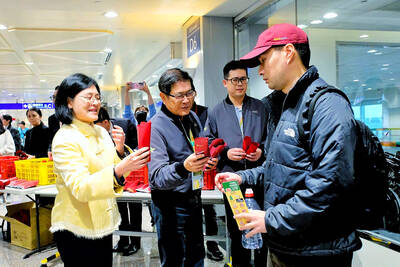
An Emirates flight from Dubai arrived at Taiwan Taoyuan International Airport yesterday afternoon, the first service of the airline since the US and Israel launched strikes against Iran on Saturday. Flight EK366 took off from the United Arab Emirates (UAE) at 3:51am yesterday and landed at 4:02pm before taxiing to the airport’s D6 gate at Terminal 2 at 4:08pm, data from the airport and FlightAware, a global flight tracking site, showed. Of the 501 passengers on the flight, 275 were Taiwanese, including 96 group tour travelers, the data showed. Tourism Administration Deputy Director-General Huang He-ting (黃荷婷) greeted Taiwanese passengers at the airport and

POSSIBILITIES EMERGE: With Taiwan’s victory and Japan’s narrow win over Australia, Taiwan now have a chance to advance if South Korea also beat the Aussies Taiwan has high hopes that the national baseball team would advance to the World Baseball Classic (WBC) quarter-finals after clinching a crucial 5-4 victory over South Korea in a nail-biting extra-inning game at the Tokyo Dome yesterday. Boosted by three home runs — two solo shots by Yu Chang (張育成) and Cheng Tsung-che (鄭宗哲) and a two-run homer by Stuart Fairchild — the triumph gave Taiwan a much-needed second victory in the five-team Pool C, where only the top two finishers would advance to the knockout stage in Miami, Florida. Entering extra innings with the game tied at four apiece, Taiwan scored
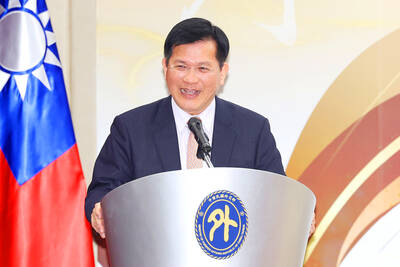
MISSION OF PEACE: The foreign minister urged Beijing to respect Taiwan’s existence as an independent nation, and work together to ensure peace and stability in the region Minister of Foreign Affairs Lin Chia-lung (林佳龍) yesterday rejected Chinese Minister of Foreign Affairs Wang Yi’s (王毅) comments about Taiwan, criticizing China as a “troublemaker” in the international community and a disruptor of cross-strait peace. Speaking at a news conference on the sidelines of the Chinese National People’s Congress, Wang said that Taiwan has always been a territory of China and that it would be impossible for it to become its own country. The “return” of Taiwan to China was the natural outcome of the Chinese people’s resistance against Japan in World War II, and that any pursuit of independence was “doomed
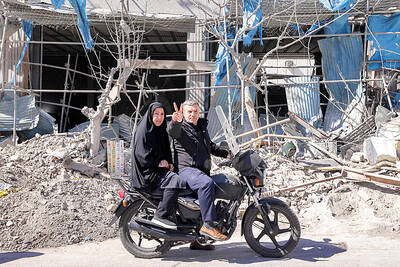
STRAIT OF HORMUZ: In the case of a prolonged blockade by Iran, Taiwan would look to sources of LNG outside the Middle East, including Australia and the US Taiwan would not have to ration power due to a shortage of natural gas, Minister of Economic Affairs Kung Ming-hsin (龔明鑫) said yesterday, after reports that the Strait of Hormuz was closed amid the conflict in the Middle East. The government has secured liquefied natural gas (LNG) supplies for this month and contingency measures are in place if the conflict extends into next month, Kung told lawmakers. Saying that 25 percent of Taiwan’s natural gas supplies are from Qatar, Chinese Nationalist Party (KMT) caucus secretary-general Lin Pei-hsiang (林沛祥) asked about the situation in light of the conflict. There would be “no problems” with


 RSS
RSS