


Fang Lizhi (方勵之), one of China’s best-known dissidents, whose speeches inspired student protesters throughout the 1980s, has died in the US, where he fled after China’s 1989 military crackdown on the pro-democracy movement. He was 76.
Once China’s leading astrophysicist, Fang and his wife hid in the US embassy for 13 months after the crackdown. In exile, he was a physics professor at the University of Arizona in Tucson.
Fang’s wife, Li Shuxian (李淑嫻), confirmed in Beijing that Fang died on Friday morning in Tucson, Arizona.
Fang inspired a generation, said his friend and fellow exiled dissident Wang Dan (王丹), who announced the death on Facebook and Twitter.
“I hope the Chinese people will never forget that there was once a thinker like Fang Lizhi. He inspired the ’89 generation, and awoke in the people their yearning for human rights and democracy,” Wang said. “One day, China will be proud to once have had Fang Lizhi.”
“Fang is my spiritual teacher, his death is a major blow to me. At this moment, my grief is beyond words,” Wang said.
The son of a postal clerk in Hangzhou, China, Fang was admitted to Beijing University in 1952 at age 16 to study theoretical physics and nuclear physics. He became one of China’s pioneer researchers in laser theory.
He burst into political prominence during pro-democracy student demonstrations between 1986 and 1988 when he became China’s most outspoken proponent of democratic reform.
Authorities said his speeches to students at the University of Science and Technology, where he was vice president, incited unrest.
Fang was expelled from the Chinese Communist Party and fired from his university post. However, he refused to be silenced.
After the June 4, 1989, military crackdown that crushed the seven-week pro-democracy movement, Fang and his wife fled into the US embassy. Fang and Li had both been named in Chinese warrants that could have carried death sentences upon conviction. US diplomats refused to turn them over to Chinese authorities.
China decided to allow the couple to leave the country a year later.
Fang had been a professor in Tucson for about 20 years, said a colleague, physics professor Elliott Cheu. He chatted about his pro-democracy background at cocktail parties, but Cheu mainly knew him as a physicist.
“Even at this stage of his career he was fairly well versed in physics and really understood the material and had a deep understanding of how things worked — which is kind of the mark of a real physicist,” Cheu said.
Meanwhile, following Fang’s death, the exiled leaders of the 1989 Tiananmen Square movement and other Chinese dissidents have asked the government to allow them to visit their homeland.
“Because of political reasons we were denied renewal of our passports, had our passports revoked or were denied entry into China,” Wang Dan, Wuer Kaixi (吾爾開希), Hu Ping (胡平), Wang Juntao (王軍濤), Wu Renhua (吳仁華) and Xiang Xiaoji (項小吉) said in a letter.
“In short, we have been deprived of our right to return to our country,” they said in the correspondence dated on Friday and released by the Human Rights in China group.

The nation’s fastest supercomputer, Nano 4 (晶創26), is scheduled to be launched in the third quarter, and would be used to train large language models in finance and national defense sectors, the National Center for High-Performance Computing (NCHC) said. The supercomputer, which would operate at about 86.05 petaflops, is being tested at a new cloud computing center in the Southern Taiwan Science Park in Tainan. The exterior of the server cabinet features chip circuitry patterns overlaid with a map of Taiwan, highlighting the nation’s central position in the semiconductor industry. The center also houses Taiwania 2, Taiwania 3, Forerunner 1 and

FIRST TRIAL: Ko’s lawyers sought reduced bail and other concessions, as did other defendants, but the bail judge denied their requests, citing the severity of the sentences Former Taipei mayor Ko Wen-je (柯文哲) was yesterday sentenced to 17 years in prison and had his civil rights suspended for six years over corruption, embezzlement and other charges. Taipei prosecutors in December last year asked the Taipei District Court for a combined 28-year, six-month sentence for the four cases against Ko, who founded the Taiwan People’s Party (TPP). The cases were linked to the Core Pacific City (京華城購物中心) redevelopment project and the mismanagement of political donations. Other defendants convicted on separate charges included Chinese Nationalist Party (KMT) Taipei City Councilor Angela Ying (應曉薇), who was handed a 15-year, six-month sentence; Core Pacific
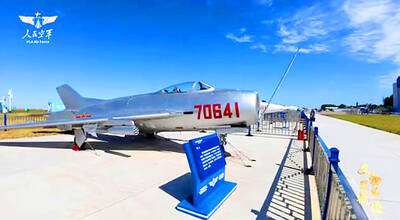
J-6 REMODEL: The converted drones are part of Beijing’s expanding mix of airpower weapons, including bombers with stand-off missiles and UAV swarms, the report said China has stationed obsolete supersonic fighters converted to attack drones at six air bases close to the Taiwan Strait, a report published this month by the Arlington, Virginia-based Mitchell Institute for Aerospace Studies said. Satellite imagery of the airfields from the institute’s “China Airpower Tracker” shows what appear to be lines of stubby, swept-winged aircraft matching the shape of J-6 fighters that first flew with the Chinese People’s Liberation Army (PLA) Air Force in the 1960s. Since their conversion to drones, the aircraft have been identified at five bases in China’s Fujian Province and one in Guangdong Province, the report said. J.

China used fake LinkedIn profiles to harvest sensitive data from NATO and EU institutions by soliciting information from staff, a European security source said on Friday. The operation, allegedly orchestrated by the Chinese Ministry of State Security, targeted dozens of employees at the military alliance or EU organizations through fictitious accounts, the source said, confirming reports in French and Belgian media. Posing as recruiters on the online professional networking platform, Chinese spies would initially request paid reports before later soliciting non-public or even classified information. One particularly active fake profile used the name “Kevin Zhang,” claiming to be the head


 RSS
RSS