


The Democratic Progressive Party (DPP) yesterday urged the judicial authorities to launch an investigation into Council for Cultural Affairs (CCA) Minister Emile Sheng (盛治仁) for allegedly profiting certain performance companies and individuals when staging a rock musical to celebrate the 100th anniversary of the Republic of China.
The two-night presentation of the musical, Dreamers, cost more than NT$215 million (US$7.15 million), DPP spokesman Chuang Ruei-hsiung (莊瑞雄) told a press conference yesterday.
The project was divided into 13 bids, of which six were restricted bids totaling NT$180 million to evade the Public Procurement Act (政府採購法), Chuang said.
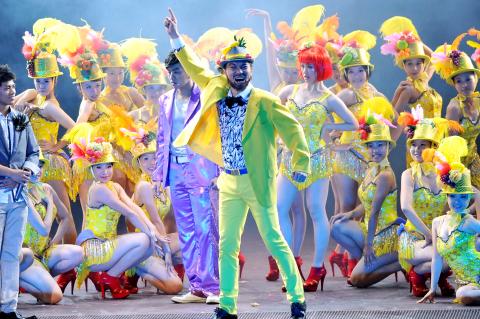
Photo: Liao Hui-tung, Taipei Times
Winners of those bids were almost the same group of winners of bids related to Taipei’s Deaflympics in 2009 and the Taipei International Flora Expo, a pair of projects Sheng was also in charge of, Chuang said.
The “creativity design project” portion, which had a NT$39 million budget, was not put up for public auction.
It went to Performance Workshop Theatre founder Stan Lai (賴聲川), who has now drawn public attention to his role in the case, Chuang said.
DPP spokesperson Liang Wen-jie (梁文傑) said that minutes of a March 21 meeting of the Taiwan Association of Theater Technology showed that the association, which is closely linked with Lai’s company, said it “would win the bid and could collaborate with other groups on the project,” despite the bidding not opening until April 20.
At least two executive members of the association are employees of the Performance Workshop Theatre, Liang said, adding that the association and Lai’s workshop had received close to NT$100 million of the total budget of NT$215 million.
“As the CCA minister, Sheng has evaded the law by dividing the bids and favoring Lai in the bidding process. He should be held accountable for an act of corruption,” Liang said.
It was suspicious that the prices of six of the 11 bids were the same as the base prices, while another only came in at a NT$300 difference, DPP Legislator Huang Wei-cher (黃偉哲) said, adding that the way the money was spent was “nightmarish.”
With more than half of the bids restricted, the council could have violated the Public Procurement Act, DPP Legislator Lee Chun-yi (李俊毅) said, adding that prosecutors should launch a full investigation into the case.
At a separate setting yesterday, DPP Chairperson Tsai Ing-wen (蔡英文) said that compared with the musical, which cost more than NT$215 million, the central government’s annual budget for a sponsorship program providing nutritional supplements to 42,643 disadvantaged children three days a week was only about NT$9 million per year.
In response to the allegations of wrongdoing, Sheng told a separate press conference that all matters concerning the musical were conducted in accordance with procedures.
Sheng said he had asked the council’s Department of Government Ethics to submit all relevant information to the judiciary for an investigation, adding that he would refuse to dance to the opposition’s tune by commenting further on the matter.
Additional reporting by staff writer, with CNA

‘NO SECURITY RISK’: The Railway Bureau reassured the public that the technicians’ activities were limited to technical guidance and did not involve sensitive systems The Railway Bureau yesterday said it had invited eight Chinese technicians to assist with an airport MRT construction project. The bureau issued the confirmation after an Internet user said Chinese nationals had entered the construction zone of Taiwan Taoyuan International Airport’s Terminal 3 project. They asked why “individuals from an enemy state” were allowed access to such a major national infrastructure project, which raised serious concerns over Taiwan’s industrial safety, sensitive systems and information security. The bureau’s Northern Region Engineering Branch Office said subcontractor Taiwan Handle Industrial Co (台灣手把工業) of the Taoyuan airport MRT’s “Contract No. CU05 Project A14 Station Civil, MEP &

The National Chungshan Institute of Science and Technology yesterday showcased its locally developed variants of the Vision 60 robotic patrol dog, which it plans to deploy on the nation’s outlying territories in the South China Sea. The variants were produced under the Joint Lab project — created by the institute and domestic companies — and assembled with domestically produced motors, lenses and artificial intelligence (AI) systems alongside licensed tech from the US, Missile and Rocket Systems Research Division deputy director Jen Kuo-kang (任國光) told the media event at a military base in Taipei’s Dazhi (大直) area. Taiwan has built up its strengths

TIT-FOR-TAT: The US allegedly revoked the visa of a Chinese national working at Xinhua News Agency in the US in response to Beijing’s expulsion of Vivian Wang The Presidential Office yesterday condemned China for expelling a New York Times correspondent from Beijing following the newspaper’s interview with President William Lai (賴清德), saying the move highlighted Beijing’s suppression of press freedom and its threat to international news media. Taiwan has noted a series of recent incidents in which Beijing used similar tactics to “threaten and pressure international media outlets and journalists,” Presidential Office spokeswoman Karen Kuo (郭雅慧) said in a statement. “This concerns not only press freedom and freedom of expression, but also the safety of journalists, and Taiwan and relevant partners are paying close attention to the situation,” she

NOT IMMEDIATE: Taiwan has a chance to appeal the proposed 10 percent tariff before it starts, while other countries face a 12.5 percent tariff from the trade office Taiwan is among 60 economies determined by the US to have failed to impose or enforce a ban on the importation of goods produced with forced labor, according to a notice released on Tuesday by the Office of the US Trade Representative (USTR), which proposed imposing an additional 10 percent or more tariff on them. The USTR in a statement said that following an investigation, it had determined under Section 301 of the Trade Act of 1974 that the failure of the 60 economies to impose and effectively enforce a prohibition on the importation of goods produced with forced labor is


 RSS
RSS