


Thailand yesterday announced a five-day holiday to give people the chance to escape the floodwaters closing in on Bangkok as authorities ordered the evacuation of a housing estate on the outskirts of the city after a protective wall gave way.
The Cabinet declared tomorrow through Monday a holiday in Bangkok and 20 provinces affected by the country’s worst flooding in 50 years as weekend high tides in the Gulf of Thailand could complicate efforts to divert water from the low-lying capital.
Financial markets will remain open.
As water levels climbed, some of those already evacuated were preparing to be evacuated again, with 4,000 people sheltering at a northern Bangkok airport told they would be moved to the eastern province of Chon Buri.
The floods have killed at least 366 people since the middle of July and disrupted the lives of nearly 2.5 million, with more than 113,000 in shelters and 720,000 seeking medical attention.
Authorities are scrambling to pump out water around the east and west of Bangkok, but record-high water levels in the Chao Phraya river that winds through the city raise the risk of floods in the commercial heart when the tide rises.
“It’s still hard to say whether the water will swell over the Chao Phraya dyke, but the situation is changing all the time. Things we didn’t think would happen have happened,” said Seri Supharatid, director of Rangsit University’s Center on Climate Change and Disaster.
“In the worst-case scenario, if all the dykes break, all parts of Bangkok would be more or less flooded,” he said.
The floods have also forced the closure of seven industrial estates in Ayutthaya, Nonthaburi and Pathum Thani provinces bordering Bangkok, causing billions of dollars of damage, disrupting supply chains for industry and putting about 650,000 people temporarily out of work.
The Cabinet yesterday announced a 325 billion baht (US$10.6 billion) budget to help rebuild the country, mostly for small and medium-sized enterprises, small vendors and individuals.
“If they get back to normal quickly, it will help push the economy forward,” Thai Finance Minister Thirachai Phuvanatnaranubala said.
Heavy rain late yesterday, the first in four days, could complicate an already precarious situation and more showers were forecast for today.
Don Muang Airport, Bangkok’s second biggest, closed late yesterday due to concerns that passengers and staff might have problems reaching the terminal. It is expected to reopen on Tuesday next week.
Airports of Thailand said the main Suvarnabhumi Airport, built on a snake-infested swamp, was not affected because it was on higher ground.
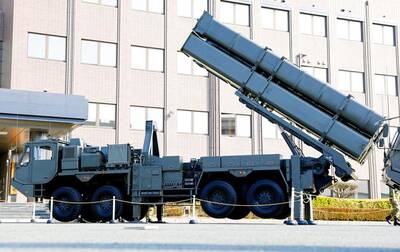
Japan has deployed long-range missiles in a southwestern region near China, the Japanese defense minister said yesterday, at a time when ties with Beijing are at their lowest in recent years. The missiles were installed in Kumamoto in the southern region of Kyushu, as Japan is attempting to shore up its military capacity as China steps up naval activity in the East China Sea. “Standoff defense capabilities enable us to counter the threat of enemy forces attempting to invade our country ... while ensuring the safety of our personnel,” Japanese Minister of Defense Shinjiro Koizumi said. “This is an extremely important initiative for

Chinese Nationalist Party (KMT) Chairwoman Cheng Li-wun (鄭麗文) today accepted an invitation from Chinese President Xi Jinping (習近平) to lead a delegation to China next month, saying she hopes to promote the peaceful development of cross-strait relations and bring stability to the Taiwan Strait. “I am grateful and happy to accept this invitation,” Cheng said in a statement from the KMT chairperson’s office. Cheng said she hopes both sides can work together to promote the peaceful development of cross-strait relations, enhance exchange and cooperation, bring stability to the Taiwan Strait and improve people’s livelihoods. At today's news conference, Cheng said any efforts to
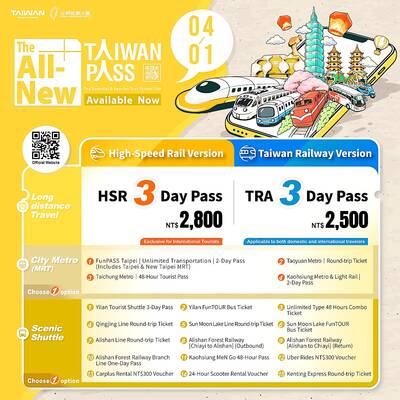
MORE POPULAR: Taiwan Pass sales increased by 59 percent during the first quarter compared with the same period last year, the Tourism Administration said The Tourism Administration yesterday said that it has streamlined the Taiwan Pass, with two versions available for purchase beginning today. The tourism agency has made the pass available to international tourists since 2024, allowing them to access the high-speed rail, Taiwan Railway Corp services, four MRT systems and four Taiwan Tourist Shuttles. Previously, five types of Taiwan Pass were available, but some tourists have said that the offerings were too complicated. The agency said only two types of Taiwan Pass would be available, starting from a three-day pass with the high-speed rail and a three-day pass with Taiwan Railway Corp. The former costs NT$2,800

The nation’s fastest supercomputer, Nano 4 (晶創26), is scheduled to be launched in the third quarter, and would be used to train large language models in finance and national defense sectors, the National Center for High-Performance Computing (NCHC) said. The supercomputer, which would operate at about 86.05 petaflops, is being tested at a new cloud computing center in the Southern Taiwan Science Park in Tainan. The exterior of the server cabinet features chip circuitry patterns overlaid with a map of Taiwan, highlighting the nation’s central position in the semiconductor industry. The center also houses Taiwania 2, Taiwania 3, Forerunner 1 and


 RSS
RSS