


The Democratic Progressive Party (DPP) made history yesterday by grabbing both speaker and deputy speaker seats in the Greater Tainan City Council, as well as deputy speaker seats in the Taipei and Greater Kaohsiung City Councils.
Mayors and councilors in the country’s five special municipalities — Taipei, New Taipei (新北市, the proposed name of the upgraded Taipei County), Greater Taichung, Greater Tainan and Greater Kaohisung — were sworn in yesterday morning, followed by elections for city council speakers and deputy speakers.
While local council heads are traditionally dominated by Chinese Nationalist Party (KMT) and independent councilors, the DPP, for the first time in the nation’s history, took both the speaker and deputy speaker seats in the Greater Tainan City Council, as well as deputy speaker seats in the Taipei and Greater Kaohsiung City Councils.
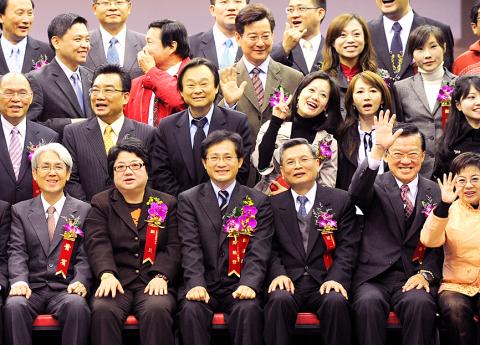
PHOTO: FANG PIN-CHAO, TAIPEI TIMES
In Taipei City, the incumbent council speaker, Wu Bi-chu (吳碧珠), of the KMT garnered 37 seats and won the seat for the fourth time, while her DPP rival Lee Chien-chang (李建昌) received 32 votes.
However, DPP councilor Chou Po-ya (周柏雅) defeated the incumbent deputy speaker Chen Chin-hsiang (陳錦祥) by a 30 to 29 margin, making him the first-ever DPP member to serve as deputy speaker of Taipei City Council.
The KMT accounted for 30 of all 62 Taipei City councilors, while the DPP garnered 23 seats. There are eight councilors from the New Party, People First Party and Taiwan Solidarity Union, and one independent councilor.
DPP Taipei City councilors began cheering when the election result was announced, while the KMT councilors appeared surprised.
KMT spokesman Su Jun-pin (蘇俊賓) said the party will look into the situation and punish party councilors who failed to vote for KMT candidates.
The KMT’s Taipei branch director Pan Chia-sen (潘家森) said the party “trusted party members too much” and did not send party staff to oversee the voting.
Pan said about five to seven KMT members voted for Chou in the election, and the party will revoke the membership of those who violated party regulations and supported DPP candidates in the election.
New Party Chairman Yok Mu-ming (郁慕明) said all three party councilors voted for Chen in the election, urging the KMT to offer an explanation on the surprising defeat.
Chou, a veteran city councilor who is in his sixth term, promised to maintain neutrality as the vice speaker and enhance -communication between the KMT and the DPP in the council.
In Greater Tainan, after a three-hour delay because councilors could not agree on where the ballot box should be placed, DPP Greater Tainan Councilor Lai Mei-hui (賴美惠) won the speaker seat with 30 votes from her colleagues against independent councilor Wu Chien-pao’s (吳健保) 21 votes, and became not only the first DPP member to be elected to a special municipality council speaker seat, but also the first female council speaker in the Tainan City Council.
Being the only candidate for deputy speaker in the Greater Tainan Council, DPP councilor Kuo Hsin-liang (郭信良) won the seat with 30 votes.
In the Greater Kaohsiung Council, the KMT’s Hsu Kun-yuan (許崑源) grabbed the speaker seat with 33 votes, defeating his DPP rival Kang Yu-cheng (康裕成) by only two votes.
However, after the DPP’s Tsai Chang-ta (蔡昌達) and the KMT’s Lu Shu-mei (陸淑美) tied in two rounds of voting for the position of deputy speaker, Tsai eventually won the seat through lot drawing.
In Greater Taichung, independent candidate Chang Ching-tang (張清堂) took the speaker seat with 38 votes against his DPP rival Ho Min-cheng’s (何敏誠) 25, and Chang’s campaign partner, Lin Shih-chang (林士昌) of the KMT, defeated DPP rival Chang Tien-sheng (張天生) with 37 votes against 25.
In New Taipei City, former KMT Taipei County Council speaker Chen Hsing-chin (陳幸進) secured the speaker seat with 35 votes against DPP nominee Lu Tzu-chang’s (呂子昌) 30 votes, and former Taipei County Council Deputy Speaker Chen Hung-yuan (陳鴻源) took the deputy speaker seat with 35 seats against the DPP nominee Cheng Yung-fu’s (陳永福) 30 votes.
In addition to the delay in the elections of the Greater Tainan Council, the election of council heads of the New Taipei Council was also delayed because DPP Councilor Icyang Parod of the Amis tribe protested that his name was only written in Chinese characters on both his name plaque in front of his seat in the assembly hall and on the ballot.
According to the law, Aborigines who choose to use their tribal names as their official names could register either in phonetically translated characters, or in both -Chinese characters and Latin. Although Icyang chose the latter, his name was written only in Chinese characters as Yijiang Baroer (夷將拔路兒), but not “Icyang Parod.”
The election resumed after the council reprinted the ballots.
The DPP New Taipei Council caucus, meanwhile, has decided to remove Lee Wan-yu (李婉鈺) from the caucus as a penalty for her mistake during the speaker election, and will ask the party to expel her from the party as announced in advance.
Instead of voting for the party nominee, Lee voted for herself. She told reporters afterwards that she did so by mistake because she was too nervous, adding that she felt quite upset at herself for making the mistake.
Commenting later yesterday on the council election results, DPP spokesperson Cheng Wen-tsang (鄭文燦) said the party was pleased to have won four seats in the five councils.
This meant DPP councilors are united and the party’s councilors were able to avoid alleged enticements from KMT candidates, meaning the DPP is an incorrupt party, he said.
Several candidates the KMT nominated or supported in private are controversial individuals for alleged links to ‘gold and black’ power, and the election results showed the KMT was still with such powers and its reform promise is just a lie, he added.
Alleging KMT Greater Kaohsiung Councilor Hsu Kun-yuan (許崑源), who was supported by the KMT and won the speakership election, is a controversial figure who has close ties with gangsters in Kaohsiung, former DPP acting Kaohsiung mayor Chen Chi-mai (陳其邁) yesterday said President Ma Ying-jeou (馬英九), who doubles as the KMT’s chairman, “will pay for it in his next presidential election.”
While the voting was going on, Taichung, Tainan and Kaohsiung prosecutors showed up at the council in their respective areas to monitor the speakership elections.
Tainan prosecutors said they have questioned 13 councilors as witnesses because of tips they received that alleged bribery may have taken place.
In Greater Taichung, prosecutors said they have launched an investigation into some councilors who are suspected of disclosing their votes to their colleagues during the speakership and vice speakership elections.
ADDITIONAL REPORTING BY RICH CHANG

The Tourism Administration yesterday announced that it would reward repeat international visitors with incentives of up to NT$8,000 to boost inbound tourism. The incentives are available to all international tourists, it said, adding that repeat visitors would be rewarded with NT$5,000 and would receive an additional NT$3,000 if they bring travel companions. The nation received 2,990,657 inbound visitors during the first quarter, marking a 3.8 percent increase from the same period last year, agency data showed. Japanese nationals are among groups visiting Taiwan the most. About 1.48 million Japanese tourists arrived last year, a year-on-year increase of more than 12
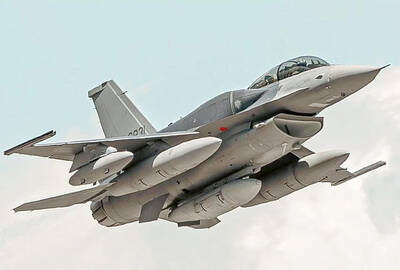
66 FIGHTER JETS: The aircraft is likely undergoing preparations for its transfer to Taiwan — a significant step forward in the nation’s modernization program, a lawmaker said The first of Taiwan’s order of F-16V Block 70 aircraft has been sighted in Texas ahead of delivery, Democratic Progressive Party (DPP) Legislator Wang Ting-yu (王定宇) said. Taiwan’s first F-16V Block 70 two-seat aircraft, tail number 6831, was seen flying from Lockheed Martin’s production facility in Greenville, South Carolina, to Naval Air Station Joint Reserve Base Fort Worth in Texas, Wang wrote on Facebook yesterday. The plane is likely undergoing preparations for its transfer to Taiwan, marking a significant step forward in the Republic of China Air Force’s modernization program, Wang said, citing military analysts. The F-16V Block 70 is a new-build version
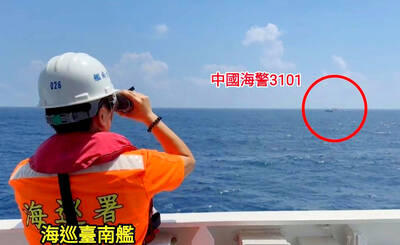
‘BRAZEN’: The holiday did not stop China from activities that infringe on Taiwan’s maritime jurisdiction, but the CGA is ready to defend the nation, Kuan Bi-ling said Beijing is intensifying maritime pressure on Taiwan, but the nation will never yield, Ocean Affairs Council Deputy Minister Sung Chen-en (宋承恩) said. The Coast Guard Administration (CGA) has adopted a “shadowing and monitoring” approach to avoid falling into a Chinese trap to escalate tensions and deepen the conflict, Sung said in an interview published yesterday in the Chinese-language Liberty Times (the Taipei Times’ sister newspaper). China Coast Guard formations patrolling waters east of Taiwan, as well as official Chinese vessels entering areas around Itu Aba Island (Taiping Island, 太平島) and Pratas Islands (Dongsha Islands, 東沙群島) show Beijing’s attempts to significantly step up
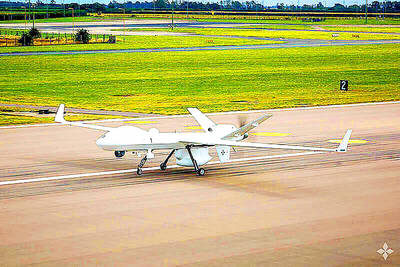
BOOST: By operating the same advanced systems as the US military, Taiwan would be better positioned to share and integrate intelligence with partners, an expert said The first batch of MQ-9B SkyGuardian drones has arrived in Taiwan, and is being assembled and tested by drone manufacturer General Atomics and the military ahead of flight trials as part of the air force’s acquisition to bolster its aerial surveillance capabilities, a source said yesterday. The air force allocated a budget of NT$21.7 billion (US$687 million) from 2022 to 2029 to procure four MQ-9B uncrewed aerial vehicles (UAVs) manufactured by General Atomics along with associated equipment such as ground control stations. The US has agreed to deliver the four MQ-9Bs to Taiwan in two batches this year and next


 RSS
RSS