


President Ma Ying-jeou (馬英九) yesterday gave the Ministry of the Interior and the National Police Agency (NPA) a month to present solid results on crime-fighting and police integrity.
Ma, speaking in his capacity as Chinese Nationalist Party (KMT) chairman, also ordered Premier Wu Den-yih (吳敦義) and local government heads to hold monthly meetings on public order.
“The ministry and the NPA must do a better job combating crime and improving police integrity. I need the two agencies to present solid results in a month and respond to public concerns,” Ma said at KMT headquarters.
His remarks came as concern grows about ties between police and organized crime, after the shooting of alleged gang leader Weng Chi-nan (翁奇楠) on May 28. Four Taichung police officers were at the scene but failed to intervene.
The scandal has undermined Taichung Mayor Jason Hu’s (胡志強) approval ratings and prompted him to fire Taichung police chief Hu Mu-yuan (胡木源).
Minister of the Interior Jiang Yi-huah (江宜樺) gave a briefing on the ministry’s efforts to solve the shooting and improve police integrity. He said the ministry was determined to improve integrity and said it would do its best to improve social order, including seizing illegal firearms and preventing violent crimes.
He confirmed reports that NPA Director-General Wang Cho-chiun (王卓鈞) twice offered to resign over a recent crime wave in Taichung and poor police integrity, but said he did not accept his resignation.
“The government needs Wang to help us combat crime and improve police integrity. For the moment, I will not consider his resignation,” Jiang said.
The NPA has dispatched a 41-member SWAT team to Taichung to help maintain public order.
Ma called on the ministry to draw up detailed regulations governing integrity — including providing a list of places police should not be allowed to visit.
“Attending birthday celebrations of a gang leader’s father, for example, is inappropriate. Police and civil servants should behave more cautiously,” Ma said.
He said the ministry should conduct regular polls to gain a better understanding of residents’ views on public order, as public sentiment on the overall environment should be more important than statistics on public order.
Meanwhile, the Democratic Progressive Party (DPP) said Jason Hu should take responsibility for the crime wave.
Jason Hu had managed to deflect criticism by using police as a scapegoat in covering up his own responsibility for the issue, DPP spokesperson Tsai Chi-chang (蔡其昌) said.
“Both Mayor Hu and the central government washed their hands of the incident in record time. But the fact is, it’s not just a police matter, it’s a political issue,” he said.
“Mayor Hu must take ultimate responsibility for Taichung’s public safety problems and for the breakdown in police discipline,” Tsai said. “He should apologize to Taichung residents immediately.”
However, he stopped short of calling for the mayor’s resignation, saying such a decision would have to be made by Taichung voters in the year-end elections.
The DPP’s candidate for Greater Taichung, former DPP secretary-general Su Jia-chyuan (蘇嘉全), said both the city government and the central government have sought to avoid taking responsibility over the affair.
“It’s definitely not beneficial to Taichung’s overall public safety,” Su said.
Meanwhile, a poll released yesterday by the Chinese-language Liberty Times (the Taipei Times’ sister newspaper), showed that the election battle in Greater Taichung was intensifying between Jason Hu and Su. The survey found public support for the mayor at 36 percent against 29 percent for Su, a sharp contrast with earlier polls giving the mayor a double-digit lead.
Also See: Tainan prison chief, Taichung officers transferred

MAKING WAVES: China’s maritime militia could become a nontraditional threat in war, clogging up shipping lanes to prevent US or Japanese intervention, a report said About 1,900 Chinese ships flying flags of convenience and fishing vessels that participated in China’s military exercises around Taiwan last month and in January last year have been listed for monitoring, Coast Guard Administration (CGA) Deputy Director-General Hsieh Ching-chin (謝慶欽) said yesterday. Following amendments to the Commercial Port Act (商港法) and the Law of Ships (船舶法) last month, the CGA can designate possible berthing areas or deny ports of call for vessels suspected of loitering around areas where undersea cables can be accessed, Oceans Affairs Council Minister Kuan Bi-ling (管碧玲) said. The list of suspected ships, originally 300, had risen to about
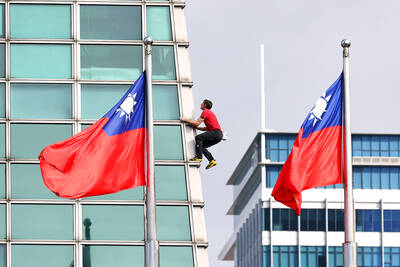
DAREDEVIL: Honnold said it had always been a dream of his to climb Taipei 101, while a Netflix producer said the skyscraper was ‘a real icon of this country’ US climber Alex Honnold yesterday took on Taiwan’s tallest building, becoming the first person to scale Taipei 101 without a rope, harness or safety net. Hundreds of spectators gathered at the base of the 101-story skyscraper to watch Honnold, 40, embark on his daredevil feat, which was also broadcast live on Netflix. Dressed in a red T-shirt and yellow custom-made climbing shoes, Honnold swiftly moved up the southeast face of the glass and steel building. At one point, he stepped onto a platform midway up to wave down at fans and onlookers who were taking photos. People watching from inside

Japan’s strategic alliance with the US would collapse if Tokyo were to turn away from a conflict in Taiwan, Japanese Prime Minister Sanae Takaichi said yesterday, but distanced herself from previous comments that suggested a possible military response in such an event. Takaichi expressed her latest views on a nationally broadcast TV program late on Monday, where an opposition party leader criticized her for igniting tensions with China with the earlier remarks. Ties between Japan and China have sunk to the worst level in years after Takaichi said in November that a hypothetical Chinese attack on Taiwan could bring about a Japanese
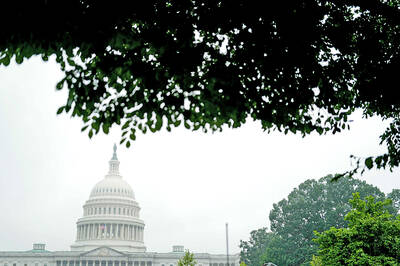
STREAMLINED: The dedicated funding would allow the US to transfer equipment to Taiwan when needed and order upgraded replacements for stockpiles, a source said The US House of Representatives on Thursday passed a defense appropriations bill totaling US$838.7 billion, of which US$1 billion is to be allocated to reinforcing security cooperation with Taiwan and US$150 million to replace defense articles provided to the nation. These are part of the Consolidated Appropriation Act, which the US House yesterday passed with 341 votes in favor and 88 against. The act must be passed by the US Senate before Friday next week to avoid another government shutdown. The US House Committee on Appropriations on Monday unveiled the act, saying that it allocates US$1 billion for the Taiwan Security Cooperation Initiative


 RSS
RSS