


South Korea accused North Korea yesterday of torpedoing a warship near their disputed border, sending regional tensions rising as the North responded with threats of war.
South Korean President Lee Myung-bak promised “resolute countermeasures” after a multinational investigation team said there was overwhelming evidence a North Korean submarine sank the ship on March 26 with the loss of 46 lives.
The US, Britain, Australia and Japan strongly condemned Pyongyang, but China, whose backing would be crucial in any attempt to penalize the North, appealed for restraint and did not criticize its ally.
Taiwan's Presidential Office yesterday did not follow Japan and the US in condemning North Korea, instead emphasizing that the national security unit would continue to monitor the development closely.
It said it would continue to stay alert and prepare a necessary response, but did not elaborate on what “necessary response” meant.
Pyongyang said the investigators' report was based on “sheer fabrication” and threatened “all-out war” in response to any attempt to punish it.
“The evidence points overwhelmingly to the conclusion that the torpedo was fired by a North Korean submarine,” the investigators said in a report. “There is no other plausible explanation.”
The White House called the attack “a challenge to international peace and security and a violation of the armistice agreement” which ended the 1950-1953 war.
British Foreign Secretary William Hague condemned a “callous act,” while Japan said the North's action was “unforgivable” and soured hopes of restarting six-party nuclear disarmament talks.
UN Secretary-General Ban Ki-moon described the facts in the report as deeply troubling.
The sinking caused outrage in South Korea, which declared five days of national mourning last month. Cross-border relations, which have been frosty for months, went into a deep chill.
However, Seoul has apparently ruled out a military counterstrike for fear of igniting all-out war and is instead likely to ask the UN Security Council to slap new sanctions on its neighbor.
This would need agreement from China, a veto-wielding member.
“All parties should stay calm and exercise restraint,” Chinese foreign ministry spokesman Ma Zhaoxu (馬朝旭) said in Beijing, adding that China would make its own assessment of the investigation results.
The investigators laid out apparently damning evidence against Pyongyang, which is thought by some analysts to have acted in revenge for a naval firefight in November in the area.
The 1,200-tonne corvette was split apart by a shockwave and bubble effect produced by a 250kg homing North Korean torpedo, the report said.
It said parts salvaged from the Yellow Sea “perfectly match” a type of torpedo that the North has offered for export.
A marking in Korea's hangeul script was found on one recovered section and matches markings on a stray North Korean torpedo recovered by the South seven years ago, investigators said.
Investigators displayed evidence at a nationally televised press conference, including rusty torpedo parts with two propellers.
They said the attack was likely carried out by a small submarine that infiltrated from international waters to avoid detection.
“We confirmed that a few small submarines and a mother ship supporting them left a North Korean naval base in the West [Yellow] Sea two to three days prior to the attack and returned to port two to three days after the attack,” the report said.
The North's top organ, the National Defense Commission, said it would send its own investigators to the South to check the purported evidence.
ADDITIONAL REPORTING BY KO SHU-LING
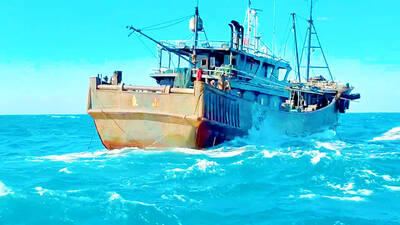
MAKING WAVES: China’s maritime militia could become a nontraditional threat in war, clogging up shipping lanes to prevent US or Japanese intervention, a report said About 1,900 Chinese ships flying flags of convenience and fishing vessels that participated in China’s military exercises around Taiwan last month and in January last year have been listed for monitoring, Coast Guard Administration (CGA) Deputy Director-General Hsieh Ching-chin (謝慶欽) said yesterday. Following amendments to the Commercial Port Act (商港法) and the Law of Ships (船舶法) last month, the CGA can designate possible berthing areas or deny ports of call for vessels suspected of loitering around areas where undersea cables can be accessed, Oceans Affairs Council Minister Kuan Bi-ling (管碧玲) said. The list of suspected ships, originally 300, had risen to about
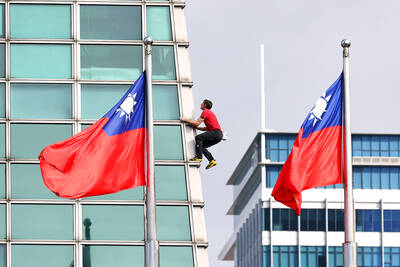
DAREDEVIL: Honnold said it had always been a dream of his to climb Taipei 101, while a Netflix producer said the skyscraper was ‘a real icon of this country’ US climber Alex Honnold yesterday took on Taiwan’s tallest building, becoming the first person to scale Taipei 101 without a rope, harness or safety net. Hundreds of spectators gathered at the base of the 101-story skyscraper to watch Honnold, 40, embark on his daredevil feat, which was also broadcast live on Netflix. Dressed in a red T-shirt and yellow custom-made climbing shoes, Honnold swiftly moved up the southeast face of the glass and steel building. At one point, he stepped onto a platform midway up to wave down at fans and onlookers who were taking photos. People watching from inside
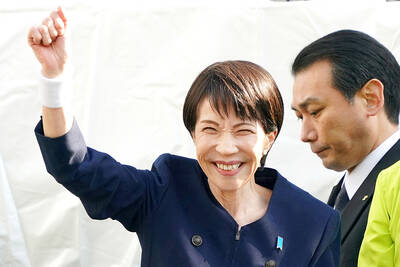
Japan’s strategic alliance with the US would collapse if Tokyo were to turn away from a conflict in Taiwan, Japanese Prime Minister Sanae Takaichi said yesterday, but distanced herself from previous comments that suggested a possible military response in such an event. Takaichi expressed her latest views on a nationally broadcast TV program late on Monday, where an opposition party leader criticized her for igniting tensions with China with the earlier remarks. Ties between Japan and China have sunk to the worst level in years after Takaichi said in November that a hypothetical Chinese attack on Taiwan could bring about a Japanese
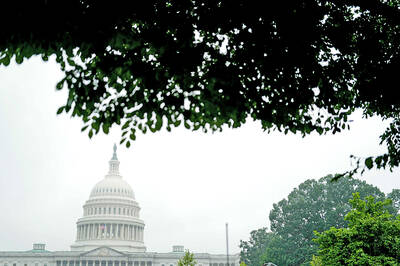
STREAMLINED: The dedicated funding would allow the US to transfer equipment to Taiwan when needed and order upgraded replacements for stockpiles, a source said The US House of Representatives on Thursday passed a defense appropriations bill totaling US$838.7 billion, of which US$1 billion is to be allocated to reinforcing security cooperation with Taiwan and US$150 million to replace defense articles provided to the nation. These are part of the Consolidated Appropriation Act, which the US House yesterday passed with 341 votes in favor and 88 against. The act must be passed by the US Senate before Friday next week to avoid another government shutdown. The US House Committee on Appropriations on Monday unveiled the act, saying that it allocates US$1 billion for the Taiwan Security Cooperation Initiative


 RSS
RSS