


Thai security forces fired into a crowd of anti-government protesters during a clash just outside Bangkok yesterday as they tried to keep the Red Shirts from expanding their demonstrations from a base in the capital. One soldier was killed and at least 18 protesters were hurt.
The troops appeared to be shooting live ammunition as well as rubber bullets in the confrontation along a major road connecting Bangkok with its northern suburbs that security forces had blocked with razor wire.
The Red Shirts, whose protests have paralyzed parts of the capital for weeks in their campaign to bring down a government they view as illegitimate, had announced that they were widening their demonstrations and dared the military to stop them as hundreds headed on motorbikes and pickup trucks to a planned rally in a suburb.
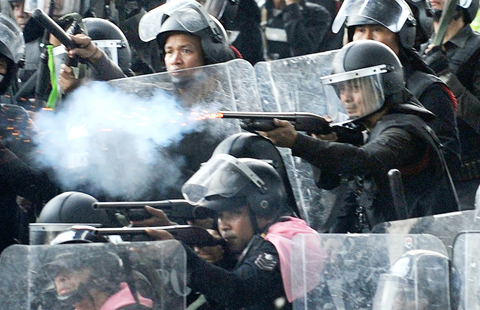
PHOTO: AFP
Along Vibhavadi-Rangsit road, riot squads fired into the air to push back protesters, but several tried to remove the razor wire, prompting troops to level their rifles and shoot directly at protesters who fled into oncoming traffic. Police huddled behind riot shields, while soldiers wielding rifles took up positions behind concrete pylons.
The confrontation was chaotic and at one point security forces fired on a group of troops riding toward them on motorbikes in what appeared to be an accident, although some members of the security forces have been accused of siding with the protesters. At least four motorbikes crashed and one soldier was carried away on a stretcher, bleeding profusely from the head. Several others from the group threw their hands in the air.
The government’s Erawan emergency center said a soldier was killed and 18 people wounded during the clash.
The confrontation ended yesterday evening and the protesters headed back to their enclave.
The shooting, however, raised concerns that more violence was to come after government warnings that patience was running out in the seven-week standoff.
Am army spokesman, Sansern Kaewkamnerd, said troops were told to use rubber bullets, but they also had authority to use live ammunition for self-defense.
“We brought force out to stop them. At this point, society finds it unacceptable to have protesters traveling in a motorcade like this,” Sansern said. “We try our best to prevent losses.”
The demonstration appeared intended to provoke the government, which has repeatedly said it would not tolerate protests beyond the Red Shirts’ enclave in the city.
At least 26 people have been killed and nearly 1,000 wounded since protesters began occupying parts of Bangkok last month, barricading major roads with tires and bamboo sticks and forcing the closure of some of the city’s ritziest malls and hotels.
The Red Shirts said they were sending a team of activists to drum up support at an outdoor market north of the capital.
Meanwhile, the Constitutional Court agreed yesterday to consider a recommendation by the Election Commission to dissolve the ruling Democrat party for alleged misuse of government money, a court official said.
The official said declined to give a timeframe for the case but said the Democrats would be asked to provide a written defence.
The case centers on allegations of misuse of a grant from the commission.

SILENCING CRITICS: In addition to blocking Taiwan, China aimed to prevent rights activists from speaking out against authoritarian states, a Cabinet department said The Ministry of Foreign Affairs (MOFA) yesterday condemned transnational repression by Beijing after RightsCon, a major digital human rights conference scheduled to be held in Zambia this week, was abruptly canceled due to Chinese pressure over Taiwanese participation. This year’s RightsCon, the world’s largest conference discussing issues “at the intersection of human rights and technology,” was scheduled to take place from tomorrow to Friday in Lusaka, and expected to draw 2,600 in-person attendees from 150 countries, along with 1,100 online participants. However, organizers were forced to cancel the event due to behind-the-scenes pressure from China, the ministry said, expressing its “strongest condemnation”
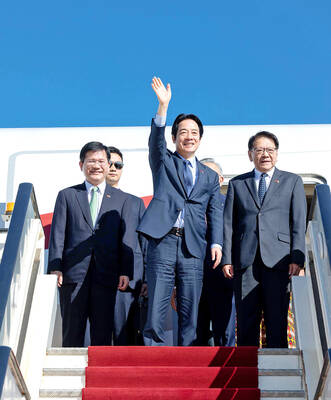
DELAYED BUT DETERMINED: The president’s visit highlights Taiwan’s right to international engagement amid regional pressure from China President Willaim Lai (賴清德) yesterday arrived in Eswatini, more than a week after his planned visit to Taiwan’s sole African ally was suspended because of revoked overflight permits. “The visit, originally scheduled for April 22, was postponed due to unforeseen external factors,” Lai wrote on social media. “After several days of careful arrangements by our diplomatic and national security teams, we successfully arrived today.” Lai said he looked forward to further deepening Taiwan-Eswatini relations through closer cooperation in the economy, agriculture, culture and education, as well as advancing the nation’s international partnerships. The president was initially scheduled to arrive in time to celebrate
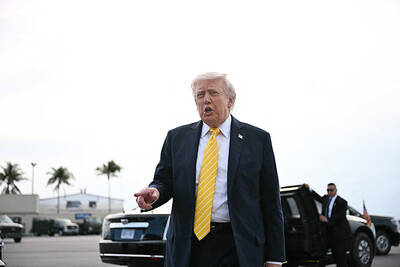
Iran’s Islamic Revolutionary Guard Corp (IRGC) yesterday said the US faced a choice between an “impossible” military operation or a “bad deal” with Tehran, after US President Donald Trump disparaged Iran’s latest peace proposal. Negotiations between the two countries have been deadlocked since a ceasefire came into effect on April 8, with only one round of direct peace talks held so far. Iran’s Tasnim and Fars news agencies reported that Tehran had submitted a 14-point proposal to mediator Pakistan, but Trump was quick to cast doubt on it. “I will soon be reviewing the plan that Iran has just sent to us, but

A group affiliated with indicted Chinese immigrant Xu Chunying (徐春鶯) is to be dissolved for monitoring Chinese immigrants in Taiwan, a source said yesterday. Xu, the secretary-general of the Cross-Strait Marriage and Family Service Alliance, was indicted on March 24 on charges of violating the Anti-Infiltration Act (反滲透法). The alliance “illegally monitored" Chinese immigrants living in Taiwan on behalf of the Chinese Communist Party (CCP) and the Ministry of the Interior is expected to dissolve the organization in the coming days under provisions of the Civil Associations Act (人民團體法), the source said. Xu, who married a Taiwanese in 1993 and became a Republic


 RSS
RSS