


Minister of Justice Wang Ching-feng (王清峰) said yesterday she would rather step down than execute any of the 44 individuals on death row.
“I will not execute any of the people on death row during my term. I would rather go to hell,” Wang, a devout Buddhist, told reporters after publishing a statement titled “Reason and Forgiveness — Suspension of Practicing the Death Penalty” on Tuesday, in which she expressed her opposition to capital punishment.
Wang’s comments came after Vice Minister of Justice Huang Shih-ming (黃世銘), President Ma Ying-jeou’s (馬英九) choice for state public prosecutor-general, told a legislative hearing reviewing his nomination on Monday that while the 44 convicts on death row should be executed, he would support an amendment abolishing the death penalty.
Huang told legislators that those already on death row should not have their sentences delayed indefinitely.
No executions have been carried out in four years since former minister of justice Morley Shih (施茂林) and then Wang adopted a policy that maintains capital punishment, but has stayed executions.
The death penalty is the most dangerous penalty, Wang said in her statement, because judges are “people,” not “God.”
The “Hsichih Trio” case was a good example, Wang said, as different judges reached very different verdicts — a death sentence versus not guilty — with almost the same evidence.
“Those who kill will not be able to make amends with their lives. Executing them would only break more families,” Wang said, adding that she understood the great pain of victims’ families and that the ministry would do its best to compensate and take care of them.
Responding to criticism that a stay of execution was unconstitutional, Wang said the Constitution protects human life, and human life cannot be taken away under the Constitution.
Chinese Nationalist Party (KMT) Legislator Wu Yu-sheng (吳育昇) said later that Wang should step down for failing to uphold the law.
“If Wang does not offer to resign, I will submit a malpractice complaint to the Control Yuan,” he said.
“I think that Minister Wang should resign immediately to campaign for the abolition of the death penalty,” Wu told a meeting of the Internal Administration Committee, where National Police Agency Director-General Wang Cho-chiun (王卓鈞) was being questioned over the matter.
“Since the death penalty is still part of our legal system, Wang Ching-feng’s stay of executions is in violation of the law and the Constitution,” Wu said.
Wang Cho-chiun said that as long as the death penalty is written in law, “the 44 people on death row should be executed.”
However, Hsieh Kuo-liang (謝國樑), another KMT legislator, said abolishing the death penalty was a growing trend globally and that no matter who served as the next minister of justice, he or she should not sign any execution orders.
“Asking Wang Ching-feng to step down would be a waste of a good justice minister,” Hsieh said.
Taiwan Alliance to End the Death Penalty executive director Lin Hsin-yi (林欣怡) said: “The law gives the justice minister the power to decide whether to sign an execution order and does not place a limit on when it should be signed.”
“Wang Ching-feng was not acting against the law or the Constitution,” Lin said.
The minister’s decision was a responsible decision made in accordance with international human rights standards, Lin said.
Meanwhile, Control Yuan member Chao Chang-ping (趙昌平) said he would look into the appropriateness of the freeze on executions to determine if that was against the principles of fairness and rule of law.
Chao said the ministry must carry out sentences already handed down, lest its actions constitute negligence.
ADDITIONAL REPORTING BY SHIH HSIU-CHUAN
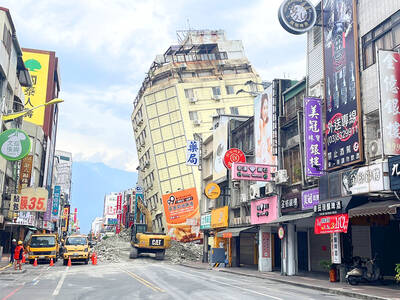
LANDSLIDES POSSIBLE: The agency advised the public to avoid visiting mountainous regions due to more expected aftershocks and rainfall from a series of weather fronts A series of earthquakes over the past few days were likely aftershocks of the April 3 earthquake in Hualien County, with further aftershocks to be expected for up to a year, the Central Weather Administration (CWA) said yesterday. Based on the nation’s experience after the quake on Sept. 21, 1999, more aftershocks are possible over the next six months to a year, the agency said. A total of 103 earthquakes of magnitude 4 on the local magnitude scale or higher hit Hualien County from 5:08pm on Monday to 10:27am yesterday, with 27 of them exceeding magnitude 5. They included two, of magnitude

A total of 41 US military personnel were stationed in Taiwan as of December last year, a US congressional report said on Friday last week ahead of Tuesday’s passage of an aid package that included US$8 billion for Taiwan. The Congressional Research Service in a report titled Taiwan Defense Issues for Congress said that according to the US Department of Defense’s Defense Manpower Data Center, 41 US military personnel were assigned for duty in Taiwan. Although the normalization of relations with the People’s Republic of China (PRC) in 1979 included a vow to withdraw a military presence from Taiwan, “observers have indicated
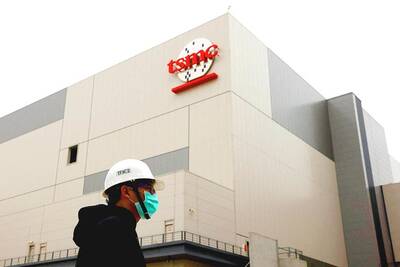
Taiwan Semiconductor Manufacturing Co (TSMC, 台積電) on Wednesday said that a new chip manufacturing technology called “A16” is to enter production in the second half of 2026, setting up a showdown with longtime rival Intel over who can make the fastest chips. TSMC, the world’s biggest contract manufacturer of advanced computing chips and a key supplier to Nvidia and Apple, announced the news at a conference in Santa Clara, California, where TSMC executives said that makers of artificial intelligence (AI) chips will likely be the first adopters of the technology rather than a smartphone maker. Analysts said that the technologies announced on
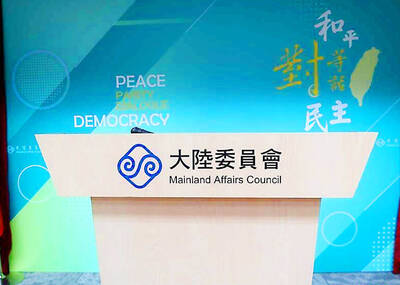
NO RECIPROCITY: Taipei has called for cross-strait group travel to resume fully, but Beijing is only allowing people from its Fujian Province to travel to Matsu, the MAC said The Mainland Affairs Council (MAC) yesterday criticized an announcement by the Chinese Ministry of Culture and Tourism that it would lift a travel ban to Taiwan only for residents of China’s Fujian Province, saying that the policy does not meet the principles of reciprocity and openness. Chinese Deputy Minister of Culture and Tourism Rao Quan (饒權) yesterday morning told a delegation of Chinese Nationalist Party (KMT) lawmakers in a meeting in Beijing that the ministry would first allow Fujian residents to visit Lienchiang County (Matsu), adding that they would be able to travel to Taiwan proper directly once express ferry


 RSS
RSS