


Police have finally presented a case against prominent dissident Liu Xiaobo (劉曉波), who has been jailed for a year without charge after helping produce a high-profile manifesto calling for sweeping democratic reforms in China, a lawyer said yesterday.
The development moves Liu one step closer to standing trial and ends months of anxious uncertainty for his family and supporters.
Police extended their investigation of Liu three times over the past year — China's legal limit.
Lawyer Shang Baojun (尚寶軍) said the report presented by investigators alleges Liu incited to subvert state power with several essays he posted online and by helping produce Charter 08, an appeal for more civil rights in China and an end to the Chinese Communist Party's political dominance.
“This marks the end of the investigation phase and the beginning of the prosecution phase,” Shang said.
Prosecutors have about a month to examine the report and accompanying evidence and decide whether it is sufficient for a trial.
There have been numerous international appeals for Liu's release, including one last December signed by famous writers Wole Soyinka, Nadine Gordimer and Umberto Eco. The latest development is likely to trigger a new round of lobbying on his behalf.
The investigator's report was handed over to prosecutors on Dec. 1, Shang said, but he was not given a copy until yesterday morning.
Beijing routinely uses the charge of subversion to imprison dissidents. Shang said Liu could face up to 15 years in jail.
Liu, a former university professor who spent 20 months in jail after joining pro-democracy protests in 1989, was taken away by police on Dec. 8 last year, a day before the charter was made public, and held at a secret location for six months.
He was formally arrested in June.
In other news, China said yesterday police had detained 94 people who fled the western region of Xinjiang after deadly rioting there in July — the country's worst communal violence in decades.
China continues to pursue and punish people involved in the violence, which it says left more than 200 dead, most of them from the majority Han ethnic group.
As of Friday, China has handed down 17 death sentences over the rioting.
A month-long “strike hard” campaign last month caught the latest 94 people, police in Xinjiang said.
A woman who answered the phone in Xinjiang's police office said no further details were available, including how many of the 94 were Muslim Uighurs and how many were Han. The woman gave her surname as Li.
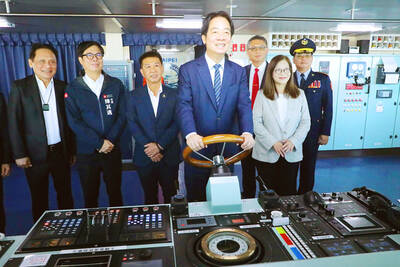
CALL FOR SUPPORT: President William Lai called on lawmakers across party lines to ensure the livelihood of Taiwanese and that national security is protected President William Lai (賴清德) yesterday called for bipartisan support for Taiwan’s investment in self-defense capabilities at the christening and launch of two coast guard vessels at CSBC Corp, Taiwan’s (台灣國際造船) shipyard in Kaohsiung. The Taipei (台北) is the fourth and final ship of the Chiayi-class offshore patrol vessels, and the Siraya (西拉雅) is the Coast Guard Administration’s (CGA) first-ever ocean patrol vessel, the government said. The Taipei is the fourth and final ship of the Chiayi-class offshore patrol vessels with a displacement of about 4,000 tonnes, Lai said. This ship class was ordered as a result of former president Tsai Ing-wen’s (蔡英文) 2018
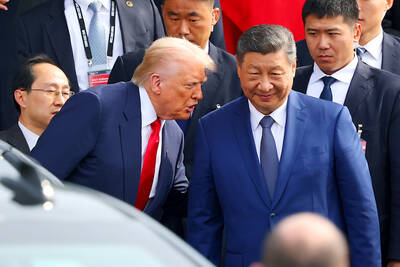
UKRAINE, NVIDIA: The US leader said the subject of Russia’s war had come up ‘very strongly,’ while Jenson Huang was hoping that the conversation was good Chinese President Xi Jinping (習近平) and US President Donald Trump had differing takes following their meeting in Busan, South Korea, yesterday. Xi said that the two sides should complete follow-up work as soon as possible to deliver tangible results that would provide “peace of mind” to China, the US and the rest of the world, while Trump hailed the “great success” of the talks. The two discussed trade, including a deal to reduce tariffs slapped on China for its role in the fentanyl trade, as well as cooperation in ending the war in Ukraine, among other issues, but they did not mention
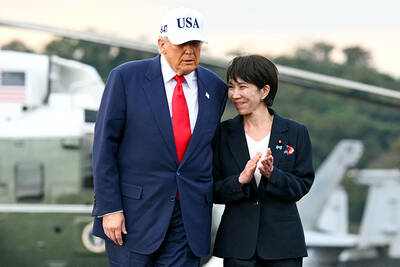
Japanese Prime Minister Sanae Takaichi yesterday lavished US President Donald Trump with praise and vows of a “golden age” of ties on his visit to Tokyo, before inking a deal with Washington aimed at securing critical minerals. Takaichi — Japan’s first female prime minister — pulled out all the stops for Trump in her opening test on the international stage and even announced that she would nominate him for a Nobel Peace Prize, the White House said. Trump has become increasingly focused on the Nobel since his return to power in January and claims to have ended several conflicts around the world,
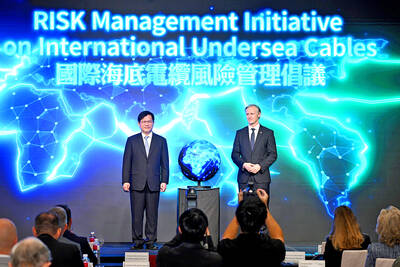
GLOBAL PROJECT: Underseas cables ‘are the nervous system of democratic connectivity,’ which is under stress, Member of the European Parliament Rihards Kols said The government yesterday launched an initiative to promote global cooperation on improved security of undersea cables, following reported disruptions of such cables near Taiwan and around the world. The Management Initiative on International Undersea Cables aims to “bring together stakeholders, align standards, promote best practices and turn shared concerns into beneficial cooperation,” Minister of Foreign Affairs Lin Chia-lung (林佳龍) said at a seminar in Taipei. The project would be known as “RISK,” an acronym for risk mitigation, information sharing, systemic reform and knowledge building, he said at the seminar, titled “Taiwan-Europe Subsea Cable Security Cooperation Forum.” Taiwan sits at a vital junction on


 RSS
RSS