


Lawmakers across party lines yesterday urged the Ministry of Foreign Affairs to lodge a protest against China over reports that a Taiwanese student in South Korea was harassed by a group of Chinese students for displaying a Republic of China (ROC) flag.
Local media reported yesterday that the Taiwanese student, surnamed Lin (林), at South Korea’s Silla University in Busan, received first prize in a Korean-language speech contest. However, after the contest, Lin was chased and besieged by a group of Chinese contestants who were angry over Lin showing an ROC flag during the speech, they said.
Chinese Nationalist Party (KMT) Legislator Justin Chou (周守訓) said Taipei should complain to the host and the Beijing government, and investigate whether officials at the Taiwanese representative office in South Korea were guilty of dereliction of duty in handling the matter.
“It was regretful that this happened ahead of the upcoming cross-strait talks. The government should lodge a protest [with Chinese authorities] during the cross-strait talks,” Chou said.
Describing the incident as “outrageous,” KMT Legislator Shyu Jong-shyoung demanded the administration condemn the Beijing government and its people for their unfriendly behavior.
The government also has to voice its protest with the Seoul government if it failed to protect the Taiwanese student, Shyu said.
“There was nothing wrong with displaying our national flag or whatever the Taiwanese student said in her speech. Freedom of expression is a right that we enjoy. The Chinese might not like it, but they can’t stop us from upholding this value,” Shyu said.
KMT Legislator Yang Chiung-ying (楊瓊瓔) said Beijing should apologize although she believed that it was an isolated incident.
“Displaying the national flag was normal behavior as it represents the country. Any normal person would do the same thing,” Yang said.
Ministry Spokesman Henry Chen (陳銘政) said the Busan representative office would look into the matter, adding that the organizers had said there was no report of violence and that the media might have exaggerated it.
The ministry is in contact with Lin to clarify what happened, Chen said.
“We will do what needs to be done,” Chen said. “However, we must have a clear picture of the incident before taking any action such as lodging a protest.”
Meanwhile, Democratic Progressive Party (DPP) lawmakers blamed the incident on President Ma Ying-jeou’s (馬英九) “diplomatic truce,” which they said was a form of self-denigration and humiliation designed to please Beijing.
DPP Legislator Tsai Huang-liang (蔡煌瑯) said what happened in Busan was a “typical example” of the failure of Ma’s diplomatic policy.
“If our own government doesn’t even care about safeguarding the nation’s sovereignty, why should the citizens of any other country respect Taiwan? What the Chinese students did was indirectly permitted by Ma,” he said.
DPP Legislator Chen Ting-fei (陳亭妃) said despite the so-called truce, tensions between people on both sides of the Taiwan Strait were worse than ever “because Chinese hostility toward Taiwan has spread from the government down to the individual level.”
“Ma’s weak stand when confronted with China has made Chinese students overseas feel it’s perfectly fine to oppress Taiwanese students in non-political venues,” she said.
“Ma kept saying the cross-strait détente will help bridge understanding between the two sides, but the reality is, it has only made the Chinese think we are easy pickings,” she said.
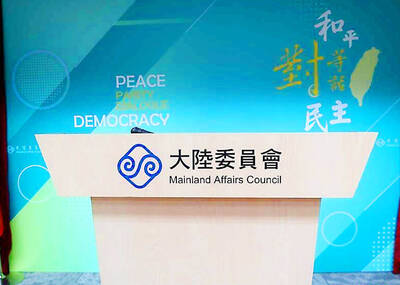
NO RECIPROCITY: Taipei has called for cross-strait group travel to resume fully, but Beijing is only allowing people from its Fujian Province to travel to Matsu, the MAC said The Mainland Affairs Council (MAC) yesterday criticized an announcement by the Chinese Ministry of Culture and Tourism that it would lift a travel ban to Taiwan only for residents of China’s Fujian Province, saying that the policy does not meet the principles of reciprocity and openness. Chinese Deputy Minister of Culture and Tourism Rao Quan (饒權) yesterday morning told a delegation of Chinese Nationalist Party (KMT) lawmakers in a meeting in Beijing that the ministry would first allow Fujian residents to visit Lienchiang County (Matsu), adding that they would be able to travel to Taiwan proper directly once express ferry

STUMPED: KMT and TPP lawmakers approved a resolution to suspend the rate hike, which the government said was unavoidable in view of rising global energy costs The Ministry of Economic Affairs yesterday said it has a mandate to raise electricity prices as planned after the legislature passed a non-binding resolution along partisan lines to freeze rates. Chinese Nationalist Party (KMT) lawmakers proposed the resolution to suspend the price hike, which passed by a 59-50 vote. The Taiwan People’s Party (TPP) voted with the KMT. Legislative Speaker Han Kuo-yu (韓國瑜) of the KMT said the resolution is a mandate for the “immediate suspension of electricity price hikes” and for the Executive Yuan to review its energy policy and propose supplementary measures. A government-organized electricity price evaluation board in March

FAST RELEASE: The council lauded the developer for completing model testing in only four days and releasing a commercial version for use by academia and industry The National Science and Technology Council (NSTC) yesterday released the latest artificial intelligence (AI) language model in traditional Chinese embedded with Taiwanese cultural values. The council launched the Trustworthy AI Dialogue Engine (TAIDE) program in April last year to develop and train traditional Chinese-language models based on LLaMA, the open-source AI language model released by Meta. The program aims to tackle the information bias that is often present in international large-scale language models and take Taiwanese culture and values into consideration, it said. Llama 3-TAIDE-LX-8B-Chat-Alpha1, released yesterday, is the latest large language model in traditional Chinese. It was trained based on Meta’s Llama-3-8B

NOVEL METHODS: The PLA has adopted new approaches and recently conducted three combat readiness drills at night which included aircraft and ships, an official said Taiwan is monitoring China’s People’s Liberation Army (PLA) exercises for changes in their size or pattern as the nation prepares for president-elect William Lai’s (賴清德) inauguration on May 20, National Security Bureau (NSB) Director-General Tsai Ming-yen (蔡明彥) said yesterday. Tsai made the comment at a meeting of the Legislative Yuan’s Foreign Affairs and National Defense Committee, in response to Democratic Progressive Party (DPP) Legislator Wang Ting-yu’s (王定宇) questions. China continues to employ a carrot-and-stick approach, in which it applies pressure with “gray zone” tactics, while attempting to entice Taiwanese with perks, Tsai said. These actions aim to help Beijing look like it has


 RSS
RSS