


British Prime Minister Gordon Brown was to embrace the central thrust of General Stanley McChrystal’s report into the future of Afghanistan when he spoke yesterday of the need to develop a military and political “push.”
Days before US President Barack Obama spells out US strategy in Afghanistan, Brown was to outline what is being dubbed in London a “McChrystalesque” approach.
In his landmark report, McChrystal, commander of US and NATO forces, recommended a surge of up to 40,000 US troops and a more sophisticated counter-insurgency strategy designed to reassure the Afghan people that NATO troops do not see themselves as occupying forces and that their primary task is to protect local people. Obama will respond to the report on Tuesday.
TRINIDAD
Speaking before the biennial Commonwealth heads of government meeting, which opened yesterday in Trinidad and Tobago, Brown was to talk of “the need to complement our military strategy with our political strategy ... and the need therefore for a comprehensive approach to both Afghanistan and Pakistan as we move forward with a strategy to deal with the risk of al-Qaeda and also to deal with the threat of the Taliban returning to power in Afghanistan.”
Brown said on Wednesday he had received assurances from NATO countries outside the US that they were prepared to commit an extra 5,000 troops.
The UK does not expect Obama to sign up to every aspect of the McChrystal report and the president may decide on different troop levels, possibly about 30,000.
The White House has made clear that the next stage of its strategy is designed to lead to an eventual withdrawal.
The opening Commonwealth session yesterday was dominated by climate change.
Authorities have detained three former Taiwan Semiconductor Manufacturing Co (TMSC, 台積電) employees on suspicion of compromising classified technology used in making 2-nanometer chips, the Taiwan High Prosecutors’ Office said yesterday. Prosecutors are holding a former TSMC engineer surnamed Chen (陳) and two recently sacked TSMC engineers, including one person surnamed Wu (吳) in detention with restricted communication, following an investigation launched on July 25, a statement said. The announcement came a day after Nikkei Asia reported on the technology theft in an exclusive story, saying TSMC had fired two workers for contravening data rules on advanced chipmaking technology. Two-nanometer wafers are the most
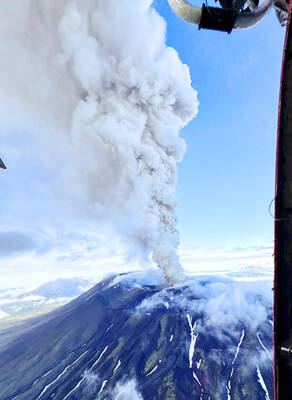
Tsunami waves were possible in three areas of Kamchatka in Russia’s Far East, the Russian Ministry for Emergency Services said yesterday after a magnitude 7.0 earthquake hit the nearby Kuril Islands. “The expected wave heights are low, but you must still move away from the shore,” the ministry said on the Telegram messaging app, after the latest seismic activity in the area. However, the Pacific Tsunami Warning System in Hawaii said there was no tsunami warning after the quake. The Russian tsunami alert was later canceled. Overnight, the Krasheninnikov volcano in Kamchatka erupted for the first time in 600 years, Russia’s RIA
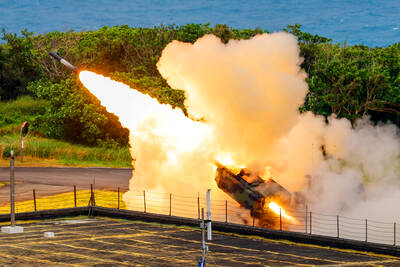
DEFENSE: The first set of three NASAMS that were previously purchased is expected to be delivered by the end of this year and deployed near the capital, sources said Taiwan plans to procure 28 more sets of M-142 High Mobility Artillery Rocket Systems (HIMARS), as well as nine additional sets of National Advanced Surface-to-Air Missile Systems (NASAMS), military sources said yesterday. Taiwan had previously purchased 29 HIMARS launchers from the US and received the first 11 last year. Once the planned purchases are completed and delivered, Taiwan would have 57 sets of HIMARS. The army has also increased the number of MGM-140 Army Tactical Missile Systems (ATACMS) purchased from 64 to 84, the sources added. Each HIMARS launch pod can carry six Guided Multiple Launch Rocket Systems, capable of
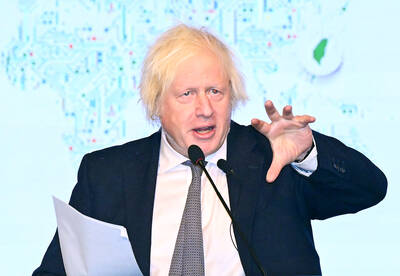
CHINA’s BULLYING: The former British prime minister said that he believes ‘Taiwan can and will’ protect its freedom and democracy, as its people are lovers of liberty Former British prime minister Boris Johnson yesterday said Western nations should have the courage to stand with and deepen their economic partnerships with Taiwan in the face of China’s intensified pressure. He made the remarks at the ninth Ketagalan Forum: 2025 Indo-Pacific Security Dialogue hosted by the Ministry of Foreign Affairs and the Prospect Foundation in Taipei. Johnson, who is visiting Taiwan for the first time, said he had seen Taiwan’s coastline on a screen on his indoor bicycle, but wanted to learn more about the nation, including its artificial intelligence (AI) development, the key technology of the 21st century. Calling himself an


 RSS
RSS