


China should see the Dalai Lama as “part of the solution” on Tibet instead of trying to isolate him, US President Barack Obama’s top Asia adviser said on Friday.
Jeff Bader, senior director for Asia on the White House’s National Security Council, told the Committee of 100, a Chinese-American group, that it should use its influence in Beijing to encourage a different view of the Dalai Lama.
“I hope that you will use that credibility and those relationships to help persuade Chinese officials that the Dalai Lama is not part of their problem but rather part of the solution to the situation in Tibet,” Bader said.
Beijing brands the Dalai Lama a separatist and has stepped up pressure on world leaders, including Obama, not to meet with him. The Nobel Peace laureate is currently touring the US, but he does not plan to visit Washington.
Bader acknowledged that human rights have become an irritant in US-China relations — “unsurprisingly, because China’s human rights record, as we know, is poor.”
The Dalai Lama, 73, has frequently said he wants to retire but has kept a frenetic travel schedule. His current visit to the US has included serving food to the homeless in San Francisco and opening an ethics center named after him at the prestigious Massachusetts Institute of Technology.
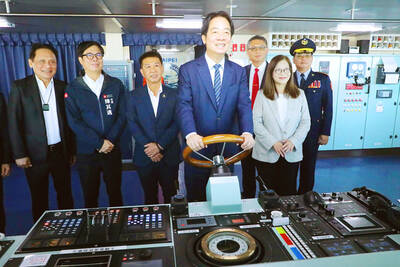
CALL FOR SUPPORT: President William Lai called on lawmakers across party lines to ensure the livelihood of Taiwanese and that national security is protected President William Lai (賴清德) yesterday called for bipartisan support for Taiwan’s investment in self-defense capabilities at the christening and launch of two coast guard vessels at CSBC Corp, Taiwan’s (台灣國際造船) shipyard in Kaohsiung. The Taipei (台北) is the fourth and final ship of the Chiayi-class offshore patrol vessels, and the Siraya (西拉雅) is the Coast Guard Administration’s (CGA) first-ever ocean patrol vessel, the government said. The Taipei is the fourth and final ship of the Chiayi-class offshore patrol vessels with a displacement of about 4,000 tonnes, Lai said. This ship class was ordered as a result of former president Tsai Ing-wen’s (蔡英文) 2018
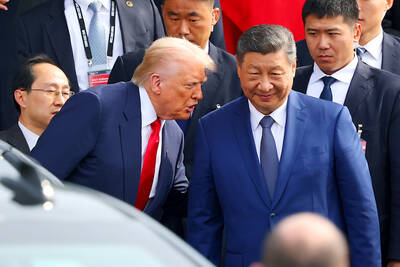
UKRAINE, NVIDIA: The US leader said the subject of Russia’s war had come up ‘very strongly,’ while Jenson Huang was hoping that the conversation was good Chinese President Xi Jinping (習近平) and US President Donald Trump had differing takes following their meeting in Busan, South Korea, yesterday. Xi said that the two sides should complete follow-up work as soon as possible to deliver tangible results that would provide “peace of mind” to China, the US and the rest of the world, while Trump hailed the “great success” of the talks. The two discussed trade, including a deal to reduce tariffs slapped on China for its role in the fentanyl trade, as well as cooperation in ending the war in Ukraine, among other issues, but they did not mention
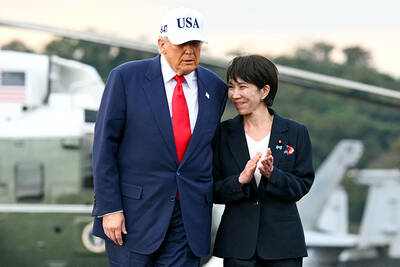
Japanese Prime Minister Sanae Takaichi yesterday lavished US President Donald Trump with praise and vows of a “golden age” of ties on his visit to Tokyo, before inking a deal with Washington aimed at securing critical minerals. Takaichi — Japan’s first female prime minister — pulled out all the stops for Trump in her opening test on the international stage and even announced that she would nominate him for a Nobel Peace Prize, the White House said. Trump has become increasingly focused on the Nobel since his return to power in January and claims to have ended several conflicts around the world,
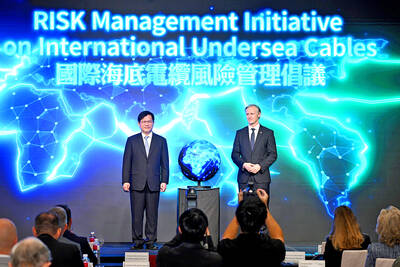
GLOBAL PROJECT: Underseas cables ‘are the nervous system of democratic connectivity,’ which is under stress, Member of the European Parliament Rihards Kols said The government yesterday launched an initiative to promote global cooperation on improved security of undersea cables, following reported disruptions of such cables near Taiwan and around the world. The Management Initiative on International Undersea Cables aims to “bring together stakeholders, align standards, promote best practices and turn shared concerns into beneficial cooperation,” Minister of Foreign Affairs Lin Chia-lung (林佳龍) said at a seminar in Taipei. The project would be known as “RISK,” an acronym for risk mitigation, information sharing, systemic reform and knowledge building, he said at the seminar, titled “Taiwan-Europe Subsea Cable Security Cooperation Forum.” Taiwan sits at a vital junction on


 RSS
RSS