


China declared an end yesterday to the crisis over a brimming lake formed by a massive earthquake that had threatened to flood downstream communities.
Sichuan Province's top official, Liu Qibao (劉奇葆), claimed a “decisive victory” after water flowed from Tangjiashan lake and its level dropped rapidly, Xinhua news agency said.
Liu is Chinese Communist Party chief of the southwestern province that was hardest-hit by the May 12 quake that has killed almost 70,000 people.
Towns downstream had been placed on alert for possible flooding in case of an uncontrolled breaching of the lakes unstable banks.
However, Xinhua said more than half of the 250 million cubic meters of water in the lake had been drained off by 5pm, establishing a balance between inflow and outflow and easing pressure on the dam.
State broadcaster CCTV showed water flowing quickly out of Tangjiashan lake, flooding low-lying areas of the devastated town of Beichuan just downstream. Residents in the area were previously evacuated and others along the river were preparing to leave if waters rose too high, CCTV said.
Flood waters seeped into riverside houses in the largely evacuated town of Qinglian, a resident said.
“Everybody feels lucky that it didn’t submerge the streets and the neighborhood,” Wu Zhenxing said.
In the city of Mianyang, where residents had been practicing evacuation drills, the Fujiang river flowed high and swifly under a key railway bridge, but stayed within its course.
For days, troops have been using dynamite and anti-tank weapons to blast boulders and other obstacles in a man-made diversion canal, trying to speed the flow of water and relieve pressure on the lake’s unstable mud and rock banks.
More than 250,000 people downstream had already moved to high ground over concerns that the barrier holding back the lake could break apart. A total of about 1.3 million people live in the downstream area.
Xinhua said trees, barrels, TV sets, refrigerators “and the occasional dead bodies of quake victims” were seen in waters pouring out of the mountains.
Also yesterday, state media said searchers have discovered the wreckage of an air force helicopter that crashed in deep mountains in the southwest while ferrying people injured in last month’s quake.
The remains of the five-person crew and 14 quake victims were found at the crash site near the town of Yingxiu, Xinhua said. It said the wreckage was spread over a wide area of deep vegetation.
The Russian-designed Mi-171 crashed on May 31 near the epicenter of the quake in Wenchuan, after flying into fog and turbulence.
Meanwhile, staff at Wolong, the world’s most famous panda reserve, buried a nine-year-old female panda that was killed in a landslide triggered by the quake.
Another Wolong panda, Xiao Xiao, has been missing since the quake. Forty-seven other pandas still live at Wolong, while others have been moved to Chengdu and Beijing.
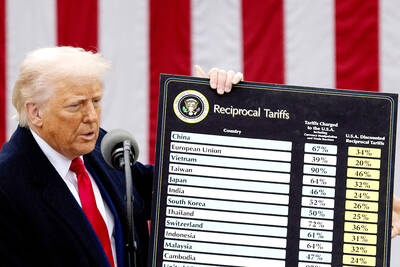
WAITING GAME: The US has so far only offered a ‘best rate tariff,’ which officials assume is about 15 percent, the same as Japan, a person familiar with the matter said Taiwan and the US have completed “technical consultations” regarding tariffs and a finalized rate is expected to be released soon, Executive Yuan spokeswoman Michelle Lee (李慧芝) told a news conference yesterday, as a 90-day pause on US President Donald Trump’s “reciprocal” tariffs is set to expire today. The two countries have reached a “certain degree of consensus” on issues such as tariffs, nontariff trade barriers, trade facilitation, supply chain resilience and economic security, Lee said. They also discussed opportunities for cooperation, investment and procurement, she said. A joint statement is still being negotiated and would be released once the US government has made

Authorities have detained three former Taiwan Semiconductor Manufacturing Co (TMSC, 台積電) employees on suspicion of compromising classified technology used in making 2-nanometer chips, the Taiwan High Prosecutors’ Office said yesterday. Prosecutors are holding a former TSMC engineer surnamed Chen (陳) and two recently sacked TSMC engineers, including one person surnamed Wu (吳) in detention with restricted communication, following an investigation launched on July 25, a statement said. The announcement came a day after Nikkei Asia reported on the technology theft in an exclusive story, saying TSMC had fired two workers for contravening data rules on advanced chipmaking technology. Two-nanometer wafers are the most
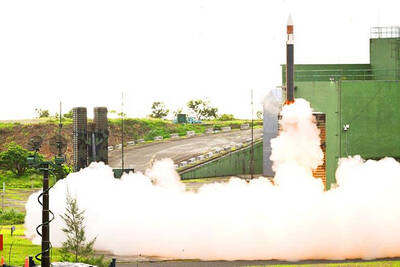
NEW GEAR: On top of the new Tien Kung IV air defense missiles, the military is expected to place orders for a new combat vehicle next year for delivery in 2028 Mass production of Tien Kung IV (Sky Bow IV) missiles is expected to start next year, with plans to order 122 pods, the Ministry of National Defense’s (MND) latest list of regulated military material showed. The document said that the armed forces would obtain 46 pods of the air defense missiles next year and 76 pods the year after that. The Tien Kung IV is designed to intercept cruise missiles and ballistic missiles to an altitude of 70km, compared with the 60km maximum altitude achieved by the Missile Segment Enhancement variant of PAC-3 systems. A defense source said yesterday that the number of
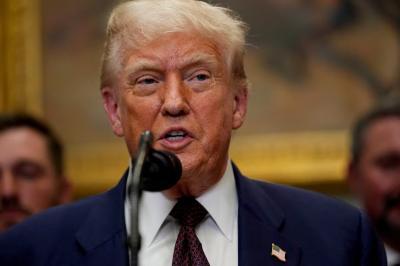
Taiwanese exports to the US are to be subject to a 20 percent tariff starting on Thursday next week, according to an executive order signed by US President Donald Trump yesterday. The 20 percent levy was the same as the tariffs imposed on Vietnam, Sri Lanka and Bangladesh by Trump. It was higher than the tariffs imposed on Japan, South Korea and the EU (15 percent), as well as those on the Philippines (19 percent). A Taiwan official with knowledge of the matter said it is a "phased" tariff rate, and negotiations would continue. "Once negotiations conclude, Taiwan will obtain a better


 RSS
RSS