


Democratic Progressive Party (DPP) presidential candidate Frank Hsieh (謝長廷) said yesterday that if elected, he would remove the 40 percent ceiling on China investment and restrictions imposed on local banks on opening branches in China with certain conditions.
Hsieh unveiled his cross-strait policies in his new book titled Viva Taiwan (
Hsieh promised to replace the China-bound investment cap of 40 percent of a local company's net worth, with a "case by case" review system.
The regulation could be readjusted in accordance with the impact of an applicant's China-bound investment on its global competitiveness, local industries and local labor market, Hsieh said.
"We should put strict restrictions on industries whose China-bound investment will make more local industries move to China or compete with local industries," Hsieh said.
"But for industries that consider their China-bound investment as a step for their advancement to the global market, the cap should be relaxed to ensure their global competitiveness," he said.
Hsieh said he would encourage local banks to establish branches in China on condition that both sides of the strait complete negotiations to establish a system for financial supervision and management so that financial supervisory agencies can exercise their right of jurisdiction.
This would ensure effective supervision and management of such branch operations, he said.
"With increasing Taiwanese investment in China, there is an enormous demand for financial services. Local banks should be allowed to seize the huge business opportunities," Hsieh said.
While advocating a more liberal and flexible approach to managing Taiwan's investment in China, Hsieh also suggested opening the country to Chinese capital.
"China's banks should be allowed to set up offices in Taiwan and then regulations should be gradually relaxed to allow Chinese banks to set up branches or sub-branches," Hsieh said.
He also proposed allowing Chinese businessmen to invest in Taiwan, with the exception of investments in residential property, agriculture and high-tech industries.
He also proposed allowing more Chinese tourists to visit Taiwan, with the ultimate aim of increasing their numbers to 3,000 a day.
Hsieh said that the so-called "92 consensus," embraced by his Chinese Nationalist Party (KMT) counterpart Ma Ying-jeou (
What both sides of the strait need is consensus about "time" and "procedure," Hsieh said.
"We should have a consensus that it might take about 10 to 20 years, or even longer, for both sides to resolve disagreements, enhance mutual understanding and reach a consensus that the solution to cross-strait relations must conform to the choice of the 23 million people of Taiwan," Hsieh said.
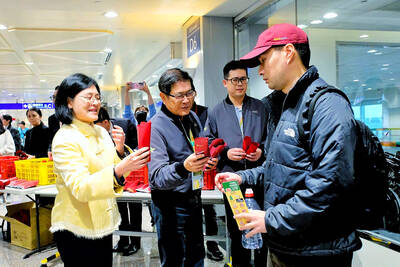
An Emirates flight from Dubai arrived at Taiwan Taoyuan International Airport yesterday afternoon, the first service of the airline since the US and Israel launched strikes against Iran on Saturday. Flight EK366 took off from the United Arab Emirates (UAE) at 3:51am yesterday and landed at 4:02pm before taxiing to the airport’s D6 gate at Terminal 2 at 4:08pm, data from the airport and FlightAware, a global flight tracking site, showed. Of the 501 passengers on the flight, 275 were Taiwanese, including 96 group tour travelers, the data showed. Tourism Administration Deputy Director-General Huang He-ting (黃荷婷) greeted Taiwanese passengers at the airport and

POSSIBILITIES EMERGE: With Taiwan’s victory and Japan’s narrow win over Australia, Taiwan now have a chance to advance if South Korea also beat the Aussies Taiwan has high hopes that the national baseball team would advance to the World Baseball Classic (WBC) quarter-finals after clinching a crucial 5-4 victory over South Korea in a nail-biting extra-inning game at the Tokyo Dome yesterday. Boosted by three home runs — two solo shots by Yu Chang (張育成) and Cheng Tsung-che (鄭宗哲) and a two-run homer by Stuart Fairchild — the triumph gave Taiwan a much-needed second victory in the five-team Pool C, where only the top two finishers would advance to the knockout stage in Miami, Florida. Entering extra innings with the game tied at four apiece, Taiwan scored
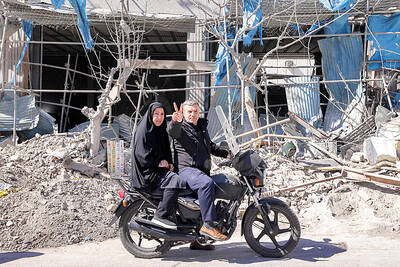
STRAIT OF HORMUZ: In the case of a prolonged blockade by Iran, Taiwan would look to sources of LNG outside the Middle East, including Australia and the US Taiwan would not have to ration power due to a shortage of natural gas, Minister of Economic Affairs Kung Ming-hsin (龔明鑫) said yesterday, after reports that the Strait of Hormuz was closed amid the conflict in the Middle East. The government has secured liquefied natural gas (LNG) supplies for this month and contingency measures are in place if the conflict extends into next month, Kung told lawmakers. Saying that 25 percent of Taiwan’s natural gas supplies are from Qatar, Chinese Nationalist Party (KMT) caucus secretary-general Lin Pei-hsiang (林沛祥) asked about the situation in light of the conflict. There would be “no problems” with
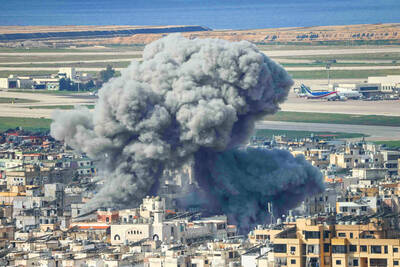
PLANE HIT: The Israeli military said it shot down an Iranian Air Force fighter over Tehran, while an Iranian warship sank off Sri Lanka, with no cause known The US and Israel yesterday hit Iran’s capital and other cities in multiple airstrikes on the fifth day of the war with Iran. Israel targeted the Iranian leadership and security forces, while the Islamic Republic responded with missile barrages and drone attacks on Israel, and across the region. Tehran residents woke to dawn blasts and Iranian state television showed the ruins of building in the center of the capital. The Shiite seminary city of Qom and multiple other cities were also targeted. With fighter jets roaring overhead, those still in Tehran looked anxiously to the skies. One man, who ran a clothing shop,


 RSS
RSS