


US trio Leonid Hurwicz, Eric Maskin and Roger Myerson yesterday won this year's Nobel Economics Prize for pioneering work on how to design solutions for complex economic and social tasks.
The Nobel jury said the three took the prize in light of their work on Mechanism Design theory, a sub-field of economics, which aims to ensure the most efficient use of resources in search of desired ends.
The theory, which was initiated by Hurwicz and further developed by Maskin and Myerson, "has helped economists identify efficient trading mechanisms, regulation schemes and voting procedures," the jury said.
The theory, for example, can help identify which mechanisms will realize the largest gains from trade, maximize a seller's expected gain or provide an insurance scheme which provides the best coverage without inviting misuse.
Hurwicz, born in Moscow, is Regents' Professor of Economics Emeritus at the University of Minnesota and in 1990 won the US National Medal of Science in Behavioral and Social Science for his pioneering work in Mechanism Design. Maskin is professor of Social Science at Princeton University and Myerson professor of Economics at University of Chicago.
Last year, the economics prize went to Edmund Phelps of the US for his work on how overall economic policy affected welfare for present and future generations.
This year's laureates will receive a gold medal, a diploma and 10 million Swedish kronor (US$1.53 million), to be shared between them.
The formal prize ceremony will be held in Stockholm as tradition dictates on Dec. 10, the anniversary of the death in 1896 of the prize's creator, Swedish industrialist and inventor of dynamite Alfred Nobel.
On Friday, the peace prize went to former US vice president Al Gore and the UN's top climate panel for their efforts to combat global warming.
British writer Doris Lessing won the literature prize, while the physics prize went to Peter Gruenberg of Germany and Albert Fert of France for a discovery that led to the miniaturized hard disk, an essential component in modern-day computers.
Gerhard Ertl of Germany took the chemistry prize while medicine went to Mario Capecchi and Oliver Smithies of the US and Martin Evans of Britain for their work on creating genetically manipulated mice that replicate human diseases.

‘NO SECURITY RISK’: The Railway Bureau reassured the public that the technicians’ activities were limited to technical guidance and did not involve sensitive systems The Railway Bureau yesterday said it had invited eight Chinese technicians to assist with an airport MRT construction project. The bureau issued the confirmation after an Internet user said Chinese nationals had entered the construction zone of Taiwan Taoyuan International Airport’s Terminal 3 project. They asked why “individuals from an enemy state” were allowed access to such a major national infrastructure project, which raised serious concerns over Taiwan’s industrial safety, sensitive systems and information security. The bureau’s Northern Region Engineering Branch Office said subcontractor Taiwan Handle Industrial Co (台灣手把工業) of the Taoyuan airport MRT’s “Contract No. CU05 Project A14 Station Civil, MEP &

A US uncrewed surface vessel (USV) encountered multiple Chinese warships during an autonomous transit of the Taiwan Strait, US defense company Seasats said in a statement on Wednesday. Seasats announced that a Lightfish USV had completed the first autonomous transit of the Taiwan Strait. Over five days, the USV traversed the entire length of the Strait while constantly monitoring surface vessel traffic, the company said. The Lightfish encountered multiple Chinese warships, one of which was a Chinese People’s Liberation Army Navy (PLAN) Type 056 corvette, it said. The Chinese vessels were operating “well within Taiwan’s exclusive economic zone without transmitting their identity via the
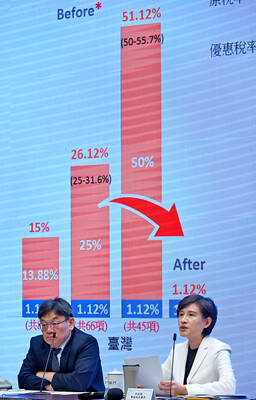
GREATER REACH? Auto parts and wood products would face tariffs of up to 15%, matching those targeting the EU, Japan and South Korea, Vice Premier said The US has announced that preferential tariff treatment for Taiwan’s non-semiconductor Section 232 goods would take effect retroactively from May 1, the Executive Yuan said yesterday. The US government yesterday posted a notice on the Federal Register’s public inspection Web site previewing tariff concessions for Taiwan under a memorandum of understanding (MOU) on Taiwan-US investment after two months of negotiations. The MOU signed on Jan. 15 stipulated three major preferential tariff arrangements: a 15 percent “reciprocal” tariff rate for Taiwan without stacking most-favored nation (MFN) rates; preferential Section 232 treatment for semiconductors and related products; and preferential Section 232 treatment for non-semiconductor

TIT-FOR-TAT: The US allegedly revoked the visa of a Chinese national working at Xinhua News Agency in the US in response to Beijing’s expulsion of Vivian Wang The Presidential Office yesterday condemned China for expelling a New York Times correspondent from Beijing following the newspaper’s interview with President William Lai (賴清德), saying the move highlighted Beijing’s suppression of press freedom and its threat to international news media. Taiwan has noted a series of recent incidents in which Beijing used similar tactics to “threaten and pressure international media outlets and journalists,” Presidential Office spokeswoman Karen Kuo (郭雅慧) said in a statement. “This concerns not only press freedom and freedom of expression, but also the safety of journalists, and Taiwan and relevant partners are paying close attention to the situation,” she


 RSS
RSS