


An eminent South African historian believes he has stumbled on Jack the Ripper.
Charles van Onselen said at first he wasn't sure he wanted to publicize the conclusions he drew when he noticed parallels in the century-old, unsolved Jack the Ripper case and the background of Joseph Silver, a feared international criminal who terrorized women as the "King of the Pimps" in Johannesburg.
He expected resistance, especially from the UK, where there is a "whole cottage industry" devoted to the 1888 murders of streetwalkers in London's Whitechapel, van Onselen said.
The publicity around van Onselen's The Fox and The Flies: The World of Joseph Silver, Racketeer and Psychopath, published last month, has made much of Silver being Jack the Ripper. But van Onselen, who took nearly three decades to research the book, only makes his Ripper case in the final 25th chapter, written in the last 36 months.
And while the book has been well-received as a great work of "historical detection," reaction from "Ripperologists" has been skeptical.
A reader on a Web site dedicated to the elusive Jack found that the book "from the Ripperological perspective is fairly weak" and that there were probably dozens of men who could have fitted the profile of the crazed killer that van Onselen describes.
To his doubters the author said: "It is infuriating because no one of these things is definitive. I haven't got a knife with blood on it, nor will you ever get that. But my question then is: How many coincidences do you want to mount up in your mind simultaneously until you start saying this is a real possibility? It is in fact not a possibility, it's a probability."
Van Onselen, an acclaimed biographer, started out, though, exploring South Africa's criminal history. He was researching the white slave trade when he encountered Silver, the head of Johannesburg's pimps and "the most dangerous man" in the country.
The book paints a vivid picture of Johannesburg as a young mining town, which the author describes as "hell's playground."
Silver, born in Kielce, Poland in 1868, arrived in Johannesburg in 1898 fresh from a stint in Sing Sing for burglary and a stay in London a decade earlier, which he spent the rest of his life trying to conceal.
The evidence that Silver was in Whitechapel at the time of the Ripper murders includes the birth of his daughter there, van Onselen said.
Shortly after arriving in Johannesburg, Silver set up a string of cafes, cigar shops and police-protected brothels. He was backed by a gang of Russo-Polish Jews from New York.
Silver was litigious, wrote bold letters to newspapers and had an array of mocking aliases, while Jack the Ripper is believed to have taunted police with brazen letters to the papers.
Van Onselen, the son of a detective, tracked Silver across four continents. Aided by cheap steamship travel, Silver made his way among the demimonde of the Atlantic world from South Africa to Buenos Aires, Santiago, Paris and Brussels before being executed as a spy in Poland in 1918.
Van Onselen points to similarities between the subject of his book and the Whitechapel murderer, both psychopaths with a deep hatred of women. Silver had bitter, violent relationships with women all his life.
Van Onselen also believes, with a touch of pride, that he has made an important connection.
The Ripper murderer carved up women's bodies, removed their cheap rings and cut off their noses and ears. In one case, a heart was reportedly missing, possibly thrown into a fire.
Van Onselen believes the Ripper drew his inspiration from the Book of Ezekiel, which calls for the purging of whores: "And I will set my jealously against thee, and they shall deal furiously with thee: they shall take away thy nose and thine ears ... thy residue shall be devoured by fire. ... They shall also strip thee out of thy clothes, and take away thy fair jewels. ... Thus will I make thy lewdness to cease from thee..."

‘NO SECURITY RISK’: The Railway Bureau reassured the public that the technicians’ activities were limited to technical guidance and did not involve sensitive systems The Railway Bureau yesterday said it had invited eight Chinese technicians to assist with an airport MRT construction project. The bureau issued the confirmation after an Internet user said Chinese nationals had entered the construction zone of Taiwan Taoyuan International Airport’s Terminal 3 project. They asked why “individuals from an enemy state” were allowed access to such a major national infrastructure project, which raised serious concerns over Taiwan’s industrial safety, sensitive systems and information security. The bureau’s Northern Region Engineering Branch Office said subcontractor Taiwan Handle Industrial Co (台灣手把工業) of the Taoyuan airport MRT’s “Contract No. CU05 Project A14 Station Civil, MEP &

A US uncrewed surface vessel (USV) encountered multiple Chinese warships during an autonomous transit of the Taiwan Strait, US defense company Seasats said in a statement on Wednesday. Seasats announced that a Lightfish USV had completed the first autonomous transit of the Taiwan Strait. Over five days, the USV traversed the entire length of the Strait while constantly monitoring surface vessel traffic, the company said. The Lightfish encountered multiple Chinese warships, one of which was a Chinese People’s Liberation Army Navy (PLAN) Type 056 corvette, it said. The Chinese vessels were operating “well within Taiwan’s exclusive economic zone without transmitting their identity via the
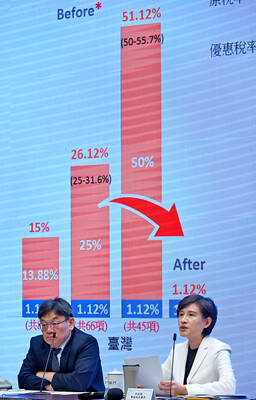
GREATER REACH? Auto parts and wood products would face tariffs of up to 15%, matching those targeting the EU, Japan and South Korea, Vice Premier said The US has announced that preferential tariff treatment for Taiwan’s non-semiconductor Section 232 goods would take effect retroactively from May 1, the Executive Yuan said yesterday. The US government yesterday posted a notice on the Federal Register’s public inspection Web site previewing tariff concessions for Taiwan under a memorandum of understanding (MOU) on Taiwan-US investment after two months of negotiations. The MOU signed on Jan. 15 stipulated three major preferential tariff arrangements: a 15 percent “reciprocal” tariff rate for Taiwan without stacking most-favored nation (MFN) rates; preferential Section 232 treatment for semiconductors and related products; and preferential Section 232 treatment for non-semiconductor

The National Chungshan Institute of Science and Technology yesterday showcased its locally developed variants of the Vision 60 robotic patrol dog, which it plans to deploy on the nation’s outlying territories in the South China Sea. The variants were produced under the Joint Lab project — created by the institute and domestic companies — and assembled with domestically produced motors, lenses and artificial intelligence (AI) systems alongside licensed tech from the US, Missile and Rocket Systems Research Division deputy director Jen Kuo-kang (任國光) told the media event at a military base in Taipei’s Dazhi (大直) area. Taiwan has built up its strengths


 RSS
RSS