


Former Russian president Boris Yeltsin -- who engineered the final collapse of the Soviet Union and pushed Russia to embrace democracy and a market economy -- has died, a Kremlin official said yesterday. He was 76.
Kremlin spokesman Alexander Smirnov confirmed Yeltsin's death, but gave no cause or further information. The Interfax news agency cited an unidentified medical source as saying he had died of heart failure.
Although Yeltsin pushed Russia to embrace democracy and a market economy, many of its citizens will remember him for presiding over the country's steep decline.
He was a contradictory figure, rocketing to popularity in the Communist era on pledges to fight corruption -- but proving unable to prevent the looting of state industry as it moved into private hands during his nine years as Russia's first freely elected president.
He steadfastly defended freedom of the press, but was a master at manipulating the media.
He amassed as much power as possible while in office -- then gave it all up in a dramatic New Year's address at the end of 1999.
Yeltsin's greatest moments came in bursts. He stood atop a tank to resist an attempted coup in August 1991, and spearheaded the peaceful end of the Soviet state on Dec. 25 of that year. Ill with heart problems, and facing possible defeat by a Communist challenger in his 1996 re-election bid, he marshaled his energy and sprinted through the final weeks of the campaign.
The challenge transformed a shaky convalescent into a spry, dancing candidate.
But Yeltsin was an inconsistent reformer who never took much interest in the mundane tasks of day-to-day government and nearly always blamed Russia's myriad problems on subordinates.
In December 1994, Yeltsin launched a war against separatists in the southern republic of Chechnya.
Tens of thousands of people were killed in the conflict, and a defeated and humiliated Russian army withdrew at the end of 1996. The war solved nothing -- and Russian troops resumed fighting in the breakaway region in fall 1999.
In the final years of his leadership, Yeltsin was dogged by health problems and often seemed out of touch. He retreated regularly to his country residence outside Moscow and stayed away from the Kremlin for days, even weeks at a time. As the country lurched from crisis to crisis, its leader appeared increasingly absent.
Yet Yeltsin had made a stunning debut as Russian president. He introduced many basics of democracy, guaranteeing the rights to free speech, private property and multiparty elections, and opening the borders to trade and travel. Though full of bluster, he revealed more of his personal life and private doubts than any previous Russian leader had.
Yeltsin pushed through free-market reforms, creating a private sector and allowing foreign investment. In foreign policy, he assured independence for Russia's Soviet-era satellites, oversaw troop and arms reductions, and developed warm relations with Western leaders.
However, he struggled to preserve a role for his former superpower calling for a "multipolar world" as a way to counterbalance what Russia perceived as excessive US global clout.

SILENCING CRITICS: In addition to blocking Taiwan, China aimed to prevent rights activists from speaking out against authoritarian states, a Cabinet department said The Ministry of Foreign Affairs (MOFA) yesterday condemned transnational repression by Beijing after RightsCon, a major digital human rights conference scheduled to be held in Zambia this week, was abruptly canceled due to Chinese pressure over Taiwanese participation. This year’s RightsCon, the world’s largest conference discussing issues “at the intersection of human rights and technology,” was scheduled to take place from tomorrow to Friday in Lusaka, and expected to draw 2,600 in-person attendees from 150 countries, along with 1,100 online participants. However, organizers were forced to cancel the event due to behind-the-scenes pressure from China, the ministry said, expressing its “strongest condemnation”
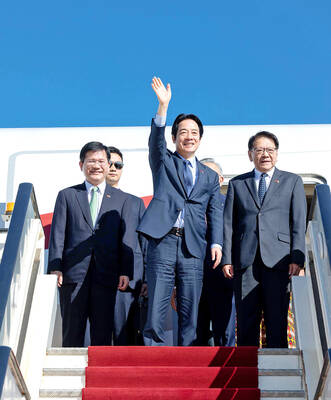
DELAYED BUT DETERMINED: The president’s visit highlights Taiwan’s right to international engagement amid regional pressure from China President Willaim Lai (賴清德) yesterday arrived in Eswatini, more than a week after his planned visit to Taiwan’s sole African ally was suspended because of revoked overflight permits. “The visit, originally scheduled for April 22, was postponed due to unforeseen external factors,” Lai wrote on social media. “After several days of careful arrangements by our diplomatic and national security teams, we successfully arrived today.” Lai said he looked forward to further deepening Taiwan-Eswatini relations through closer cooperation in the economy, agriculture, culture and education, as well as advancing the nation’s international partnerships. The president was initially scheduled to arrive in time to celebrate
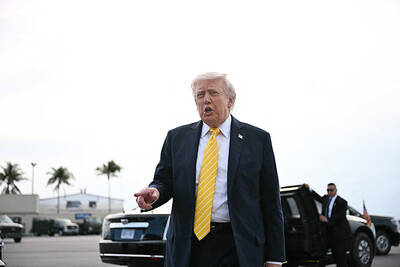
Iran’s Islamic Revolutionary Guard Corp (IRGC) yesterday said the US faced a choice between an “impossible” military operation or a “bad deal” with Tehran, after US President Donald Trump disparaged Iran’s latest peace proposal. Negotiations between the two countries have been deadlocked since a ceasefire came into effect on April 8, with only one round of direct peace talks held so far. Iran’s Tasnim and Fars news agencies reported that Tehran had submitted a 14-point proposal to mediator Pakistan, but Trump was quick to cast doubt on it. “I will soon be reviewing the plan that Iran has just sent to us, but
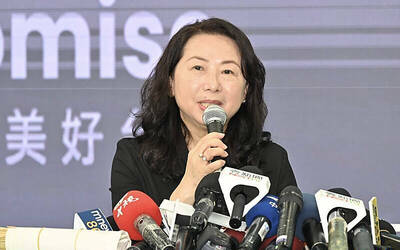
A group affiliated with indicted Chinese immigrant Xu Chunying (徐春鶯) is to be dissolved for monitoring Chinese immigrants in Taiwan, a source said yesterday. Xu, the secretary-general of the Cross-Strait Marriage and Family Service Alliance, was indicted on March 24 on charges of violating the Anti-Infiltration Act (反滲透法). The alliance “illegally monitored" Chinese immigrants living in Taiwan on behalf of the Chinese Communist Party (CCP) and the Ministry of the Interior is expected to dissolve the organization in the coming days under provisions of the Civil Associations Act (人民團體法), the source said. Xu, who married a Taiwanese in 1993 and became a Republic


 RSS
RSS