


Taiwanese independence is not an option for the Chinese Nationalist Party (KMT), Chairman Ma Ying-jeou (馬英九) said yesterday, almost a year after running an ad in a local newspaper saying that he recognized independence as an option for the people of Taiwan.
Although Ma has said that the KMT's policy has not changed -- that is, seeking to maintain the status quo -- confusion over Ma's inconsistent stance prompted some KMT grassroots members to ask questions during Ma's visit to Taichung yesterday on the party's policy toward China.
"The KMT will not advocate Taiwan's independence ? it will only bring disturbance and agitation to the country if we declare independence," Ma said in response to the questions, adding that the nation has to take into account US and Japanese concerns involving these issues.
Ma's lack of a clear discourse on cross-strait issues had given rise to confusion among some KMT members over party policy.
During an interview with Newsweek International in December 2005, Ma said that unification with China was the party's ultimate goal. The KMT then ran an advertisement last February in the Liberty Times (the Taipei Times' sister paper) which said that Ma recognized that "independence is an option for the Taiwanese people."
That rhetoric caused widespread criticism from within the party at the time, including former KMT chairman Lien Chan (連戰), who complained that Ma had not consulted him before making the statement.
Ma later tried to clarify his statement by arguing that the KMT policy of maintaining the status quo had not changed and presenting "five dos" to highlight the KMT's approach to cross-strait relations.
The five dos are: To resume negotiations based on the so-called "1992 consensus;" to agree upon a peace accord; to facilitate economic exchanges with the aim of establishing a common market; to work with China to boost Taiwan's presence in international bodies; and to expand educational and cultural exchanges.
Arguing that the KMT would never seek independence, Ma said yesterday that the country's future should not be decided based solely on opinion polls.
The country's relations with the US, Japan and China and the conflict of interests with these countries should be considered as well, he said, reaffirming the KMT's policy of maintaining the status quo and the constitutional system.
Meanwhile, in response to local members voicing support for him running in the presidential election -- even if indicted over his alleged misuse of his mayoral special allowance -- Ma repeated yesterday that he would follow party regulations and would resign as party chairman if indicted, but refused to comment on whether he would then join the race as an independent candidate.
KMT Spokesman Su Jun-pin (蘇俊賓) said the party would not answer any questions based on hypothetical assumptions.
"Some party members have suggested that we should change the regulations so that Chairman Ma wouldn't need to quit. But Ma Ying-jeou would not be the person we know he is if he agreed to that," Su said.
The KMT's black gold exclusion clause stipulates that the party chairman should resign if indicted.
"The party has its own regulations and I will definitely follow the rules, as I have always done," Ma said.
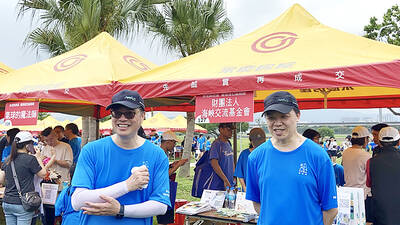
SECURITY: As China is ‘reshaping’ Hong Kong’s population, Taiwan must raise the eligibility threshold for applications from Hong Kongers, Chiu Chui-cheng said When Hong Kong and Macau citizens apply for residency in Taiwan, it would be under a new category that includes a “national security observation period,” Mainland Affairs Council (MAC) Minister Chiu Chui-cheng (邱垂正) said yesterday. President William Lai (賴清德) on March 13 announced 17 strategies to counter China’s aggression toward Taiwan, including incorporating national security considerations into the review process for residency applications from Hong Kong and Macau citizens. The situation in Hong Kong is constantly changing, Chiu said to media yesterday on the sidelines of the Taipei Technology Run hosted by the Taipei Neihu Technology Park Development Association. With
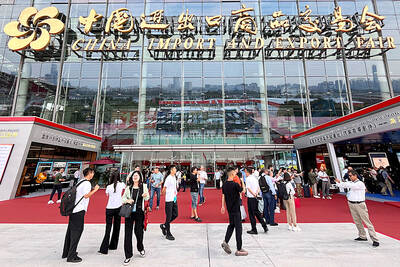
CARROT AND STICK: While unrelenting in its military threats, China attracted nearly 40,000 Taiwanese to over 400 business events last year Nearly 40,000 Taiwanese last year joined industry events in China, such as conferences and trade fairs, supported by the Chinese government, a study showed yesterday, as Beijing ramps up a charm offensive toward Taipei alongside military pressure. China has long taken a carrot-and-stick approach to Taiwan, threatening it with the prospect of military action while reaching out to those it believes are amenable to Beijing’s point of view. Taiwanese security officials are wary of what they see as Beijing’s influence campaigns to sway public opinion after Taipei and Beijing gradually resumed travel links halted by the COVID-19 pandemic, but the scale of
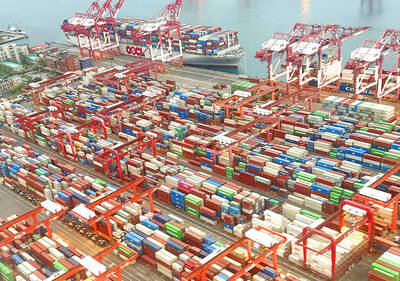
TRADE: A mandatory declaration of origin for manufactured goods bound for the US is to take effect on May 7 to block China from exploiting Taiwan’s trade channels All products manufactured in Taiwan and exported to the US must include a signed declaration of origin starting on May 7, the Bureau of Foreign Trade announced yesterday. US President Donald Trump on April 2 imposed a 32 percent tariff on imports from Taiwan, but one week later announced a 90-day pause on its implementation. However, a universal 10 percent tariff was immediately applied to most imports from around the world. On April 12, the Trump administration further exempted computers, smartphones and semiconductors from the new tariffs. In response, President William Lai’s (賴清德) administration has introduced a series of countermeasures to support affected
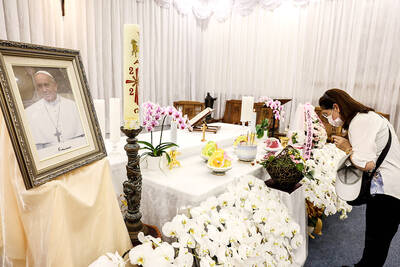
Pope Francis is be laid to rest on Saturday after lying in state for three days in St Peter’s Basilica, where the faithful are expected to flock to pay their respects to history’s first Latin American pontiff. The cardinals met yesterday in the Vatican’s synod hall to chart the next steps before a conclave begins to choose Francis’ successor, as condolences poured in from around the world. According to current norms, the conclave must begin between May 5 and 10. The cardinals set the funeral for Saturday at 10am in St Peter’s Square, to be celebrated by the dean of the College


 RSS
RSS