


President Chen Shui-bian's (
The Chaos were found guilty of insider trading in connection with the Taiwan Development Corp scandal and other illegal deals.
The father and son were also fined NT$30 million (US$927,000) each.
The Chaos and other defendants may appeal the ruling to the Taiwan High Court.
In its ruling yesterday, the Taipei District Court said: "They used their political influence to intervene in big business and political affairs. Illegal lobbying and insider trading were the methods they used."
They had shown no regret for their actions and heavy sentences were appropriate, the ruling said.
Chao Yu-chu embezzled NT$11 million from Eslite Books chairman Robert Wu (
Former Taiwan Development Corp chairman Su Teh-jien (
Waterland Securities Co board director Tsai Chin-wen (
Chao Chien-ming, Chao Yu-chu, Su, Tsai and Yu made more than NT$10 million through insider trading of TDC shares.
The scandal dates back to last summer when Su, Chang Hwa Commercial Bank chairman Chang Po-shin (張伯欣) and bank president Chen Chen-chao (陳辰昭) dined on two occasions with Chao Chien-ming, Tsai and Yu at a Japanese restaurant in Taipei.
Confidential information about Taiwan Development Corp was discussed on both occasions.
The court noted that Chao Chien-ming, his father, Tsai and Yu each bought a large number of shares in the corporation shortly afterwards.
In related news, Nice Group president Chen Jing-yao (
Chen and Hung were found guilty of breach of trust in connection with the transfer of NT$27 million to Chao Yu-chu's accounts.
Prosecutors believe that the money was a bribe for Chao Chien-ming's efforts to help Chen Jing-yao win the leadership of Waterland Financial Holdings Co last year.
The court found that there was insufficient evidence that the Chao family attempted to manipulate that leadership race, and thus neither were charged on that count.
also see story:
Reaction mixed to convictions of Chen's in-laws

‘NO SECURITY RISK’: The Railway Bureau reassured the public that the technicians’ activities were limited to technical guidance and did not involve sensitive systems The Railway Bureau yesterday said it had invited eight Chinese technicians to assist with an airport MRT construction project. The bureau issued the confirmation after an Internet user said Chinese nationals had entered the construction zone of Taiwan Taoyuan International Airport’s Terminal 3 project. They asked why “individuals from an enemy state” were allowed access to such a major national infrastructure project, which raised serious concerns over Taiwan’s industrial safety, sensitive systems and information security. The bureau’s Northern Region Engineering Branch Office said subcontractor Taiwan Handle Industrial Co (台灣手把工業) of the Taoyuan airport MRT’s “Contract No. CU05 Project A14 Station Civil, MEP &

The National Chungshan Institute of Science and Technology yesterday showcased its locally developed variants of the Vision 60 robotic patrol dog, which it plans to deploy on the nation’s outlying territories in the South China Sea. The variants were produced under the Joint Lab project — created by the institute and domestic companies — and assembled with domestically produced motors, lenses and artificial intelligence (AI) systems alongside licensed tech from the US, Missile and Rocket Systems Research Division deputy director Jen Kuo-kang (任國光) told the media event at a military base in Taipei’s Dazhi (大直) area. Taiwan has built up its strengths
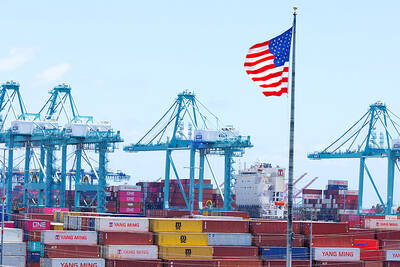
NOT IMMEDIATE: Taiwan has a chance to appeal the proposed 10 percent tariff before it starts, while other countries face a 12.5 percent tariff from the trade office Taiwan is among 60 economies determined by the US to have failed to impose or enforce a ban on the importation of goods produced with forced labor, according to a notice released on Tuesday by the Office of the US Trade Representative (USTR), which proposed imposing an additional 10 percent or more tariff on them. The USTR in a statement said that following an investigation, it had determined under Section 301 of the Trade Act of 1974 that the failure of the 60 economies to impose and effectively enforce a prohibition on the importation of goods produced with forced labor is

RIGHT DIRECTION: Taiwan’s efforts to prevent forced labor include a proposal to ‘fully prohibit’ employers from withholding workers’ documents, an official said Taiwan is to establish a mechanism to restrict imports of goods linked to forced labor, the Executive Yuan said yesterday, after the US proposed imposing additional tariffs on Taiwanese goods over labor concerns. “The Ministry of Labor and the Ministry of Economic Affairs are to establish an interministerial review procedure,” Executive Yuan spokesperson Michelle Lee (李慧芝) said at a news briefing in Taipei. “The government is to use the Foreign Trade Act [貿易法] as the legal basis to restrict imports of goods produced with forced labor” and bring its supply chain governance more in line with international standards on human rights, resilience


 RSS
RSS