


Fiji's military commander announced yesterday that he had taken control of the country from the elected government, confirming the South Pacific nation's fourth coup in less than two decades, after Australia refused a request from the prime minister for military help.
"As of six o'clock this evening, the military has taken over the government, has executive authority and the running of this country," Commodore Frank Bainimarama told a news conference.
He said he had invoked special powers under the Constitution to assume some powers of the president, and was using them to dismiss Prime Minister Laisenia Qarase from office and appoint an interim replacement.
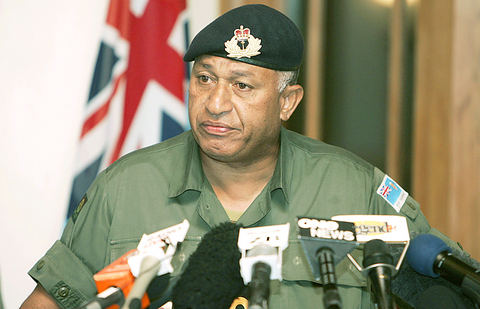
PHOTO: AP
He said he would surrender the presidential powers next week, and would ask the country's Great Council of Chiefs to restore them to President Ratu Josefa Iloilo, who he said would then appoint a full caretaker government.
Elections to restore democracy would follow sometime after that, he said.
"The government they want to set up will be totally illegal," Qarase said. "What the military has done is raped our Constitution."
Speaking at his home, surrounded by troops and where he said he considered himself under house arrest, Qarase said the economic impact of sanctions and the stoppage of foreign aid that could be expected to follow the coup would throw half the 900,000 population into poverty.
Bainimarama said that he was compelled to act against Qarase because the government was backing bills that undermined the Constitution, and insisted he was acting within the law.
Australian Prime Minister John Howard said Qarase had asked Canberra to send troops to try to prevent the coup, but that he had rejected the request.
"The possibility of Australian and Fijian troops firing on each other in the streets of Suva was not a prospect that I for a moment thought desirable," Howard told a news conference in Canberra.
Bainimarama had previously warned that any foreign intervention would be fiercely opposed.
The takeover was immediately condemned by acting Fiji Police Commissioner Moses Driver.
"The military has now indulged in a very serious criminal act, and ... we are not going to support the military in this regard, because it is unlawful," Driver told the Legend radio network.
Fiji's mostly unarmed police force has said previously it can't challenge the military's might, and Driver said police opposition would be limited to refusing to take orders from the military.
Armed troops locked down the capital, Suva, yesterday, setting up checkpoints outside government buildings and at other sites. Troops surrounded Qarase's house, blocking roads with tire-bursting spikes, with the prime minister holed up inside with his family and a handful of ministers.
"My impression is that I am under house arrest," Qarase told reporters hours before Bainimarama's declaration. "What happens next is anybody's guess."
Bainimarama had been threatening to "clean up" Qarase's government for weeks, bringing to a head a long-running feud between the two men that has at its roots deep-seated ethnic divisions in Fiji and personal grudges linked to a coup in 2000.
The slow-coming takeover has already been condemned internationally. New Zealand Prime Minister Helen Clark announced in parliament yesterday that defense ties with Fiji were being severed and officers and their families from that country would be banned.
"This is an outrage, what is happening in Fiji today," she told reporters in Wellington.
Australian Foreign Minister Alexander Downer said Canberra would impose similar conditions if it was confirmed Qarase had been removed.
also see story:
Fijian military chief completes swift fall from grace

‘NO SECURITY RISK’: The Railway Bureau reassured the public that the technicians’ activities were limited to technical guidance and did not involve sensitive systems The Railway Bureau yesterday said it had invited eight Chinese technicians to assist with an airport MRT construction project. The bureau issued the confirmation after an Internet user said Chinese nationals had entered the construction zone of Taiwan Taoyuan International Airport’s Terminal 3 project. They asked why “individuals from an enemy state” were allowed access to such a major national infrastructure project, which raised serious concerns over Taiwan’s industrial safety, sensitive systems and information security. The bureau’s Northern Region Engineering Branch Office said subcontractor Taiwan Handle Industrial Co (台灣手把工業) of the Taoyuan airport MRT’s “Contract No. CU05 Project A14 Station Civil, MEP &

A US uncrewed surface vessel (USV) encountered multiple Chinese warships during an autonomous transit of the Taiwan Strait, US defense company Seasats said in a statement on Wednesday. Seasats announced that a Lightfish USV had completed the first autonomous transit of the Taiwan Strait. Over five days, the USV traversed the entire length of the Strait while constantly monitoring surface vessel traffic, the company said. The Lightfish encountered multiple Chinese warships, one of which was a Chinese People’s Liberation Army Navy (PLAN) Type 056 corvette, it said. The Chinese vessels were operating “well within Taiwan’s exclusive economic zone without transmitting their identity via the
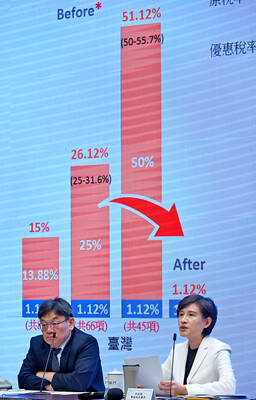
GREATER REACH? Auto parts and wood products would face tariffs of up to 15%, matching those targeting the EU, Japan and South Korea, Vice Premier said The US has announced that preferential tariff treatment for Taiwan’s non-semiconductor Section 232 goods would take effect retroactively from May 1, the Executive Yuan said yesterday. The US government yesterday posted a notice on the Federal Register’s public inspection Web site previewing tariff concessions for Taiwan under a memorandum of understanding (MOU) on Taiwan-US investment after two months of negotiations. The MOU signed on Jan. 15 stipulated three major preferential tariff arrangements: a 15 percent “reciprocal” tariff rate for Taiwan without stacking most-favored nation (MFN) rates; preferential Section 232 treatment for semiconductors and related products; and preferential Section 232 treatment for non-semiconductor
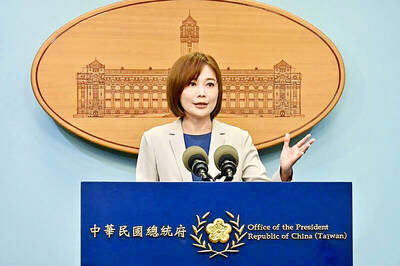
TIT-FOR-TAT: The US allegedly revoked the visa of a Chinese national working at Xinhua News Agency in the US in response to Beijing’s expulsion of Vivian Wang The Presidential Office yesterday condemned China for expelling a New York Times correspondent from Beijing following the newspaper’s interview with President William Lai (賴清德), saying the move highlighted Beijing’s suppression of press freedom and its threat to international news media. Taiwan has noted a series of recent incidents in which Beijing used similar tactics to “threaten and pressure international media outlets and journalists,” Presidential Office spokeswoman Karen Kuo (郭雅慧) said in a statement. “This concerns not only press freedom and freedom of expression, but also the safety of journalists, and Taiwan and relevant partners are paying close attention to the situation,” she


 RSS
RSS