


A shootout blamed on warring gangs in a packed slum left 16 dead, raising fears that Haiti's capital may be slipping back into disorder after months of relative calm.
"The security environment in the capital is not good at this time," said Pierre Esperance, a local human rights activist.
The UN said in a statement that Sri Lankan peacekeeping troops found the bodies on Friday morning in the southern Port-au-Prince slum of Martissant, the site of a recent spate of gunbattles between warring gangs.
Civilians
The victims apparently were killed in an hours-long shootout among gang members fighting for control of the dense area, Esperance said.
"The people who died were civilians, not gang members," said Esperance, whose National Coalition for Haitian Rights has monitored gang activity in the slum.
Including the latest deaths, he said that at least 30 people have been slain in Martissant since June 1.
The Brazil-led UN peacekeeping force stepped up patrols where the bodies were found. Many residents fled the area for fear of more attacks, local radio reported.
"The military forces ... currently control the area of where the incidents occurred and have increased their patrols to protect the population and prevent more acts of violence," the UN statement said.
The deaths were the latest in a series of killings and kidnappings that have gripped Haiti's tense capital in the weeks since the May inauguration of President Rene Preval. It was unclear whether the recent violence was politically motivated.
New president
But the killings and kidnappings have raised fears of a return to the mayhem following a 2004 revolt that toppled then-president Jean-Bertrand Aristide.
The impoverished Caribbean nation had been relatively calm since Preval's Feb. 7 election victory.
Sophie Boutaud de la Combe, a UN spokeswoman, said UN police would work with Haitian authorities to investigate Friday's deaths.
Police say gangs stage kidnappings as a source of income, but others believe they are waging attacks to pressure Preval to return Aristide, his one-time political mentor, from exile in South Africa.

Through the noise of rushing papers and whirring belts at a print factory in Kyoto, two creators watch their photo essay come to life in broadsheet form — part of an effort to win new audiences in the age of artificial intelligence (AI). Despite the decline of the publishing industry, self-publication and handmade “zine” magazines are growing in popularity in Japan, reflecting the nation’s enduring love of paper in the digital era. While speaking to Agence France-Presse at the plant, his hands black with ink, one of the creators, Kazuma Obara, said: “I think [paper] is a medium that engages all five

‘CROSSING THE LINE’: China’s embassy in Seoul criticized US Forces Korea Commander General Xavier Brunson, asking if his ‘hostile’ remarks were authorized by Washington South Korea and the US are in talks over recent public remarks by the commander of US Forces Korea, Seoul’s presidential office said yesterday, after the comments drew sharp criticism from China. In a recent podcast interview, US Forces Korea Commander General Xavier Brunson described South Korea as “the dagger in the heart of Asia” from China’s east coast, prompting the Chinese embassy in Seoul to say that he had “truly crossed the line.” The interview came amid growing speculation that Washington might seek to expand the role of US Forces Korea in countering the growing regional influence of China, a key

Australian researchers have trained lab-grown brain cells on a silicon computer chip to play the 1990s shooter game Doom and said they are just scratching the surface of what the neurons could be capable of doing. It is the science-fiction work of biotech boffins at Cortical Labs, who researched and developed the technology that harnesses the workings of the brain’s networking system. Each so-called “biological computer” contains about 200,000 living human brain cells, grown from stem cells that were harvested from blood donations. Having mastered the simple computer game Pong, where a paddle is moved up and down to send a ball
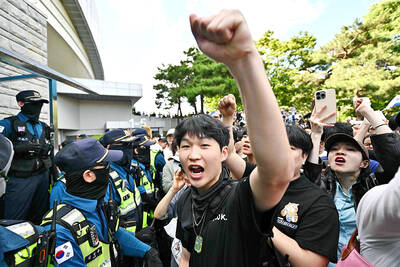
‘ABSURD MISTAKE’: The election commission said that there had been a failure to anticipate turnout after 14 polling stations ran short of ballot papers South Korean riot police yesterday cleared protesters from a Seoul polling station after a 35-hour blockade sparked by a shortage of ballot papers during local elections earlier this week. Wednesday’s election was the first nationwide vote since South Korean President Lee Jae-myung took office following the ouster of Yoon Suk-yeol over his short-lived martial law declaration. Lee’s ruling Democratic Party swept most races, but failed to flip the crucial Seoul mayoral seat. The South Korean National Election Commission apologized, blaming a failure to anticipate turnout after 14 polling stations in Seoul ran short of ballot papers. Some polling stations stayed open until 10pm to


 RSS
RSS