


Taipei Financial Center Corp (TFCC), owner of Taipei 101, said it will start charging companies for any commercial usage of the image of the world's tallest building in a bid to protect its trademark.
As one of Taiwan's major landmarks, the Taipei 101 skyscraper, opened at the end of 2004, is not only one of the nation's hottest tourist attractions but it has also found itself being used in countless advertisements, commercials, music videos and TV dramas.
"Unlike Chiang Kai-shek Memorial Hall and the National Palace Museum, which are public assets, Taipei 101 is private property," Joery Wei (魏善平), a public relations official, said yesterday.
"We have registered a three-dimensional trademark for the building with the Intellectual Property Office, which entitles us the right to protect the trademark from being abused," he added.
As TFCC has spent a considerable amount of money in establishing and running the "Taipei 101" brand, companies that use Taipei 101 to promote their products are also in violation of the Fair Trade Law (公平交易法), Wei said.
Last year alone, TFCC found over 1,000 cases of other companies using Taipei 101 as a promotional tool -- mostly in real estate advertising -- that could potentially mislead consumers, Wei said.
As a result, TFCC decided to charge royalty for any commercial use of the building's image. For example, a poster featuring the Taipei 101 tower will be charged NT$100,000 (US$3,099), Wei said.
The fee for TV commercials and drama series will be set depending on each case, he added. TFCC may take legal action against individuals and companies that fail to request permission, Wei said.
Use for the government and public is free of charge, Wei said.
The decision drew the ire of advertisers and TV producers, as other major landmarks around the world, such as the Empire State Building in New York City and the Eiffel Tower in Paris, have no such charges.
Jack Lu (盧文祥), deputy director general of Taiwan's Intellectual Property Office, said as long as ads and commercials use the building in the background and not as the main feature, they will not infringe upon the Trademark Act (商標法), but whether the practice is in violation of the Fair Trade Law will depend on any resultant investigation by the local Fair Trade Commission.
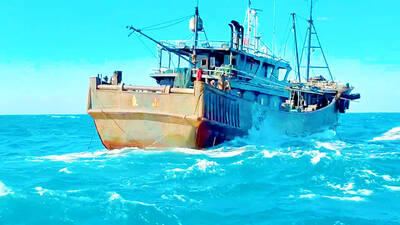
MAKING WAVES: China’s maritime militia could become a nontraditional threat in war, clogging up shipping lanes to prevent US or Japanese intervention, a report said About 1,900 Chinese ships flying flags of convenience and fishing vessels that participated in China’s military exercises around Taiwan last month and in January last year have been listed for monitoring, Coast Guard Administration (CGA) Deputy Director-General Hsieh Ching-chin (謝慶欽) said yesterday. Following amendments to the Commercial Port Act (商港法) and the Law of Ships (船舶法) last month, the CGA can designate possible berthing areas or deny ports of call for vessels suspected of loitering around areas where undersea cables can be accessed, Oceans Affairs Council Minister Kuan Bi-ling (管碧玲) said. The list of suspected ships, originally 300, had risen to about
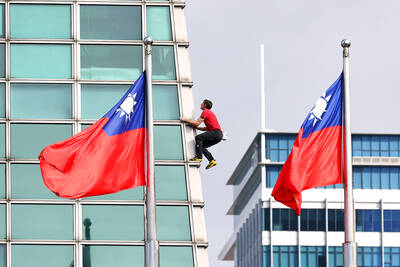
DAREDEVIL: Honnold said it had always been a dream of his to climb Taipei 101, while a Netflix producer said the skyscraper was ‘a real icon of this country’ US climber Alex Honnold yesterday took on Taiwan’s tallest building, becoming the first person to scale Taipei 101 without a rope, harness or safety net. Hundreds of spectators gathered at the base of the 101-story skyscraper to watch Honnold, 40, embark on his daredevil feat, which was also broadcast live on Netflix. Dressed in a red T-shirt and yellow custom-made climbing shoes, Honnold swiftly moved up the southeast face of the glass and steel building. At one point, he stepped onto a platform midway up to wave down at fans and onlookers who were taking photos. People watching from inside
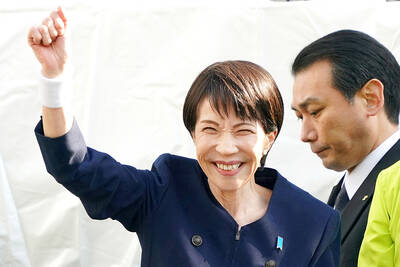
Japan’s strategic alliance with the US would collapse if Tokyo were to turn away from a conflict in Taiwan, Japanese Prime Minister Sanae Takaichi said yesterday, but distanced herself from previous comments that suggested a possible military response in such an event. Takaichi expressed her latest views on a nationally broadcast TV program late on Monday, where an opposition party leader criticized her for igniting tensions with China with the earlier remarks. Ties between Japan and China have sunk to the worst level in years after Takaichi said in November that a hypothetical Chinese attack on Taiwan could bring about a Japanese
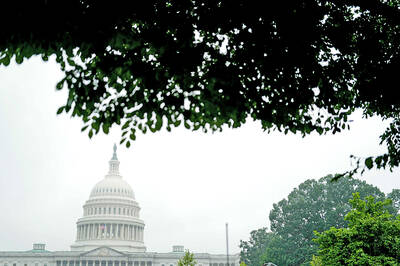
STREAMLINED: The dedicated funding would allow the US to transfer equipment to Taiwan when needed and order upgraded replacements for stockpiles, a source said The US House of Representatives on Thursday passed a defense appropriations bill totaling US$838.7 billion, of which US$1 billion is to be allocated to reinforcing security cooperation with Taiwan and US$150 million to replace defense articles provided to the nation. These are part of the Consolidated Appropriation Act, which the US House yesterday passed with 341 votes in favor and 88 against. The act must be passed by the US Senate before Friday next week to avoid another government shutdown. The US House Committee on Appropriations on Monday unveiled the act, saying that it allocates US$1 billion for the Taiwan Security Cooperation Initiative


 RSS
RSS