


Despite pouring rain and a record low turnout rate, the Democratic Progressive Party (DPP) managed a surprise victory against the Chinese Nationalist Party (KMT) in yesterday's National Assembly elections, earning 42.52 percent of the vote, compared to the KMT's 38.92 percent.
In addition, the Taiwan Solidarity Union (TSU) beat the People First Party (PFP) and became the third largest party for the first time in yesterday's election, gaining a support rate of 7.05 percent compared to the PFP's 6.11 percent.
The DPP and TSU's unexpectedly strong showings put paid to the claims of many analysts that the KMT and PFP would get a boost from the "China fever" created by KMT Chairman Lien Chan (
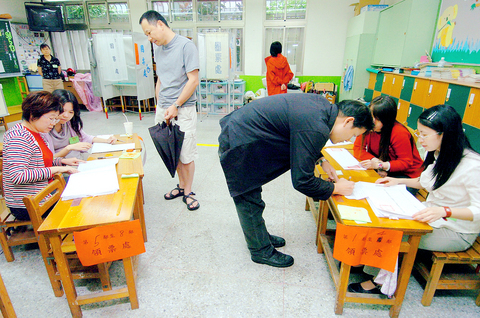
PHOTO: CHIEN JUNG-FENG, TAIPEI TIMES
More importantly, however, the DPP and the KMT enjoyed a landslide victory for their governmental reform efforts in yesterday's National Assembly elections, garnering more than 80 percent of the total ballots.
As the two parties support the constitutional amendment package passed by the Legislative Yuan last August, yesterday's polls virtually guarantee the success of the constitutional amendment package, the fifth since the first constitutional amendment was completed 14 years ago in 1991.
The 300 Assembly members, which are allotted among the 12 political parties and civic leagues taking part in the election in proportion to the number of votes gained, are required to meet 10 days after the official election result is promulgated by the Central Election Commission (CEC).
According to the tallies released by the CEC, the turnout rate was recorded at about 23.35 percent, an embarrassing drop from the 76.21 percent of the last National Assembly polls in 1996 and the 59.16 percent of last year's legislative elections.
The civic alliance led by Chang Ya-chung (
In terms of seats, the DPP is allocated with 127 seats, the KMT 117, the TSU 21 and the PFP 18. Chang's alliance receives five seats, the CPP three, the NP three, the NPSU two and the FP one.
The major task of the National Assembly is to ratify the constitutional amendment package passed by the legislature last August.
The bill includes amendments to Articles 1, 2, 4, 5 and 8 of the Additional Articles to the Constitution, on top of one article added to the Constitution in order to abolish the National Assembly, reform the legislature and regulate the methods for impeaching the president and vice president.
The amendment bill includes a provision halving the number of legislative seats from 225 to 113, extending the tenure of legislators from three to four years, adopting a "single-member district, two-vote" legislative electoral system and eliminating the National Assembly.
After the Assembly is abolished, bills regarding constitutional amendments and territorial changes will have to be ratified by the public via referendum after being passed by the legislature.
The amendment package also stipulates that when the legislature wants to pass a resolution to impeach the president or vice president, the resolution needs a simple majority to be proposed, but requires the consent of two-thirds of the Legislative Yuan for approval.
After the resolution is passed, the legislature can ask the Council of Grand Justices to review the resolution in the Constitutional Court, and if the court agrees with the resolution, the official to be impeached will be relieved of his or her title and power immediately.
Although the elections are over, Assembly members face an immediate predicament which prevents them from performing their duties, because the statute governing the National Assembly's exercise of power (
At issue is the ratification threshold for constitutional amendments, territorial changes and impeachment of the president or vice president.
The KMT legislative caucus argues that the consent of half of the assembly members should be required, but the TSU, PFP and the NPSU say that a three-fourths, or 75 percent, majority makes more sense. The DPP has adjusted its threshold from the original 50 percent to two-thirds, or about 67 percent.
All parties hold similar positions on the ratification threshold for territorial changes and impeachment of the president or vice president, however.
They propose that two-thirds of assembly members must be present, and that the consent of three-quarters of those members be required to confirm territorial changes.
The proposed ratification threshold for the impeachment of the president and vice president, meanwhile, is two-thirds of all assembly members.
DPP caucus whip Lai Ching-te (賴清德) said that he expects yesterday's election will help the passage of the bill governing the National Assembly's exercise of power.
"We do not rule out the possibility of adjusting the ratification threshold we proposed from 50 or 67 percent to 75 percent," he said.
Lai said that yesterday's victory was meaningful in three ways.
People First Party (PFP) caucus whip Chen Chih-pin (陳志彬) said that he suspects both the DPP and KMT will eventually support the 75 percent ratification threshold they insist on after winning yesterday's elections.
"Since they take up 80 percent of the assembly seats, I don't think they care that much about whether the threshold is 75 percent, 50 percent or 66 percent," he said.
TSU caucus whip Lo Chih-ming (羅志明) said that his caucus respects the choice of the people and will "unconditionally" support the DPP's previous proposition to vote on the bill governing the National Assembly's exercise of power.
The TSU had earlier said that it is not in a hurry to pass the bill, because there is still plenty of time to discuss the matter before the current legislative session ends in the end of the month.
Lo also dismissed the speculation that yesterday's polls would sway the ratification threshold proposed by his caucus.
"We support a ratification threshold of 75 percent for constitutional amendments and that the amendment package passed by the legislature should not be confirmed as a whole, but article by article," he said.
KMT Legislator Lai Shyh-bao (賴士葆) said that it still remains to be seen as whether the bill will clear the legislature by the end of the month.
"The TSU caucus still has a say in the matter," he said. "Since it is against the constitutional amendments, I expect it to do whatever it can to boycott the amendment package."
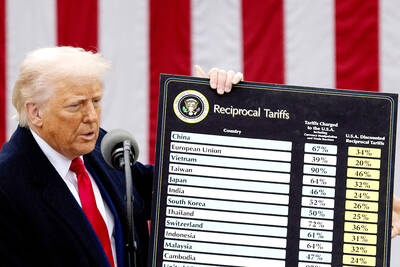
WAITING GAME: The US has so far only offered a ‘best rate tariff,’ which officials assume is about 15 percent, the same as Japan, a person familiar with the matter said Taiwan and the US have completed “technical consultations” regarding tariffs and a finalized rate is expected to be released soon, Executive Yuan spokeswoman Michelle Lee (李慧芝) told a news conference yesterday, as a 90-day pause on US President Donald Trump’s “reciprocal” tariffs is set to expire today. The two countries have reached a “certain degree of consensus” on issues such as tariffs, nontariff trade barriers, trade facilitation, supply chain resilience and economic security, Lee said. They also discussed opportunities for cooperation, investment and procurement, she said. A joint statement is still being negotiated and would be released once the US government has made
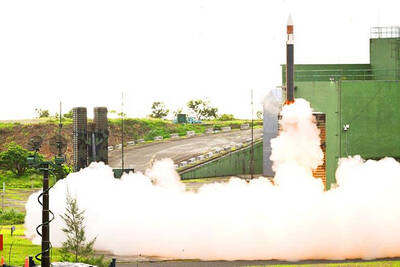
NEW GEAR: On top of the new Tien Kung IV air defense missiles, the military is expected to place orders for a new combat vehicle next year for delivery in 2028 Mass production of Tien Kung IV (Sky Bow IV) missiles is expected to start next year, with plans to order 122 pods, the Ministry of National Defense’s (MND) latest list of regulated military material showed. The document said that the armed forces would obtain 46 pods of the air defense missiles next year and 76 pods the year after that. The Tien Kung IV is designed to intercept cruise missiles and ballistic missiles to an altitude of 70km, compared with the 60km maximum altitude achieved by the Missile Segment Enhancement variant of PAC-3 systems. A defense source said yesterday that the number of
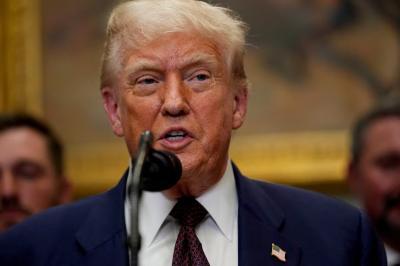
Taiwanese exports to the US are to be subject to a 20 percent tariff starting on Thursday next week, according to an executive order signed by US President Donald Trump yesterday. The 20 percent levy was the same as the tariffs imposed on Vietnam, Sri Lanka and Bangladesh by Trump. It was higher than the tariffs imposed on Japan, South Korea and the EU (15 percent), as well as those on the Philippines (19 percent). A Taiwan official with knowledge of the matter said it is a "phased" tariff rate, and negotiations would continue. "Once negotiations conclude, Taiwan will obtain a better
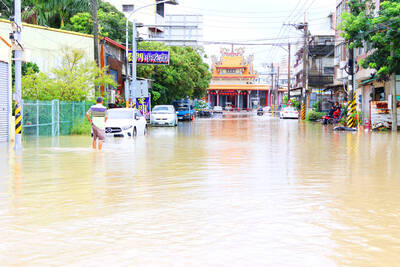
FLOOD RECOVERY: “Post-Typhoon Danas reconstruction special act” is expected to be approved on Thursday, the premier said, adding the flood control in affected areas would be prioritized About 200cm of rainfall fell in parts of southern Taiwan from Monday last week to 9am yesterday, the Central Weather Administration (CWA) said. Kaohsiung’s Taoyuan District (桃源) saw total rainfall of 2,205mm, while Pingtung County’s Sandimen Township (三地門) had 2,060.5mm and Tainan’s Nanhua District (南化) 1,833mm, according to CWA data. Meanwhile, Alishan (阿里山) in Chiayi County saw 1,688mm of accumulated rain and Yunlin County’s Caoling (草嶺) had 1,025mm. The Pingtung County Government said that 831 local residents have been pre-emptively evacuated from mountainous areas. A total of 576 are staying with relatives in low-lying areas, while the other 255 are in shelters. CWA forecaster


 RSS
RSS