


Taipei prosecutors yesterday indicted six people on charges of embezzlement and offences against the Securities Exchange Law (證券交易法) for allegedly stealing huge amounts of company funds from the Pacific Electric Wire and Cable Co (太電).
These six people are Mosel Vitelic Inc (茂矽) Chairman Hu Hung-chiu (胡洪九), who is the former chief financial officer of the company, former chairmen of Pacific Electric Tung Yu-chieh (仝玉潔), Tung Ching-yun (仝清筠) and Jack Sun (孫道存), former vice chairman Miao Chu-yi (繆竹怡) and former secretary to the chairman Huang Ching-lin (黃靜琳).
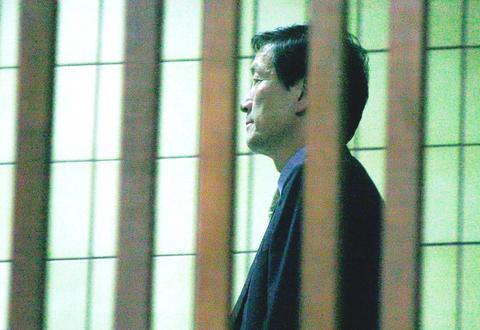
TAIPEI TIMES FILE PHOTO
In the indictment, Taipei Prosecutor Chu Ying-hsiang (朱應翔) sought a 20-year sentence for Hu with a fine of NT$1 billion, a ten-year sentence for Miao with a fine of NT$500 million, a seven-year sentence for Tung Ching-yun with a fine of NT$100 million and a four-year sentence for Huang. As for Sun and Tung Yu-chieh, Chu did not seek any specific sentences for them. Tung Yu-chieh is the father of Tung Ching-yun.
Pacific Electric's accountants Chou Chi-ping (周齊平) and Lee Chia-hui (李嘉惠) were also involved in the crimes but prosecutors decided not to indict them because they testified against the defendants and provided important evidence.
Originally prosecutors were just investigating Hu. But in the course of their investigation they discovered that both Tung Ching-yun and Miao had -- unknown to both Hu and each other -- been using similar means of syphoning off money. For purposes of efficiency, prosecutors decided to combine all three cases.
"These six people allegedly embezzled approximately NT$20 billion from the company (Pacific Electric). [The offences] are not related to each other but they used the same scenario to commit the crimes," Lin Bang-liang (林邦樑), spokesman for the Taipei District Prosecutors' Office said.
Prosecutors' investigation showed that Hu took his position at Pacific Electric as the chief financial officer from 1993 to 1998 and established at least 146 subsidiary companies in Hong Kong and Virgin Islands. However, these 146 "subsidiary companies" were all dummy accounts which Hu used to carry out money laundering for the funds he stole from Pacific Electric.
On July 14 this year, Chu interrogated three employees of one subsidiary company that Hu established in Hong Kong. Prosecutors said that they got in touch with them in May and they were encouraging the three witnesses to fly to Taiwan and testify in court. However, Chu decided to fly to Hong Kong in person because these three witnesses refused to fly to Taiwan due to a fear of being charged, indicted or detained by the nation's judicial officers over their involvement in the case.
Meanwhile, Hu also allegedly manipulated the company share price in the stock market which made many investors lose a lot of money.
In total, Hu was charged with having stolen approximately NT$17.1 billion during his time at the company.
During this period, the Tungs and Sun took turns working for the company as chairmen but prosecutors believed they knew nothing about Hu's alleged offences.
Although the former chairmen were not involved in Hu's alleged crime, they were indicted because of their negligence of the case that caused loss of the company and its shareholders.
In addition to Hu's alleged offences, prosecutors, however, claimed to have evidence that the head managers of the company committed crimes similar to Hu's.
Prosecutors claim Miao also established "subsidiary companies" which were actually dummy companies with bank accounts used to launder money and steal another NT$1.5 billion from the company. It is alleged that Tung Ching-yun made another NT$700 million by manipulating the company's share price in the stock market.

‘NO SECURITY RISK’: The Railway Bureau reassured the public that the technicians’ activities were limited to technical guidance and did not involve sensitive systems The Railway Bureau yesterday said it had invited eight Chinese technicians to assist with an airport MRT construction project. The bureau issued the confirmation after an Internet user said Chinese nationals had entered the construction zone of Taiwan Taoyuan International Airport’s Terminal 3 project. They asked why “individuals from an enemy state” were allowed access to such a major national infrastructure project, which raised serious concerns over Taiwan’s industrial safety, sensitive systems and information security. The bureau’s Northern Region Engineering Branch Office said subcontractor Taiwan Handle Industrial Co (台灣手把工業) of the Taoyuan airport MRT’s “Contract No. CU05 Project A14 Station Civil, MEP &

A US uncrewed surface vessel (USV) encountered multiple Chinese warships during an autonomous transit of the Taiwan Strait, US defense company Seasats said in a statement on Wednesday. Seasats announced that a Lightfish USV had completed the first autonomous transit of the Taiwan Strait. Over five days, the USV traversed the entire length of the Strait while constantly monitoring surface vessel traffic, the company said. The Lightfish encountered multiple Chinese warships, one of which was a Chinese People’s Liberation Army Navy (PLAN) Type 056 corvette, it said. The Chinese vessels were operating “well within Taiwan’s exclusive economic zone without transmitting their identity via the
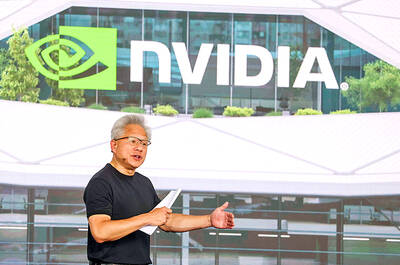
‘BOOMING’: ’ The number of partners we have here is incredible. You can see from their stock prices. They’re doing so well, they’re so happy,’ Jensen Huang said Nvidia Corp’s spending in Taiwan has ballooned to about US$150 billion a year, 10 times the US$10 billion to US$15 billion the company spent five years ago, Nvidia chief executive officer Jensen Huang (黃仁勳) said yesterday, suggesting Taiwan’s strategic importance in the global artificial intelligence (AI) supply chain. “Taiwan is the epicenter of the AI revolution. This is where the chips come, packaging comes. This is where the systems are made. This is where AI supercomputers were created,” Huang said at a meeting for the company’s employees in Beitou-Shilin Technology Park (北投士林科技園區) in Taipei, the planned site of Nvidia’s Taipei headquarters. “Taiwan
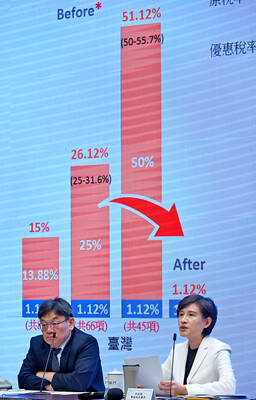
GREATER REACH? Auto parts and wood products would face tariffs of up to 15%, matching those targeting the EU, Japan and South Korea, Vice Premier said The US has announced that preferential tariff treatment for Taiwan’s non-semiconductor Section 232 goods would take effect retroactively from May 1, the Executive Yuan said yesterday. The US government yesterday posted a notice on the Federal Register’s public inspection Web site previewing tariff concessions for Taiwan under a memorandum of understanding (MOU) on Taiwan-US investment after two months of negotiations. The MOU signed on Jan. 15 stipulated three major preferential tariff arrangements: a 15 percent “reciprocal” tariff rate for Taiwan without stacking most-favored nation (MFN) rates; preferential Section 232 treatment for semiconductors and related products; and preferential Section 232 treatment for non-semiconductor


 RSS
RSS