


Amid political bickering and protests outside the Legislative Yuan, the pan-blue-dominated Procedure Committee yesterday once again struck down the NT$610.8 billion Special Arms Budget Statute, diminishing the ruling party's hope of pushing it to committee for review before the legislative elections next month.
People First Party (PFP) Legislator Nelson Ku (
Lee had accused Ku for being inconsistent in his stance on the arms procurement deal. Ku is one of the vehement opponents of the plan. Lee claimed that Ku was in favor of the project when he served as the commander-in-chief of the navy during his tenure of presidency.
Other pan-blue lawmakers, including Lin Hui-kuan (
Well aware of its numerical disadvantage, the ruling Democratic Progressive Party (DPP) withdrew from the meeting in protest of what it called the pan-blue camp's bullying behavior.
Rumor had it that the KMT caucus was going to allow its members to be absent from the meeting, in order to lower the number of pan-blue lawmakers in the Procedure Committee, thereby allowing the pan-green camp to push the arms statute to committee for review before the legislative elections.
But following the DPP's fifth failed attempt to make progress with the statute at the Procedure Committee yesterday, PFP caucus spokesperson Liu Wen-hsiung (
Aside from criticising the cost of the deal, the pan-blue caucuses object to the government's attempt to simultaneously propose both the statute that would make the special budget proposal legal and the budget plan itself.
The Executive Yuan, however, made it clear that it is impossible for the government to withdraw the budget request.
It also dismissed the pan-blue's allegation that the Cabinet violated the law by jointly presenting the draft bill and budget request to the legislature.
"It's a groundless accusation," said Cabinet Spokesman Chen Chi-mai (
"We proposed the draft bill and budget request in accordance with legislation and budget request procedures. Besides, it's not the first time we have proposed a bill and a budget request together," Chen said.

NO-LIMITS PARTNERSHIP: ‘The bottom line’ is that if the US were to have a conflict with China or Russia it would likely open up a second front with the other, a US senator said Beijing and Moscow could cooperate in a conflict over Taiwan, the top US intelligence chief told the US Senate this week. “We see China and Russia, for the first time, exercising together in relation to Taiwan and recognizing that this is a place where China definitely wants Russia to be working with them, and we see no reason why they wouldn’t,” US Director of National Intelligence Avril Haines told a US Senate Committee on Armed Services hearing on Thursday. US Senator Mike Rounds asked Haines about such a potential scenario. He also asked US Defense Intelligence Agency Director Lieutenant General Jeffrey Kruse

NOVEL METHODS: The PLA has adopted new approaches and recently conducted three combat readiness drills at night which included aircraft and ships, an official said Taiwan is monitoring China’s People’s Liberation Army (PLA) exercises for changes in their size or pattern as the nation prepares for president-elect William Lai’s (賴清德) inauguration on May 20, National Security Bureau (NSB) Director-General Tsai Ming-yen (蔡明彥) said yesterday. Tsai made the comment at a meeting of the Legislative Yuan’s Foreign Affairs and National Defense Committee, in response to Democratic Progressive Party (DPP) Legislator Wang Ting-yu’s (王定宇) questions. China continues to employ a carrot-and-stick approach, in which it applies pressure with “gray zone” tactics, while attempting to entice Taiwanese with perks, Tsai said. These actions aim to help Beijing look like it has
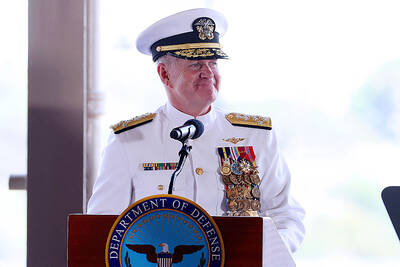
China’s intrusive and territorial claims in the Indo-Pacific region are “illegal, coercive, aggressive and deceptive,” new US Indo-Pacific Commander Admiral Samuel Paparo said on Friday, adding that he would continue working with allies and partners to keep the area free and open. Paparo made the remarks at a change-of-command ceremony at Joint Base Pearl Harbor-Hickam in Hawaii, where he took over the command from Admiral John Aquilino. “Our world faces a complex problem set in the troubling actions of the People’s Republic of China [PRC] and its rapid buildup of forces. We must be ready to answer the PRC’s increasingly intrusive and

INSPIRING: Taiwan has been a model in the Asia-Pacific region with its democratic transition, free and fair elections and open society, the vice president-elect said Taiwan can play a leadership role in the Asia-Pacific region, vice president-elect Hsiao Bi-khim (蕭美琴) told a forum in Taipei yesterday, highlighting the nation’s resilience in the face of geopolitical challenges. “Not only can Taiwan help, but Taiwan can lead ... not only can Taiwan play a leadership role, but Taiwan’s leadership is important to the world,” Hsiao told the annual forum hosted by the Center for Asia-Pacific Resilience and Innovation think tank. Hsiao thanked Taiwan’s international friends for their long-term support, citing the example of US President Joe Biden last month signing into law a bill to provide aid to Taiwan,


 RSS
RSS