


An earthquake may have killed as many as 10,000 people when it devastated a city in southeast Iran early yesterday, an Iranian legislator said after speaking to officials on the scene.
Hasan Khoshrou said a survey undertaken by helicopter indicated that over 60 percent of Bam's houses had been destroyed. The devastation was "beyond imagination," he reported local officials as telling him.
The earthquake of magnitude 6.3 hit Bam, a city of 80,000 people, at 5:28am Iranian time, state television reported. Its epicenter was outside Bam, which is about 1,000km southeast of the capital Tehran.
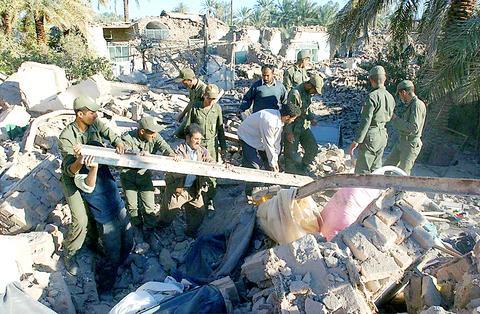
PHOTO: AP
"The quake hit the city when most of the people were in bed, raising fears that the death toll may go higher," said Khoshrou, who spoke from Kerman province. He is one of the province's representatives in parliament.
The governor of Kerman province, Mohammad Ali Karimi, said: "The death toll is very high."
"Many people are buried under the rubble," Karimi told state television. Later he told state radio: "We do not have any precise information. What is certain is that the old structure of the city has been totally destroyed."
Hardly any buildings in Iran are built to withstand earthquakes, although the country sits on several major faultlines and temblors are frequent.
A reporter for Turkey's private NTV channel said Bam looks as if it had been hit by a bomb.
"People are trying to pull bodies out of the rubble. All windows are smashed," said the reporter, who was in Bam.
"People have started walking toward Kerman -- many complaining of a lack of aid," the reporter said.
Kerman city is 190km northwest of Bam.
Iran's Red Crescent, the Islamic equivalent of the Red Cross, said rescue and relief teams had been sent to Bam from numerous provinces, including Tehran.
Grisly job
"We are doing everything we can to rescue the injured and unearth the dead," the television quoted Karimi as saying.
Relief teams set up their headquarters in a public square in Bam because their offices in the governor's building had been ruined, Karimi told state radio.
The citadel of Bam was destroyed, television reported. The oldest part of the fortress dates to about 2,000 years ago, but most was built in the 15th to 18th centuries. It attracts thousands of tourists a year.
"The historical quarter of the city has been completely destroyed and caused great human loss," said Mehran Nourbakhsh, chief spokesman for the Red Crescent.
"Authorities have demanded immediate blood donations to save the lives of those who have been admitted to hospital in the provincial capital of Kerman," the television newscaster said.
She added telephone links with Bam have been severed. Authorities were in contact with the Bam area through radio and satellite phone links. The official Islamic Republic News Agency (IRNA) quoted the Red Crescent's Nourbakhsh as saying water and electricity links to Bam had also been cut.
State media said the quake had also damaged towns and villages around Bam. Khoshrou said the population of the Bam region is about 230,000.
The quake had several aftershocks, one of magnitude 5.3, IRNA quoted the geophysics institute of Tehran University as saying.
In Iran, quakes of more than magnitude 5 usually kill people.
In Washington, the US Geological Survey reported the quake had a preliminary magnitude of 6.7.
Russian President Vladimir Putin sent his condolences to Iran and his government arranged for assistance. Emergency Situations Ministry spokeswoman Marina Ryklina said two transport aircraft bearing rescue workers and equipment were to fly to Iran later yesterday.
Aftershocks
In a second earthquake, a temblor of magnitude 4 rocked the west Iranian town of Masjid Soleiman at 8:10am yesterday, but no casualties were immediately reported, state television said. Masjid Soleiman is about 480km southwest of Tehran and about 950km northwest of Bam.
Iran has a history of earthquakes that kill thousands of people. In 1990, a temblor of magnitude 7.3 killed about 50,000 people in northwest Iran. In 1978, a quake of magnitude 7.7 killed about 25,000 people in northeast Iran.
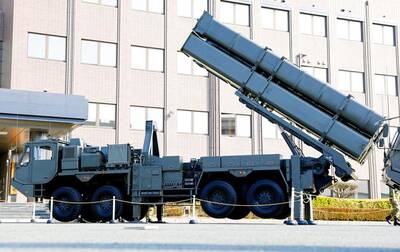
Japan has deployed long-range missiles in a southwestern region near China, the Japanese defense minister said yesterday, at a time when ties with Beijing are at their lowest in recent years. The missiles were installed in Kumamoto in the southern region of Kyushu, as Japan is attempting to shore up its military capacity as China steps up naval activity in the East China Sea. “Standoff defense capabilities enable us to counter the threat of enemy forces attempting to invade our country ... while ensuring the safety of our personnel,” Japanese Minister of Defense Shinjiro Koizumi said. “This is an extremely important initiative for

Chinese Nationalist Party (KMT) Chairwoman Cheng Li-wun (鄭麗文) today accepted an invitation from Chinese President Xi Jinping (習近平) to lead a delegation to China next month, saying she hopes to promote the peaceful development of cross-strait relations and bring stability to the Taiwan Strait. “I am grateful and happy to accept this invitation,” Cheng said in a statement from the KMT chairperson’s office. Cheng said she hopes both sides can work together to promote the peaceful development of cross-strait relations, enhance exchange and cooperation, bring stability to the Taiwan Strait and improve people’s livelihoods. At today's news conference, Cheng said any efforts to

MORE POPULAR: Taiwan Pass sales increased by 59 percent during the first quarter compared with the same period last year, the Tourism Administration said The Tourism Administration yesterday said that it has streamlined the Taiwan Pass, with two versions available for purchase beginning today. The tourism agency has made the pass available to international tourists since 2024, allowing them to access the high-speed rail, Taiwan Railway Corp services, four MRT systems and four Taiwan Tourist Shuttles. Previously, five types of Taiwan Pass were available, but some tourists have said that the offerings were too complicated. The agency said only two types of Taiwan Pass would be available, starting from a three-day pass with the high-speed rail and a three-day pass with Taiwan Railway Corp. The former costs NT$2,800

The nation’s fastest supercomputer, Nano 4 (晶創26), is scheduled to be launched in the third quarter, and would be used to train large language models in finance and national defense sectors, the National Center for High-Performance Computing (NCHC) said. The supercomputer, which would operate at about 86.05 petaflops, is being tested at a new cloud computing center in the Southern Taiwan Science Park in Tainan. The exterior of the server cabinet features chip circuitry patterns overlaid with a map of Taiwan, highlighting the nation’s central position in the semiconductor industry. The center also houses Taiwania 2, Taiwania 3, Forerunner 1 and


 RSS
RSS