


A small but growing movement in the US Congress to dump or redefine Washington's "one China" policy gained momentum on Tuesday with a group of House of Representatives members coming out in support of Taiwan independence and arguing that the country be admitted to the UN.
Representative Steve Chabot, a Republican and one of the four co-chairmen of the Congressional Taiwan Caucus, and Representative Robert Andrews, a Democrat and specialist in national security issues, along with other congressmen jointly introduced a resolution in the House on Tuesday, the day of the opening of the UN General Assembly in New York, calling for Taiwan's membership in the world body.
The resolution was introduced by Marilyn Musgrave and co-sponsored by 10 other congressmen.

PHOTO: CNA
It is the sense of the Congress that Taiwan and its 23 million people deserve full and equal membership in the UN and other international organizations, the resolution says, adding that the US should take a leading role in encouraging international support for Taiwan's participation in these organizations.
In an accompanying statement, Musgrave said it is unreasonable for the people of Taiwan to be excluded from full participation in international organizations.
"Denying Taiwan membership in the United Nations and other international organizations, such as the World Health Organization, is unacceptable," the congresswoman said.
Chabot and Andrews, in a seminar on `one China' sponsored by the conservative think tank the Heritage Foundation in Washington, argued that the US should recognize independence as official policy.
"`One China' is a fiction, and a dangerous fiction that most of the international community has bought into to mollify China," Chabot said. "It is clear to me, and should be clear to the administration, that while America might recognize `one China,' that `one China' does not include Taiwan."
Furthering democracy
Andrews urged Washington to pursue a policy of promoting democracy in China for America's long-term strategic interests, and said that, in furtherance of that goal, "the future of the people of Taiwan is the future of the people of the United States."
Likening the promotion of Chinese democracy to former president Ronald Reagan's "evil empire" speech that directed Washington to promote democracy and freedom in the then Soviet Union, Andrews said that "Taiwan is pivotal to that policy" for China.
"America is more secure when we're surrounded by democracies [such as Taiwan]," Andrews said.
The idea of scrapping the "one China" policy, which has guided American thinking on Taiwan since Washington established diplomatic relations with Beijing in 1979, has been pushed by a number of conservative Washington thinkers and some congressman for some time.
It gained visibility in June, when House majority leader Tom Delay appeared to call for its elimination in a speech to another conservative think tank, the American Enterprise Institute.
At that time, Delay called the possibility of a Chinese takeover of Taiwan "inconceivable," and labeled the `one China' policy as a "diplomatic contrivance."
"Some have wanted to transform this diplomatic nuance into a recognition of Beijing's territorial claim over Taiwan -- a recognition that has not and never will exist," he said.
In recent years, Chabot said, there has been an erosion of US support for Taiwan by a "thoughtless reverence for the shibboleth of `one China.'"
His remarks seemed to be a sign of a split in Republican ranks with the George W. Bush administration, which has reiterated its "one China" policy and reportedly told Chinese President Hu Jintao (胡錦濤) recently that Bush does not support Taiwan's independence.
However, Chabot said, he feels Bush "does not have any philosophical problems with the independence of Taiwan," and noted that Bush often refers to Taiwan as a "country."
Taiwan's rights
"As long as `one China' is not understood to mean that Taiwan is part of China, then I have no problem with it," Chabot said.
"But if carelessness or inattention to nuance or force of habit leads America's political leaders to the mistaken notion that Taiwan is part of China, then `one China' must be dumped, and the United States must declare that while we do not support Taiwan independence, nor do we have any philosophical problems with it," he said.
"If that's what the people of Taiwan want, they have every right to it."
Andrews echoed that sentiment.
"If the democratically elected government of Taiwan one day reaches an agreement, that it feels it is appropriate for its citizens, that results in Taiwan being part of an integrated China, we should recognize that agreement," he said.
"However, if such a move is not possible -- which today it's not -- or if it is rejected by the democratic leadership of Taiwan, then we should recognize Taiwan as a free and independent state, sovereign in its own determination," he said.
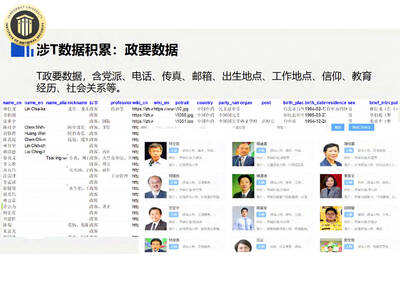
NETWORK-MAPPING PROJECT: The database contains 170 detailed files of Taiwanese politicians and about 23 million records of household registration data in Taiwan China has developed a network-mapping project targeting political figures and parties in Taiwan to monitor public opinion during elections and to craft tailored influence campaigns aimed at dividing Taiwanese society, according to documents leaked by Chinese technology firm GoLaxy (中科天璣). The documents, collected by Taipei-based Doublethink Lab, showed a database was specifically created to gather detailed information on Taiwanese political figures, including their political affiliations, job histories, birthplaces, residences, education, religion and a brief biography about them. Several notable Taiwanese politicians are in the database, including President William Lai (賴清德), former president Tsai Ing-wen (蔡英文), Minister of Foreign Affairs Lin Chia-lung (林佳龍),
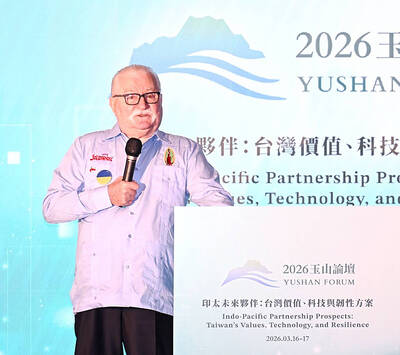
RECOGNITION: Former Fijian prime minister Mahendra Chaudhry said that Taiwan’s New Southbound Policy serves as a stabilizing force in the Indo-Pacific region Taiwan can lead the unification of the Chinese people, Nobel Peace Prize laureate and former Polish president Lech Walesa said in Taipei yesterday, adding that as the world order is changing, peaceful discussion would find good solutions, and that the use of force and coercion would always fail. Walesa made the remarks during his keynote address at a luncheon of the Yushan Forum in Taipei, titled “Indo-Pacific Partnership Prospects: Taiwan’s Values, Technology and Resilience,” organized by the Taiwan-Asia Exchange Foundation with the Ministry of Foreign Affairs. Walesa said that he had been at the forefront of a big peaceful revolution and “if
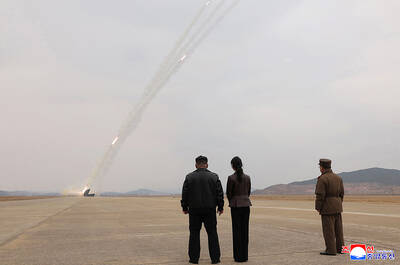
North Korea tested nuclear-capable rocket launchers, state media reported yesterday, a day after Seoul detected the launch of about 10 ballistic missiles. The test comes after South Korean and US forces launched their springtime military drills, due to run until Thursday. North Korean leader Kim Jong-un on Saturday oversaw the testing of the multiple rocket launcher system (MRLS), the Korean Central News Agency (KCNA) said. The test involved 12 600mm-caliber ultra-precision multiple rocket launchers and two artillery companies, it said. Kim said the drill gave Pyongyang’s enemies, within the 420km striking range, a sense of “uneasiness” and “a deep understanding

UPGRADED MISSILE: The Chungshan Institute of Science and Technology is reportedly to conduct a live-fire test of the Hsiung Feng III anti-ship missile on Thursday next week The US Army is planning to build new facilities to boost explosives production and strengthen its supply chain, a move aimed at addressing munitions shortages and supporting obligations to partners including Taiwan, Ukraine and Israel, Defense News reported. The army has issued a sources sought notice for a proposed Center of Excellence at the Blue Grass Army Depot in Kentucky, the report said. The facility would serve as a hub within the US industrial base for the production of key military explosives, including research department explosives (RDX) and high melting explosives (HMX), while also supporting research and development of next-generation materials. The proposed


 RSS
RSS