


President Chen Shui-bian (
The president also encouraged Taiwanese business leaders to follow the government's "go south" policy to invest in Southern Asian countries instead of becoming too reliant on the China market.
"It's good to create fortunes overseas, however, Taiwan's national security should be considered a priority and the public interest must be put first," Chen said when addressing at the opening of the ninth annual meeting of the Asian Taiwanese Chamber of Commerce.
"If our country is not secure, making more money doesn't mean anything," Chen told the group of business leaders.
Chen exhorted his audience to refrain from making themselves too reliant on China, saying that the China market is just one of a vast web of world markets they should be targeting.
"All Taiwanese businesspeople should map out a global strategy for developing the economy," Chen said. "The government will work devoutly behind everyone to jointly do our best under the `go south' policy to expand investments in Southeast Asian countries."
The president also expressed his admiration to those Asia-based Taiwanese business leaders who have staunchly supported the nation and the government's policies, urging them to continue doing so.
"I hope all of Taiwan's business-people will recognize that without Taiwan itself, there would be no Taiwanese businesspeople and that if Taiwan becomes strong, Taiwan's businesspeople will have a future on the international stage," he said.
Chen also took a shot at China, criticizing Beijing's moves to suppress Taiwan in the international community and its refusal to renounce the use of force against the country.
"Beijing has still not given any positive response to Taiwan's repeated demonstrations of goodwill over the past two years, therefore Taiwan should seriously consider going our own way and working to create our own future," Chen said.
Chen also called on the nation and on business leaders around the world to stop harboring any illusions about Beijing.
"No matter what, Taiwan can not downgrade itself to China," Chen said. "We should not have any illusions about seeking peace by stooping to compromise with China."
Chen reiterated that the government still expects to improve cross-strait relations and that it will never give up any opportunity that may lead to new possibilities in addressing the cross-strait stalemate.
"Taiwan needs to survive and develop, however, the other side of the Strait just wants to annex Taiwan," Chen said. "We cannot just keep silent when being bullied by others."
The ninth annual meeting of the Asian Taiwanese Chamber of Commerce began yesterday morning at the Sheraton Taipei with some 300 Taiwanese business delegates from Australia, New Zealand and eight other countries in Southeast Asia and Latin America participating.
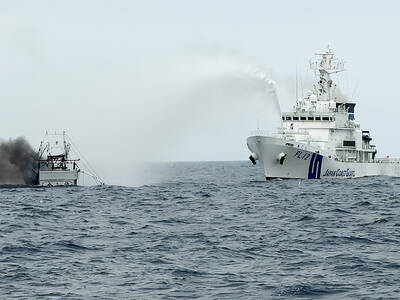
CREDIT-GRABBER: China said its coast guard rescued the crew of a fishing vessel that caught fire, who were actually rescued by a nearby Taiwanese boat and the CGA Maritime search and rescue operations do not have borders, and China should not use a shipwreck to infringe upon Taiwanese sovereignty, the Coast Guard Administration (CGA) said yesterday. The coast guard made the statement in response to the China Coast Guard (CCG) saying it saved a Taiwanese fishing boat. The Chuan Yu No. 6 (全漁6號), a fishing vessel registered in Keelung, on Thursday caught fire and sank in waters northeast of Diaoyutai Islands (釣魚台). The vessel left Keelung’s Badouzih Fishing Harbor (八斗子漁港) at 3:35pm on Sunday last week, with seven people on board — a 62-year-old Taiwanese captain surnamed Chang (張) and six
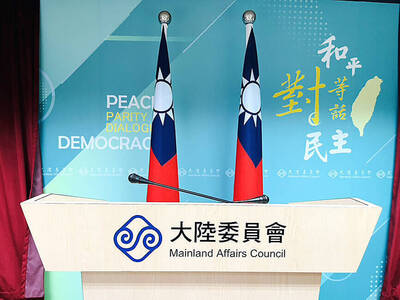
RISKY BUSINESS: The ‘incentives’ include initiatives that get suspended for no reason, creating uncertainty and resulting in considerable losses for Taiwanese, the MAC said China’s “incentives” failed to sway sentiment in Taiwan, as willingness to work in China hit a record low of 1.6 percent, a Ministry of Labor survey showed. The Directorate-General of Budget, Accounting and Statistics (DGBAS) also reported that the number of Taiwanese workers in China has nearly halved from a peak of 430,000 in 2012 to an estimated 231,000 in 2024. That marked a new low in the proportion of Taiwanese going abroad to work. The ministry’s annual survey on “Labor Life and Employment Status” includes questions respondents’ willingness to seek employment overseas. Willingness to work in China has steadily declined from

LEVERAGE: China did not ‘need to fire a shot’ to deny Taiwan airspace over Africa when it owns ‘half the continent’s debt,’ a US official said, calling it economic warfare The EU has raised concerns about overflight rights following the delay of President William Lai’s (賴清德) planned state visit to the Kingdom of Eswatini after three African nations denied overflight clearance for his charter at the last minute. Taiwanese allies Paraguay and Saint Kitts and Nevis, as well as several US lawmakers and the Inter-Parliamentary Alliance on China (IPAC) condemned China for allegedly pressuring the countries. Lai was scheduled to fly directly to Taiwan’s only African ally from yesterday to Sunday to celebrate the 40th anniversary of King Mswati III’s accession and his 58th birthday, but Seychelles, Mauritius and Madagascar suddenly revoked
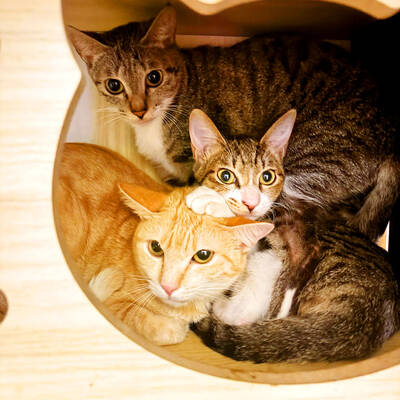
The number of pet cats in Taiwan surpassed that of pet dogs for the first time last year, reaching 1,742,033, a 32.8 percent increase from 2023, the Ministry of Agriculture said yesterday, citing a survey. By contrast, the number of pet dogs declined slightly by 1.2 percent over the same period to 1,462,528, the ministry said. Despite the shift, households with dogs still slightly outnumber those with cats by 1.2 percent. However, while the number of households with multiple dogs has remained relatively stable, households keeping more than two cats have increased, contributing to the overall rise in the feline population. The trend


 RSS
RSS