


Afghanistan's former king returned home yesterday after 29 years in exile, carrying hopes of a new beginning for his volatile nation on his frail shoulders.
The 87-year-old Mohammad Zahir Shah stepped onto a red carpet at Kabul Airport as an ordinary citizen, wearing a leather jacket, not a crown, and with no plans to reclaim his throne.
But his arrival shortly before noon immediately marked him out as the one figure able to heal ethnic and warlord divisions which could again return Afghanistan to a state of chaos.
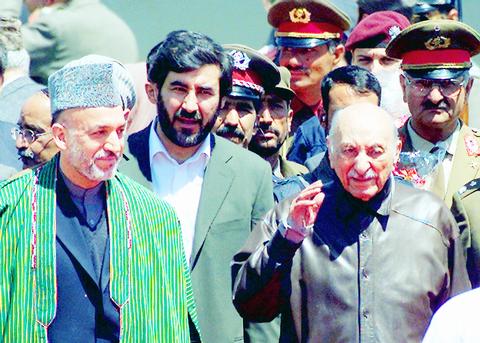
PHOTO: REUTERS
"If his return can bring unity among the various tribes, then he is more than welcome," said Ahmed Rashid as he watched the former king and his entourage speed from the airport to his new home in an exclusive Kabul suburb.
There was massive security around the two-story house, including international peacekeepers, armored cars and several dozen smartly-dressed Italian Carbineri, who travelled with him from Rome.
But not even Afghan guards at the house were overawed by the former king's return
"We don't have anything against him if he doesn't try to reinstate the monarchy," said one who did not want to give his name. "Any effort to sit on the throne again on his part will spark fighting and tension."
About 200 people, including some feuding warlords who attended as a symbol of their loyalty, cheered, applauded and thronged the former king as he stepped from an Italian C-130 aircraft.
The Zahir Shah, who still cuts a regal figure, was the first of his entourage of about 20 family members and retainers to leave the aircraft.
Afghan interim leader Hamid Karzai -- a distant cousin of the king and, like him, a Pashtun -- walked on one side of Zahir Shah. Abdul Rashid Dostum, the powerful Uzbek warlord from the north and once an opponent of the king, walked on the other.
Six government ministers went with Karzai to Rome to escort the former king home in a symbol that showed -- after delays caused by security fears -- that it was now safe to come back.
Young children presented flowers to a monarch described as an ascetic who ruled Afghanistan as a modernizer for 40 years until he was deposed by a cousin while on holiday in Italy in 1973.
Karzai has gambled that the monarch's return will help underpin a delicate balance of power which he has juggled since the fundamentalist Taliban were driven from power in December.
Ethnic Tajiks from the northern part of the country, who were in the forefront of the US-led war against the Taliban, control the powerful defense, interior and foreign ministries -- ?even though they are a minority.
The Pashtun majority, mainly from southern Afghanistan, hope the king can become a rallying figure for them, particularly at the loya jirga, or grand council, that will either endorse Karzai's Western-backed administration or choose a new government.
In a sign of the sensitivity of the king's return, there was no announcement on radio or television in the immediate hours after his return.
In Kabul, only at the airport and at one demonstration of support by about 1,000 people near the king's home were there flags and banners of welcome.
There was a bigger welcome for the king hundreds of miles from Kabul, along the Pakistan border where most Pashtuns live.
"I still don't believe the king has returned but I am so happy," said a cyclist with a photograph of the king fixed on his bike in Kandahar Province.
Old portraits of the king in military uniform adorned the walls of mud-built hotels and cafes in Kandahar, Takhta Pul, and Spinboldak across from the Pakistani border town of Chaman.
The majority of people living in the area belong to the king's Durrani tribe, a subset of Pashtuns.
But they were concerned about the king's safety in Kabul.
"He should settle in Kandahar where he will have his own Pashtun speaking people to protect him," one resident said.
The former king has said he will never leave Afghanistan once he returns. But he stepped onto home soil on a day of tragedy and violence.
In the eastern city of Khost, long a center of Taliban unrest, provincial officials said three Afghans died in a bomb attack on a busy market just hours before the king's arrival.
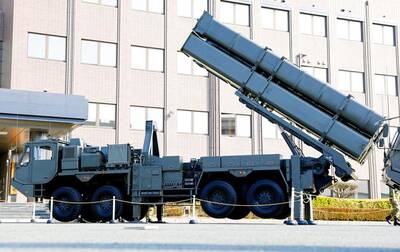
Japan has deployed long-range missiles in a southwestern region near China, the Japanese defense minister said yesterday, at a time when ties with Beijing are at their lowest in recent years. The missiles were installed in Kumamoto in the southern region of Kyushu, as Japan is attempting to shore up its military capacity as China steps up naval activity in the East China Sea. “Standoff defense capabilities enable us to counter the threat of enemy forces attempting to invade our country ... while ensuring the safety of our personnel,” Japanese Minister of Defense Shinjiro Koizumi said. “This is an extremely important initiative for
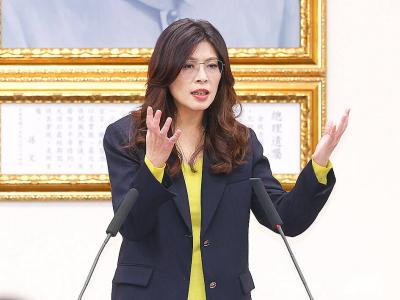
Chinese Nationalist Party (KMT) Chairwoman Cheng Li-wun (鄭麗文) today accepted an invitation from Chinese President Xi Jinping (習近平) to lead a delegation to China next month, saying she hopes to promote the peaceful development of cross-strait relations and bring stability to the Taiwan Strait. “I am grateful and happy to accept this invitation,” Cheng said in a statement from the KMT chairperson’s office. Cheng said she hopes both sides can work together to promote the peaceful development of cross-strait relations, enhance exchange and cooperation, bring stability to the Taiwan Strait and improve people’s livelihoods. At today's news conference, Cheng said any efforts to

MORE POPULAR: Taiwan Pass sales increased by 59 percent during the first quarter compared with the same period last year, the Tourism Administration said The Tourism Administration yesterday said that it has streamlined the Taiwan Pass, with two versions available for purchase beginning today. The tourism agency has made the pass available to international tourists since 2024, allowing them to access the high-speed rail, Taiwan Railway Corp services, four MRT systems and four Taiwan Tourist Shuttles. Previously, five types of Taiwan Pass were available, but some tourists have said that the offerings were too complicated. The agency said only two types of Taiwan Pass would be available, starting from a three-day pass with the high-speed rail and a three-day pass with Taiwan Railway Corp. The former costs NT$2,800

The nation’s fastest supercomputer, Nano 4 (晶創26), is scheduled to be launched in the third quarter, and would be used to train large language models in finance and national defense sectors, the National Center for High-Performance Computing (NCHC) said. The supercomputer, which would operate at about 86.05 petaflops, is being tested at a new cloud computing center in the Southern Taiwan Science Park in Tainan. The exterior of the server cabinet features chip circuitry patterns overlaid with a map of Taiwan, highlighting the nation’s central position in the semiconductor industry. The center also houses Taiwania 2, Taiwania 3, Forerunner 1 and


 RSS
RSS