


Prosecutors from the Taiwan High Court Prosecutors' Office raided the offices and printing plant of Next magazine and the apartment of one of its reporters yesterday morning, seizing thousands of copies of the latest edition of the magazine and accusing Next of leaking state secrets.
The magazine's management protested against the raids, saying they were a violation of press freedom. The controversial edition was later reprinted and delivered to newsstands last night.
Three prosecutors led the raids at 6:30am, confiscating 160,000 copies of Next edition No. 48, which contained stories about the alleged embezzlement of more than NT$192 million by former National Security Bureau (NSB) chief cashier Colonel Liu Kuan-chun (
The magazine's reports also allege that former president Lee Teng-hui (李登輝) sanctioned the establishment of two secret committees -- code-named Fengtien (奉天) and Dangyang (當陽) -- under the recommendation of then-NSB chief Ying Tsung-wen (殷宗文), to oversee a secret fund of about NT$3.5 billion, which was deposited at the Farmer's Bank of China (農民銀行).
The two committees were set up to handle secret diplomatic efforts and conduct diplomatic research.
According to Next, starting in 1994, Lee used the funds to prop up diplomatic relations with South Africa, pay for study on the "state-to-state" model of cross-strait relations announced in 1999, and established the Taiwan Research Institute (TRI, 台綜院).
"Some of the secret activities [Lee funded] contributed to Taiwan's national security, but they were in violation of the law," Next report said.
Shih Liang-po (施良波), spokesman for the Taiwan High Court Prosecutors' Office, which is in charge of investigating national security offenses, said the office received a report from the NSB accusing Next of violating Article 109 of the Criminal Code.
Article 109 states that disclosing or delivering a document, plan, information or other secret regarding the ROC's national defense is punishable by a term of imprisonment for not less than one year and not more than seven.
Next's executive editor Pei Wei (裴偉) rebuffed the NSB's allegations, noting that the China Times (中國時報) had already published information about the two secret accounts.
"It's ridiculous to seize the magazines and search our offices. This is a scandal under investigation and has nothing to do with national security," Pei told reporters.
"We will keep printing the magazine and try to deliver this edition to all newsstands on time."
"The NSB has been legalized for a long time, and its functions should be monitored by the legislature. But the bureau just used its money as it wanted. For instance, one member of the Mingte committee spent NT$70,000 to have a suit made and Tsai Ing-wen [蔡英文, current chairperson of the Mainland Affairs Council] received NT$120,000 as a New Year's gift in 2000," Pei said.
He declined to give any details about how the magazine got the information about the funds.
Magazine employees say they worked on the three stories for over a week and that most of the time was spent interviewing NSB officials.
"The pubic has the right to know and the prosecutors' searches violate the freedom of press," Pei said.
PFP .egislator Diane Lee (
"There should be a clear definition of national security before prosecutors search a magazine's premises," Lee said.
Minister of Justice Chen Ding-nan (陳定南) defended the prosecutors' actions yesterday.
"There should be certain limits on press freedom. News reports should not break the law and offices of newspapers should not be exempt from searches," Chen told reporters.
Meanwhile, the China Times said its source for its stories yesterday was Liu Kuan-chu.
The China Times yesterday published three full-pages of coverage of the documents, which they said were provided by the defected former NSB chief cashier Colonel Liu Kuan-chun (劉冠軍).
Liu fled the country in September 2000 with a fake passport and his whereabouts are unknown. He is wanted for embezzlement.
Prosecutors declined yesterday to say why they didn't search the newspaper's premises.
On March 5 the Control Yuan found a senior adviser to the president and the secretary general of the National Security Council (NSC), as well as four current and former senior NSB officials, guilty of dereliction of duty in their oversight in the handling of the secret bank account.
The NSB issued a news release after the announcement of the Control Yuan's verdicts yesterday. It stated that the NSB respected the verdicts and that the Liu case happened because "the NSB did not have a sound administrative mechanism to monitor the secret intelligence budget."

A signaling system malfunction disrupted high-speed rail (HSR) services beginning at 8am today, with trains temporarily reduced to three northbound and three southbound trains per hour as authorities conduct inspections. The malfunction occurred on a section of track in Miaoli County during pre-operation checks early this morning, forcing northbound and southbound trains to use a single track, the HSR operator said. The regular schedule has been replaced with three hourly trains offering only nonreserved seating in each direction, stopping at every station, it said, adding that business class cars would still have reserved seating. Departures from terminal stations are scheduled at the top

DRONE CENTRAL: Taiwan aims to become Asia’s democratic hub for drones, with most exports focused on high-quality military-grade models, an official said Taiwan’s drone industry is expected to expand significantly by 2030, producing 100,000 units per month and exporting half of them, the Ministry of Economic Affairs said yesterday. Current drone production capacity is about 15,000 units per month, but the industry can quickly scale up as demand increases, Industrial Development Administration Director-General Chiou Chyou-huey (邱求慧) told a news conference in Taipei. Taiwan’s drone output grew 2.5-fold last year to NT$12.9 billion (US$408.3 million) under a government program to develop the uncrewed vehicle sector, he said. The Executive Yuan in October last year approved plans to invest NT$44.2 billion into domestic production of uncrewed aerial
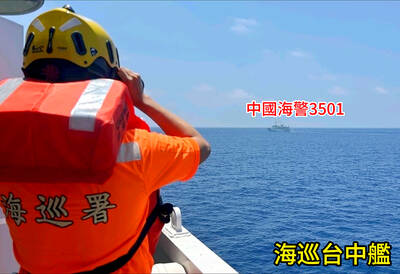
VERBOSE VESSELS: A CGA cutter and a China Coast Guard exchanged verbal barbs for more than a day in Taiwanese-controlled waters before the Chinese vessel left The Taiwanese and Chinese coast guards had a standoff near the strategically located Pratas Islands (Dongsha Islands, 東沙群島) in the north of the South China Sea, the Coast Guard Administration (CGA) said yesterday. The two sides engaged in intense radio exchanges over sovereignty claims during the 33-hour standoff. China Coast Guard vessel 3501 eventually left the restricted waters, 26.6 nautical miles (49.2km) west of the Pratas Islands, at 5pm yesterday, the CGA said. Lying approximately between southern Taiwan and Hong Kong, the Taiwan-controlled Pratas are seen by some security experts as vulnerable to Chinese attack due to their distance — more than
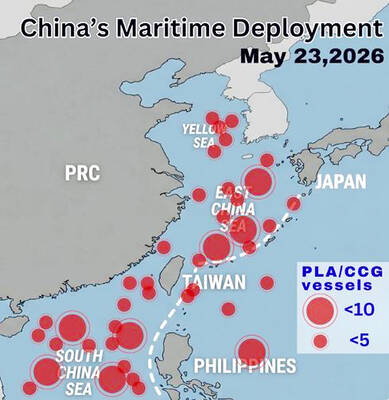
WARNING: China should stop engaging in actions that undermine regional peace and stability, as it would only build resentment among people across the Strait, the CGA said China has deployed more than 100 navy, coast guard and other vessels in waters from the Yellow Sea to the South China Sea and the western Pacific since US President Donald Trump and Chinese President Xi Jinping (習近平) met in Beijing, National Security Council Secretary-General Joseph Wu (吳釗燮) said yesterday. “In this part of the world, #China is the one & only PROBLEM wrecking the #StatusQuo & threatening regional peace & stability,” Wu wrote on X. In a separate post, he said Beijing was coercing Taiwan’s maritime domain, calling it illegal and provocative, after the Coast Guard Administration (CGA) expelled a


 RSS
RSS