


A maverick Chinese economist who is an outspoken critic of China's endemic corruption has fled to the US, fearing she was about to be arrested in a spreading crackdown on dissidents and scholars with ties to the West.
The economist, He Qinglian (
But, speaking by telephone Monday from a conference at American University in Washington, she said she left China instead on June 14, after security agents broke into her apartment in Shenzhen and seized documents, including invitations to academic conferences in the United States, Japan, Taiwan and Sweden.
Just two months earlier, she added, security agents had seized her cell phone and other personal effects, but not any cash or jewelry. And for the last year, ever since she was dismissed from her job as a writer for The Shenzhen Legal Daily, she said, the police had regularly followed her near her apartment building, and her phone and fax had been tapped.
Fearful of being arrested, she left her apartment on June 14 without any luggage and adhered to her usual routine -- except that instead of going to work she went to the bank, then to Baiyun Airport in Guangzhou for a flight to Beijing. She then flew to Singapore, and landed in the US on June 16.
"I was very worried that I would not be able to safely leave the country because they knew that I was going to the United States in two weeks," He said.
"I have decided to leave China for now; I don't know for how long."
In recent months China has arrested scores of dissidents, closed newspapers and fired outspoken editors in an accelerating effort to tighten control on public discourse.
And it has charged several visiting scholars with spying, including most recently a naturalized US citizen who had been teaching in Hong Kong and a permanent US resident who had been working as a researcher with American University in Washington.
Recent regulations allow the government to shut down publications that mention a broad range of subjects, including speculation on the country's coming leadership transition. Some people suggest that the government wants to avoid open debate ahead of the change.
President Jiang Zemin
Who fills their posts will be decided at the party's 16th Congress next year.
Some people say the crackdown is motivated by a growing fear of espionage by disaffected Chinese nationals in service to the US or Taiwan.
He, educated as an economist in Shanghai, made her name by publishing a book in 1998 titled China's Pitfalls, a pessimistic evaluation of the country's economic and political system as irretrievably corrupt. Nine publishers refused to publish the book until after it had been published in Hong Kong and won the praise of Liu Ji (劉吉), an academic who is one of Jiang Zemin's closest advisers.
Its subsequent mainland edition sold an estimated 170,000 copies, and 1 million more copies were sold in pirated editions. An essay about the book in The New York Review of Books brought He to the attention of Western journalists and academics, who have since often sought her comment on the Chinese economy.
But her attacks have been unrelenting, eroding the govern-ment's patience.
In March last year, she published a long analysis of the growing inequalities in Chinese society in a Changsha-based magazine, Reading Room.
The essay formed the core of a book that she later published under the title We Are All Still Gazing At The Stars."
The book included criticism of Jiang's three priorities for the party, the cornerstone of what he hopes will be his intellectual legacy. He says that the party should represent "the advanced forces of production, advanced culture and the interests of the grassroots." But He's book charged that the theory is really just an attempt to consolidate the power of the ruling elite.
The book was banned, and Reading Room's editor-in-chief and several other senior editors were also removed from their jobs.

‘NO SECURITY RISK’: The Railway Bureau reassured the public that the technicians’ activities were limited to technical guidance and did not involve sensitive systems The Railway Bureau yesterday said it had invited eight Chinese technicians to assist with an airport MRT construction project. The bureau issued the confirmation after an Internet user said Chinese nationals had entered the construction zone of Taiwan Taoyuan International Airport’s Terminal 3 project. They asked why “individuals from an enemy state” were allowed access to such a major national infrastructure project, which raised serious concerns over Taiwan’s industrial safety, sensitive systems and information security. The bureau’s Northern Region Engineering Branch Office said subcontractor Taiwan Handle Industrial Co (台灣手把工業) of the Taoyuan airport MRT’s “Contract No. CU05 Project A14 Station Civil, MEP &

A US uncrewed surface vessel (USV) encountered multiple Chinese warships during an autonomous transit of the Taiwan Strait, US defense company Seasats said in a statement on Wednesday. Seasats announced that a Lightfish USV had completed the first autonomous transit of the Taiwan Strait. Over five days, the USV traversed the entire length of the Strait while constantly monitoring surface vessel traffic, the company said. The Lightfish encountered multiple Chinese warships, one of which was a Chinese People’s Liberation Army Navy (PLAN) Type 056 corvette, it said. The Chinese vessels were operating “well within Taiwan’s exclusive economic zone without transmitting their identity via the
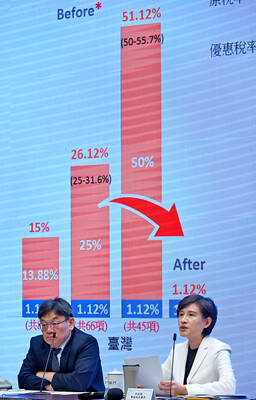
GREATER REACH? Auto parts and wood products would face tariffs of up to 15%, matching those targeting the EU, Japan and South Korea, Vice Premier said The US has announced that preferential tariff treatment for Taiwan’s non-semiconductor Section 232 goods would take effect retroactively from May 1, the Executive Yuan said yesterday. The US government yesterday posted a notice on the Federal Register’s public inspection Web site previewing tariff concessions for Taiwan under a memorandum of understanding (MOU) on Taiwan-US investment after two months of negotiations. The MOU signed on Jan. 15 stipulated three major preferential tariff arrangements: a 15 percent “reciprocal” tariff rate for Taiwan without stacking most-favored nation (MFN) rates; preferential Section 232 treatment for semiconductors and related products; and preferential Section 232 treatment for non-semiconductor

TIT-FOR-TAT: The US allegedly revoked the visa of a Chinese national working at Xinhua News Agency in the US in response to Beijing’s expulsion of Vivian Wang The Presidential Office yesterday condemned China for expelling a New York Times correspondent from Beijing following the newspaper’s interview with President William Lai (賴清德), saying the move highlighted Beijing’s suppression of press freedom and its threat to international news media. Taiwan has noted a series of recent incidents in which Beijing used similar tactics to “threaten and pressure international media outlets and journalists,” Presidential Office spokeswoman Karen Kuo (郭雅慧) said in a statement. “This concerns not only press freedom and freedom of expression, but also the safety of journalists, and Taiwan and relevant partners are paying close attention to the situation,” she


 RSS
RSS