


Russia's Mir space station plunged into the Pacific Ocean on Friday, spectacularly streaking over the islands of Fiji with a huge smoke trail after engineers ended the laboratory's "triumphant" 15-year mission.
Mission Control outside Moscow said a final signal at 1:07pm Taipei time switched on engines for a 20-minute burst that irrevocably altered the station's trajectory, pitching it into a designated splash-down in a remote part of the Pacific Ocean.
"We saw five or six fragments with a huge smoke trail that lasted for 10 to 15 seconds. [It was] followed some time later by a couple of sonic booms," said photographer Mark Baker in Nadi, Fiji.

PHOTO: REUTERS
"It was above our heads, below the clouds. It was a once in a lifetime experience."
In Canberra, Australian officials said they believed Mir ended up in an unpopulated part of the Pacific known as the "graveyard" some 3,000km southwest of Britain's Pitcairn Islands.
"It occurred in the exact area that the Russian space agency had predicted, between Australia and Chile," said Emergency Management Australia managing director David Templeman. "As far as we are aware, all the debris ended up in the graveyard area."
South Pacific nations had been on standby in case chunks hit land instead of water.
Across the globe at Mission Control, there were long faces as the reality hit home but pride in Russia's achievement at keeping Mir aloft three times longer than planned.
"Mir has completed its triumphant mission," said an announcer at Mission Control outside Moscow. "It was unprecedented in the history of space research."
The giant 136-tonne structure -- a collection of cylindrical modules sprouting a profusion of antennae and solar panels -- had been in orbit since 1986.
"Mir proved Russia cannot just build things but can operate them too," Russian Space Agency chief Yuri Koptev said. "It once again shows Russia is and will remain a space power."
Mir finally lost touch with Mission Control when the last communications window closed at 1:30pm Taipei time and screens showing data flickered into static. Mission Control showed archive footage on its main control room screen of Mir in orbit and later pictures of Mir crews and modules.
Chunks of the craft were expected to burn up on re-entry into the atmosphere but some 20-40 tonnes of metal were expected to splash into the sea around 2pm Taipei time.
Officials had said Mir, long the pride of Soviet and Russian space programs, would disappear from screens during the last 40 minutes. But they later cited US monitoring data.
Mir's demise caps 15 years of record-breaking but also an accident-prone career. Koptev said the mission had cost US$4.2 billion, not least because of constant running repairs in the past 18 months.
"Given the state of the station we are obliged to do this," Koptev said. "One should not see this in purely emotional terms."
Russia will now concentrate its efforts, and limited funds, on the US$95-billion International Space Station, which is a joint venture with the US, Canada, Europe and Japan.
Mir's recharged guidance systems maneuvered the craft into position before the first and second bursts were fired to slow the giant structure. They forced Mir to reduce its orbit until it could no longer resist the pull of earth's gravity.
The final burst tipped the craft on its way to oblivion.
The biggest man-made object to re-enter the atmosphere was expected to hurtle down at speeds fast enough to smash through 2m of reinforced concrete.

‘NO SECURITY RISK’: The Railway Bureau reassured the public that the technicians’ activities were limited to technical guidance and did not involve sensitive systems The Railway Bureau yesterday said it had invited eight Chinese technicians to assist with an airport MRT construction project. The bureau issued the confirmation after an Internet user said Chinese nationals had entered the construction zone of Taiwan Taoyuan International Airport’s Terminal 3 project. They asked why “individuals from an enemy state” were allowed access to such a major national infrastructure project, which raised serious concerns over Taiwan’s industrial safety, sensitive systems and information security. The bureau’s Northern Region Engineering Branch Office said subcontractor Taiwan Handle Industrial Co (台灣手把工業) of the Taoyuan airport MRT’s “Contract No. CU05 Project A14 Station Civil, MEP &

A US uncrewed surface vessel (USV) encountered multiple Chinese warships during an autonomous transit of the Taiwan Strait, US defense company Seasats said in a statement on Wednesday. Seasats announced that a Lightfish USV had completed the first autonomous transit of the Taiwan Strait. Over five days, the USV traversed the entire length of the Strait while constantly monitoring surface vessel traffic, the company said. The Lightfish encountered multiple Chinese warships, one of which was a Chinese People’s Liberation Army Navy (PLAN) Type 056 corvette, it said. The Chinese vessels were operating “well within Taiwan’s exclusive economic zone without transmitting their identity via the
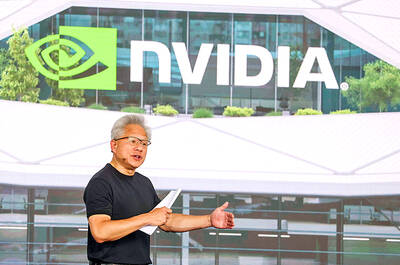
‘BOOMING’: ’ The number of partners we have here is incredible. You can see from their stock prices. They’re doing so well, they’re so happy,’ Jensen Huang said Nvidia Corp’s spending in Taiwan has ballooned to about US$150 billion a year, 10 times the US$10 billion to US$15 billion the company spent five years ago, Nvidia chief executive officer Jensen Huang (黃仁勳) said yesterday, suggesting Taiwan’s strategic importance in the global artificial intelligence (AI) supply chain. “Taiwan is the epicenter of the AI revolution. This is where the chips come, packaging comes. This is where the systems are made. This is where AI supercomputers were created,” Huang said at a meeting for the company’s employees in Beitou-Shilin Technology Park (北投士林科技園區) in Taipei, the planned site of Nvidia’s Taipei headquarters. “Taiwan
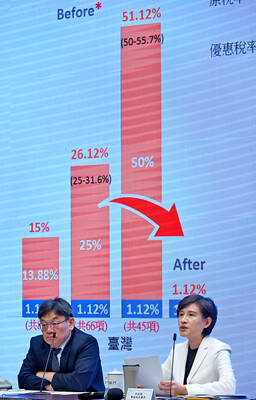
GREATER REACH? Auto parts and wood products would face tariffs of up to 15%, matching those targeting the EU, Japan and South Korea, Vice Premier said The US has announced that preferential tariff treatment for Taiwan’s non-semiconductor Section 232 goods would take effect retroactively from May 1, the Executive Yuan said yesterday. The US government yesterday posted a notice on the Federal Register’s public inspection Web site previewing tariff concessions for Taiwan under a memorandum of understanding (MOU) on Taiwan-US investment after two months of negotiations. The MOU signed on Jan. 15 stipulated three major preferential tariff arrangements: a 15 percent “reciprocal” tariff rate for Taiwan without stacking most-favored nation (MFN) rates; preferential Section 232 treatment for semiconductors and related products; and preferential Section 232 treatment for non-semiconductor


 RSS
RSS