


The state's highest watchdog, the Control Yuan, yesterday approved the findings of an investigative report and cleared once and for all the name of the late General Sun Li-jen (孫立人), who lived between 1900 and 1990.
The report commissioned by the Control Yuan and conducted by Chu Hong-yuan (
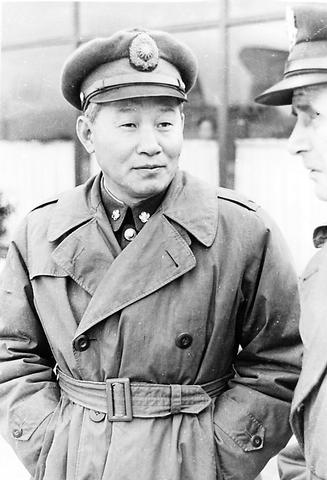
PHOTO: CNA
"The official confirmation of Sun's innocence might remind the nation of Sun's contribution to the modernization of Taiwan's army. His loyalty to the country may also be of great significance in our time," Chu said.
The famous Sun Li-jen case dates from May 1955 when Major Kuo Ting-liang (
More than 300 people were implicated in the case and more than 30 of them were sentenced to prison terms or death.
Some accounts of the story say the Virginia Military Institute-educated Sun was backed by the US in a plot to launch a coup, while some suggest Sun's fall was the result of a struggle between a pro-American faction and Chiang's faction in the army.
But Chu, in an interview with the Taipei Times, disagreed with such accounts. He said Sun was a patriot and was not pro-American.
He said according to his research Sun was purged by intelligence agents of Chiang Ching-kuo (
But the background to the Sun case was not covered in the Control Yuan report, Chu said. The report focused on the coup allegation against Sun.
The report also says that "no evidence has proved Kuo Ting-liang was a Communist spy" and "it has been proved Kuo did not conduct an act of subversion."
Kuo died in 1991 and the Control Yuan report raises doubts about the official account of his death.
The official story is that he jumped from a moving train. But according to Chu's investigation, Kuo was murdered by being hit on the head with a blunt object.
Kuo died shortly after he started to campaign against what he said was a gross miscarriage of justice.
The report also listed several suspicious points regarding Kuo's part in the case.
Kuo's sentence for the "communist spy" conviction was reduced from death to life imprisonment and then to 15 years, and the state's financial support for him and his family had been generous, the report says.
A five-member Control Yuan investigation team had produced in 1995 a report pointing to Sun's innocence.
But the document was covered up and kept secret until Chu recovered it last year.
The government at the time instead adopted another report conducted by a nine-member investigation team that was headed by then vice president Chen Cheng (陳誠), which claimed Sun was guilty.
In a note attached to the new report released yesterday, Control Yuan members praised the five former members of the Control Yuan for the courage and impartiality with which they conducted their report during an authoritarian era.
After Chiang Ching-kuo's death in 1988, however, the Control Yuan decided to re-investigate Sun's case.
Only two months later, on March 20, the government officially announced that Sun was a free man.
On Nov. 19, 1990, Sun died at his house in Taichung.
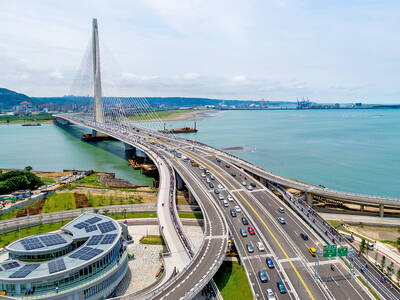
The Ministry of Transportation and Communications yesterday inaugurated the Danjiang Bridge across the Tamsui River in New Taipei City, saying that the structure would be an architectural icon and traffic artery for Taiwan. Feted as a major engineering achievement, the Danjiang Bridge is 920m long, 211m tall at the top of its pylon, and is the longest single-pylon asymmetric cable-stayed bridge in the world, the government’s Web site for the structure said. It was designed by late Iraqi-British architect Zaha Hadid. The structure, with a maximum deck of 70m, accommodates road and light rail traffic, and affords a 200m navigation channel for boats,
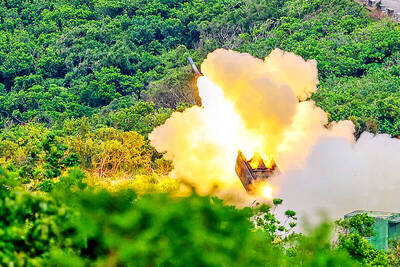
PRECISION STRIKES: The most significant reason to deploy HIMARS to outlying islands is to establish a ‘dead zone’ that the PLA would not dare enter, a source said A High Mobility Artillery Rocket System (HIMARS) would be deployed to Penghu County and Dongyin Island (東引) in Lienchiang County (Matsu) to force the Chinese military to retreat at least 100km from the coastline, a military source said yesterday. Taiwan has been procuring HIMARS and Army Tactical Missile Systems (ATACMS) from the US in batches. Once all batches have been delivered, Taiwan would possess 111 HIMARS units and 504 ATACMS, which have a range of 300km. Considering that “offense is the best defense,” the military plans to forward-deploy the systems to outlying islands such as Penghu and Dongyin so that
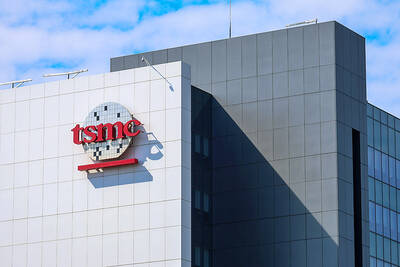
Taiwan Semiconductor Manufacturing Co (TSMC, 台積電), the world’s largest foundry service provider, yesterday said that global semiconductor revenue is projected to hit US$1.5 trillion in 2030, after the figure exceeds US$1 trillion this year, as artificial intelligence (AI) demand boosts consumption of token and compute power. “We are still at the beginning of the AI revolution, but we already see a significant impact across the whole semiconductor ecosystem,” TSMC deputy cochief operating officer Kevin Zhang (張曉強) said at the company’s annual technology symposium in Hsinchu City. “It is fair to say that in the past decade, smartphones and other mobile devices were
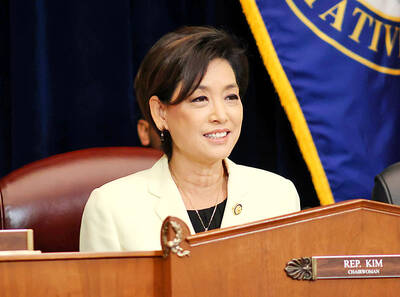
‘CLEAR MESSAGE’: The bill would set up an interagency ‘tiger team’ to review sanctions tools and other economic options to help deter any Chinese aggression toward Taiwan US Representative Young Kim has introduced a bill to deter Chinese aggression against Taiwan, calling for an interagency “tiger team” to preplan coordinated sanctions and economic measures in response to possible Chinese military or political action against Taiwan. “[Chinese President] Xi Jinping [習近平] has directed the People’s Liberation Army to be ready to invade Taiwan by 2027. China has a plan. America should have one too,” Kim said in a news release on Thursday last week. She introduced the “Deter PRC [People’s Republic of China] aggression against Taiwan act” to “ensure the US has a coordinated sanctions strategy ready should


 RSS
RSS