


Typhoon Xangsane whirled away from Taiwan and closer to southern Japan yesterday, leaving 53 dead and 10 missing in the island's worst flooding in three decades, officials said.
Xangsane was weakening to a tropical storm with winds below 118kph and located in the East China Sea as it moved toward Okinawa, Japan, the Central Weather Bureau said.
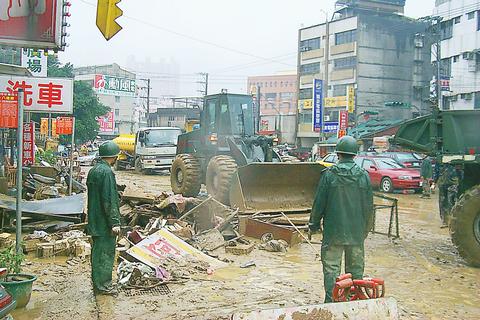
PHOTO: TSENG TEH-FENG
Taiwan experienced the worst flooding in 30 years as Xangsane swept across the northern part of the island, the government disaster relief center said in a report.
In the city of Keelung, 15 people were drowned as they prayed while trapped in the basement of a Buddhist temple. Fourteen people drowned in a home for senior citizens while waiting for rescue workers, local media reported.
The National Fire Administration, which handles search and rescue operations, said 23 sailors on a Panamanian-registered freighter were feared dead after their ship sank off northern Taiwan in the stormy weather.
There were 12 Filipinos and 12 Indonesians onboard but only one Indonesian seaman swam ashore. Two helicopter searches yesterday failed to turn up any more survivors and a rescue ship had been sent to the area, the administration said in a statement.
In Taipei City, flooding was reported in 57 locations despite the fact that all of the city's pumping stations were operating at full capacity during and after the storm, officials said.
Preliminary estimates made by the Council of Agriculture put the total damage caused by the typhoon at about NT$2 billion (US$61.73 million). Most of the damage was to fish ponds, farmland, and fruit orchards due to flooding or landslides.
Of the 19 counties and cities affected by the typhoon, Pingtung and Kaohsiung counties are entitled to apply for government cash aid to help farmers restore production. The counties of Taichung, Changhwa, Tainan, Taitung, and Hualien are entitled to apply for low-interest loans for similar relief.
State utility firms yesterday were still trying to restore electricity to 149,112 households across the island and water for 123,330 others.
Meanwhile, divers and rescue workers were working yesterday to pick up residents stranded near their half-submerged houses and cars. Residents also were searching through mud in their neighborhoods for their belongings that were swept away.
Packing winds of up to 145kph, the center of the typhoon hit Taiwan early Wednesday and stuck close to the eastern coast as it moved north. By late Wednesday, Xangsane -- a word that means ``elephant'' in Lao -- moved away from the island.
In Keelung, river dikes collapsed and wooden fishing boats remained moored in the harbor. Roads were blocked by mud and silt in the city's worst flooding in nearly eight years, local officials said.
International flights were canceled from Kaohsiung to the Philippines -- where the typhoon struck before reaching Taiwan, killing 26 people, leaving 50 missing and damaging property and crops worth US$17 million.
Taiwan may not be out of the woods just yet, however.
Typhoon Bebinca battered several eastern Philippine provinces with winds of up 160km yesterday, officials said.
By late afternoon yesterday, Bebinca was in the vicinity of Camarines Norte Province, about 220km east of Manila, with sustained winds increasing from 120kph around noon to 130kph.
It also gained speed, traveling 22kph westward, and was expected to pass about 260km northwest of metropolitan Manila yesterday afternoon, the weather bureau said.

‘NO SECURITY RISK’: The Railway Bureau reassured the public that the technicians’ activities were limited to technical guidance and did not involve sensitive systems The Railway Bureau yesterday said it had invited eight Chinese technicians to assist with an airport MRT construction project. The bureau issued the confirmation after an Internet user said Chinese nationals had entered the construction zone of Taiwan Taoyuan International Airport’s Terminal 3 project. They asked why “individuals from an enemy state” were allowed access to such a major national infrastructure project, which raised serious concerns over Taiwan’s industrial safety, sensitive systems and information security. The bureau’s Northern Region Engineering Branch Office said subcontractor Taiwan Handle Industrial Co (台灣手把工業) of the Taoyuan airport MRT’s “Contract No. CU05 Project A14 Station Civil, MEP &

The National Chungshan Institute of Science and Technology yesterday showcased its locally developed variants of the Vision 60 robotic patrol dog, which it plans to deploy on the nation’s outlying territories in the South China Sea. The variants were produced under the Joint Lab project — created by the institute and domestic companies — and assembled with domestically produced motors, lenses and artificial intelligence (AI) systems alongside licensed tech from the US, Missile and Rocket Systems Research Division deputy director Jen Kuo-kang (任國光) told the media event at a military base in Taipei’s Dazhi (大直) area. Taiwan has built up its strengths

TIT-FOR-TAT: The US allegedly revoked the visa of a Chinese national working at Xinhua News Agency in the US in response to Beijing’s expulsion of Vivian Wang The Presidential Office yesterday condemned China for expelling a New York Times correspondent from Beijing following the newspaper’s interview with President William Lai (賴清德), saying the move highlighted Beijing’s suppression of press freedom and its threat to international news media. Taiwan has noted a series of recent incidents in which Beijing used similar tactics to “threaten and pressure international media outlets and journalists,” Presidential Office spokeswoman Karen Kuo (郭雅慧) said in a statement. “This concerns not only press freedom and freedom of expression, but also the safety of journalists, and Taiwan and relevant partners are paying close attention to the situation,” she

NOT IMMEDIATE: Taiwan has a chance to appeal the proposed 10 percent tariff before it starts, while other countries face a 12.5 percent tariff from the trade office Taiwan is among 60 economies determined by the US to have failed to impose or enforce a ban on the importation of goods produced with forced labor, according to a notice released on Tuesday by the Office of the US Trade Representative (USTR), which proposed imposing an additional 10 percent or more tariff on them. The USTR in a statement said that following an investigation, it had determined under Section 301 of the Trade Act of 1974 that the failure of the 60 economies to impose and effectively enforce a prohibition on the importation of goods produced with forced labor is


 RSS
RSS