

Oct. 19 to Oct 25
For many in Hsinchu, the cold, dry October winds bring uncomfortable weather. But in the past, rice noodle makers waited all year for these winds. Laid out on bamboo racks by the Keya River (客雅溪), freshly made noodles dried in the wind without compromising their quality or texture.
The ideal conditions, it was once said, were 70 percent wind and 30 percent sun.
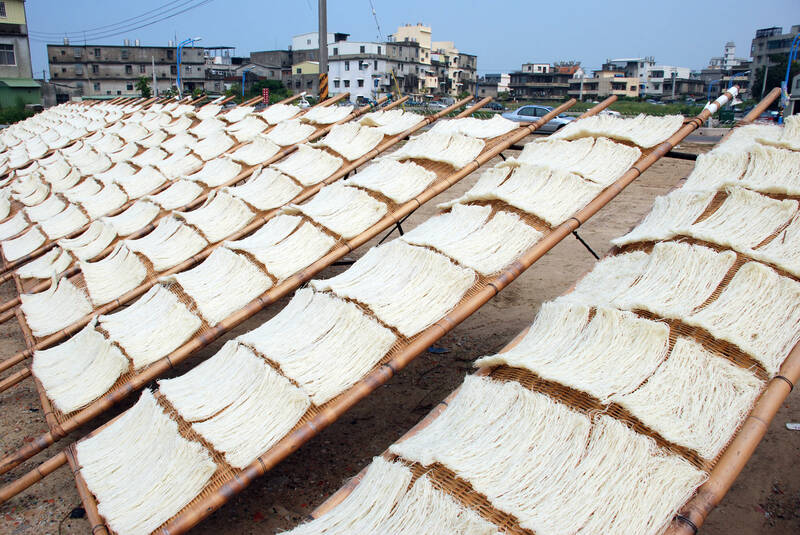
Photo: CNA
Most producers were concentrated in the Nanshih (南勢) area, which became known as Mifenliao (米粉寮, literally “rice noodle shed”). The work in the early days was entirely manual and physically grueling, often starting at 2am and lasting until 4pm. Women were reluctant to marry into rice noodle-making families, and some who did eventually ran away. Yet there were those who made a fortune in the trade.
While Hsinchu’s rice noodles were already renowned during the Japanese era, the industry surged after World War II as fierce local competition led vendors to try selling their goods in other parts of Taiwan, where they proved unexpectedly popular.
To meet rising demand, manufacturers improved their machinery, rapidly boosting production. A machine-drying method introduced in the 1970s replaced traditional wind-drying, allowing the industry to later expand overseas to the US, Japan, Europe and Southeast Asia. The innovative machines also attracted interest from foreign noodle manufacturers.
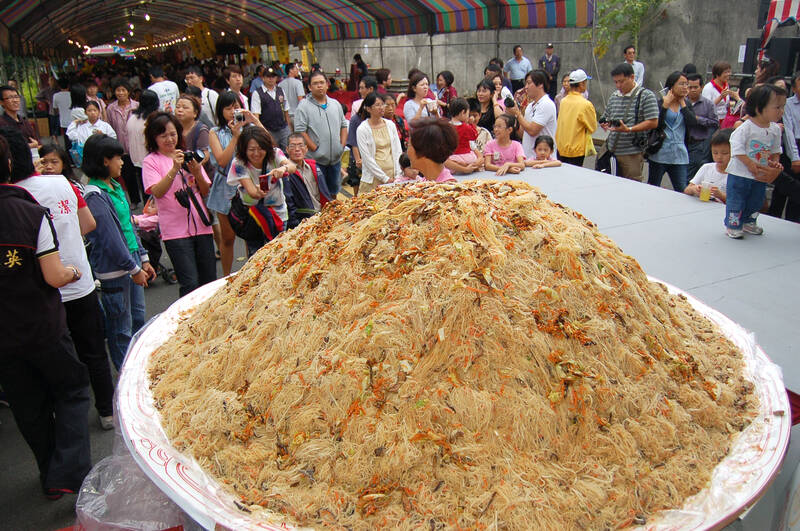
Photo: Chen Wei-jen, Taipei Times
Larger factories became so efficient that smaller operations struggled to compete and were forced to shut down. It also became increasingly difficult to hire workers. As manufacturers increasingly added corn flour to cut costs, the traditional industry began to decline in the 1980s. A few producers, however, still insist on making rice noodles entirely from rice and drying them in the wind.
WAITING FOR THE WIND
Hsinchu’s funnel-shaped plain and its location in the rain shadow of the Xueshan Range bring strong, dry northeast monsoon winds, creating ideal conditions for quickly drying rice noodles. If the wind is too warm or the sun too strong, the resulting heat and moisture can cause the noodles to deteriorate, forming a thick film on the surface or making them brittle and unpleasant in texture, according to The History of Hsinchu’s Rice Noodle Industry (新竹米粉產業史).
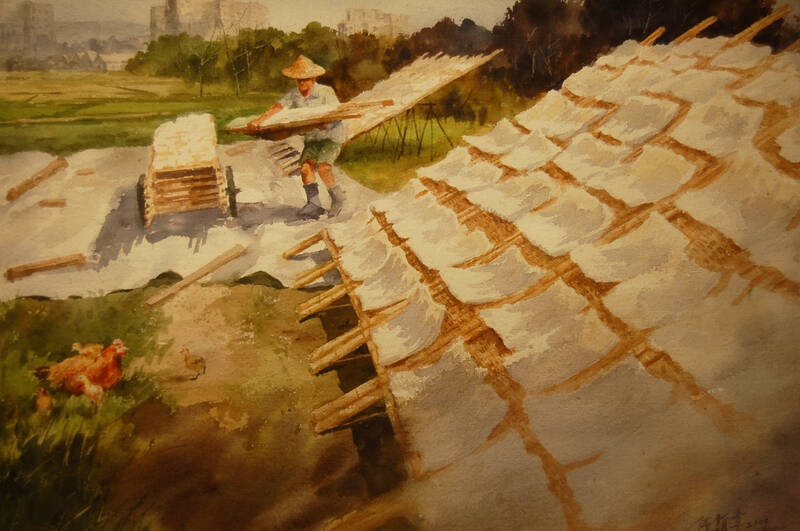
Photo: Chen Wei-jen, Taipei Times
During winter, makers could even dry noodles at night when orders piled up. They often kept watch over the noodles, using bamboo baskets to block some of the wind and sleeping in cloth sacks to keep warm.
Settlers from Huian (惠安) in China’s Fujian Province were already familiar with rice noodle-making techniques when they arrived in Hsinchu during the Qing Dynasty. Rice noodles were usually served at banquets and festivities, as they took less time to cook and were easier to transport than rice.
The process was arduous from start to finish and required specific varieties of long-grain Zailai rice (在來米), as the more commonly eaten Penglai rice was too sticky. Entire families took part, from washing and grinding the grains to mixing the flour into dough, cooking it, and then slicing and separating it into strips. Producers typically carried the noodles to the river for drying in large bamboo baskets balanced on their heads, walking barefoot on the rocky banks.
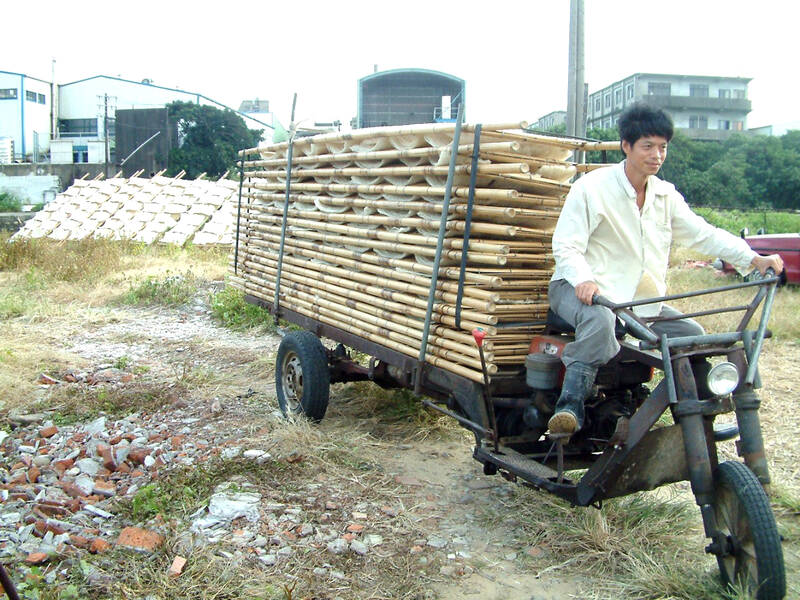
Photo courtesy of Hsinchu City Government
A producer recalled in The History of Hsinchu’s Rice Noodle Industry that they rarely got to eat the noodles themselves, especially when prices were high. There was little time for socializing, and some left the house only to recruit workers.
EVOLVING INDUSTRY
The noodles sold then differed from those sold today: they were thicker and boiled during production. In the 1910s, Kuo Shu (郭樹) traveled to Huian to learn a method that steamed the noodles instead, saving water and time. The thinner, springier noodles could be eaten fresh or dried in the wind for preservation and transport. They did not require such strong winds and soon became the area’s signature product.
During the 1940s, producers began using machines to reduce manual labor, but the work was still intensive. Many tried to save up and buy land so they could rent it to farmers and eventually switch to another profession.
With the economy in tatters after World War II, many Nanshih locals returned home to make or sell rice noodles, ushering in an era of many changes.
Kuo Chih (郭池) pioneered a system that allowed other rice noodle makers to use the machinery at his rice mill for certain stages of the process, helping mechanization spread throughout the industry.
Tseng Ching-fu (曾景福), who had trained and worked as a machinist, returned to the family business but struggled to find workers. In 1957, he cofounded a factory specializing in rice noodle-making machines. He developed a belt-and-gear system that could be powered by a single three-horsepower motor and became the main supplier of machinery to Nanshih producers.
Tseng Chi-fu (曾吉甫) got his start carrying 70 to 80kg of rice noodles, duck eggs and straw shoes on his back to nearby communities twice a day. After World War II, Tseng and his son began marketing the noodles in Keelung and Taipei, to surprising success. They acquired 20 small producers and expanded sales across Taiwan, helping bring Hsinchu rice noodles to national prominence. They entered the international market in the 1970s.
FADING TRADITIONS
The industry reached its peak in the 1960s, with more than 100 factories in Nanshih and the surrounding area. However, competition between producers led to rapid improvements in machinery, greatly increasing output over the following decades. By the 1970s, traditional family operations could no longer compete.
Rising rice prices in the 1970s also prompted some manufacturers to mix cheaper corn flour into the rice noodles. At first, they added only a little, but the proportion kept increasing, with some “rice noodles” made entirely from corn.
By the 1980s, Lin Yung-chih (林永志) had spent more than a decade tinkering with the machinery, testing his designs at his uncle’s Kuo Wei’s (郭煒) factory before placing them on the market. He eventually developed an integrated production system that streamlined the entire process.
This gave larger factories a further advantage, forcing many small and medium-sized producers to shut down, reshaping Nanshih’s once-thriving rice noodle trade.
Taiwan in Time, a column about Taiwan’s history that is published every Sunday, spotlights important or interesting events around the nation that either have anniversaries this week or are tied to current events.
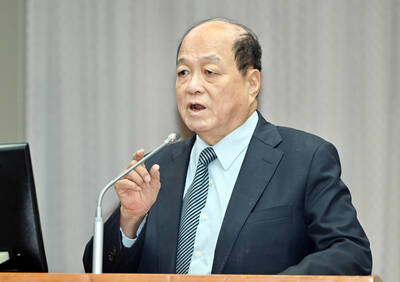
The Nuclear Safety Commission (NSC, 核安會) on Sept. 24 approved the re-operation plan that Taiwan Power Co (Taipower, 台電) filed in March for the Ma-anshan Nuclear Power Plant in Pingtung County, after three rounds of review and 589 comments. Taipower now has to carry out the work in the plan and its own inspections on ageing, radiation and seismic resistance, then report back to the commission for review and on-site checks. Minister of Economic Affairs Kung Ming-hsin (龔明鑫) has named 2028 as the earliest restart. The NSC has given no date. THE DEBATE No challenge has been identified as to whether Ma-anshan
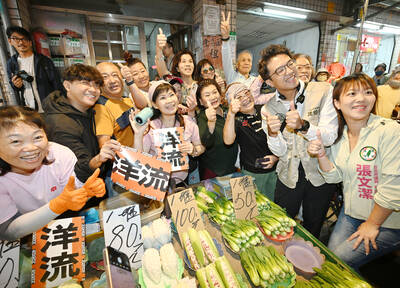
Cognitive warfare, says the Ministry of National Defense (MND), is the People’s Republic of China’s (PRC) use of “political, economic, cultural, military and legal means, with the intent to divide internal unity and undermine social stability” in Taiwan. Last week offered several examples. PRC media in October last year reported that the Chongqing Municipal Public Security Bureau had opened an investigation into Democratic Progressive Party (DPP) Legislator Puma Shen (沈伯洋), the DPP’s mayoral candidate for Taipei in next month’s election, for “Taiwan independence” activities. This was a cognitive warfare ploy, designed to unsettle the targeted person and to establish the idea
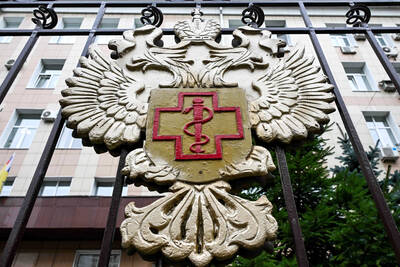
In pandemic preparedness work, scientists like to focus on the technical challenges: identifying pathogens, diagnosing infections, understanding their effects and developing vaccines and treatments. Each step promises progress through human innovation, investment and planning. The WHO, for example, brings experts together to identify and prioritize emerging disease threats and collect the evidence needed to prepare for them. But preparedness depends on more than scientific innovation. As the past week has shown, politics is the elephant in the room in all of this. No one could have predicted we would be talking about pneumonic plague, and that the death of a single
The South China Morning Post (SCMP) article from earlier this month on how Beijing would govern a post-annexation Taiwan (Amber Wang, “Beijing’s policy advisers map out how post-reunification Taiwan could be governed,” Oct. 6, 2026) is a reminder that even “peaceful” (coerced) occupation by the People’s Republic of China (PRC) will beggar Taiwan. The “scholars” cited in the SCMP piece argued that Taiwan would be governed in a manner similar to Hong Kong. As I observed in my piece for Monday (“Beijing’s intimidation tactics in Taiwan and beyond,” Oct. 12, 2026), that claim is simply a form of cognitive warfare. One


 RSS
RSS