

Just 10 years ago, the site of Shuanghu Forest Park (雙湖森林公園) was a blight on the Kaohsiung landscape. Motorists on the nearby freeway were treated to a view of a weedy hill covered in scattered graves, with a few corrugated steel buildings thrown in for good measure. Things got worse before they got better.
It was decided to turn this public land into a park, but in order for that to happen, all the human remains had to be moved and the existing mess of weeds and patchy tree growth had to be landscaped. After nearly 30,000 burials were relocated to a nearby columbarium, the whole area was razed clean and the new park laid out. Old photos from 2018 show what looks like a desert landscape of bare earth, the unsightly chrysalis of the beautifully landscaped park that is still emerging today.
Thousands of trees were planted, and detention ponds were created, both for flood protection and to create a water ecosystem. Last year, as part of a major upgrade, nectar-producing plants were added to encourage butterflies to settle here, and even more trees were planted. Frogs, dragonflies and several butterfly species now call this place home, and there is more and more shade among the maturing trees.
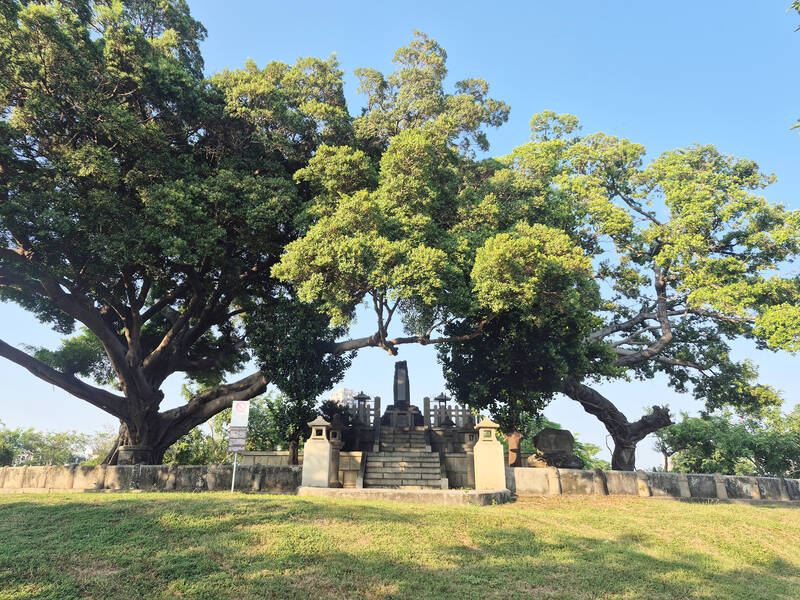
Photo by Tyler Cottenie
Lastly, the entire slope leading up to the adjacent Kaohsiung Green Park, formerly the site of a golf course, has been transformed. Where a mishmash of tombs once lay, terraced pathways now run along the length of the hill, adorned with rows of trees, including Taiwanese golden rain trees, currently displaying their gorgeous pink fall color.
WALK, RUN, CLIMB
There are a few benches scattered throughout, but the park is, above all, a place for walking or jogging. If you want a large open space where you can sit down for a picnic or to let children run around, take a walk through Shuanghu Forest Park first and then hike up the hill along one of three trails to Kaohsiung Green Park for its open, grassy spaces.
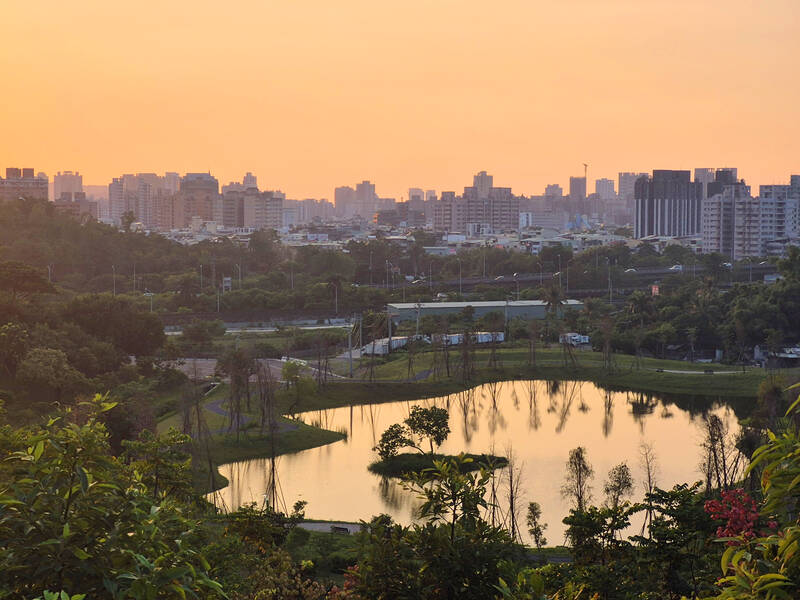
Photo by Tyler Cottenie
Dingjin 1st Lane runs right through the length of the park from south to north and is its main transportation artery. It was recently widened and paved with asphalt, so it is also a nice lane for walking, especially thanks to the ample shade from the trees on either side.
Alongside Dingjin 1st Lane itself, there are five smaller parking lots, with spaces for cars and/or scooters. Right across from the first parking lot at the south end is the site of the Islamic burial section in the old cemetery. This was the last section to be cleared out, as the remains could not be cremated and moved to a columbarium, but had to await the opening of a new cemetery in far-away Shanlin District (杉林區) before they could be moved. Nowadays, the area is newly landscaped and there is no hint of its former function.
Wherever you start your walk in the park, check out one of the signs in these parking lots if you need a quick overview of the park’s layout. The “Sunset Walkway” is not a single trail but the interconnected walkways on the terraces going up the hill to Kaohsiung Green Park. These provide the best view of the surrounding city by far and are west-facing so they are a perfect spot to end your day around sunset. The “Green Hiking Trails” are newly built connectors providing access to Kaohsiung Green Park above.
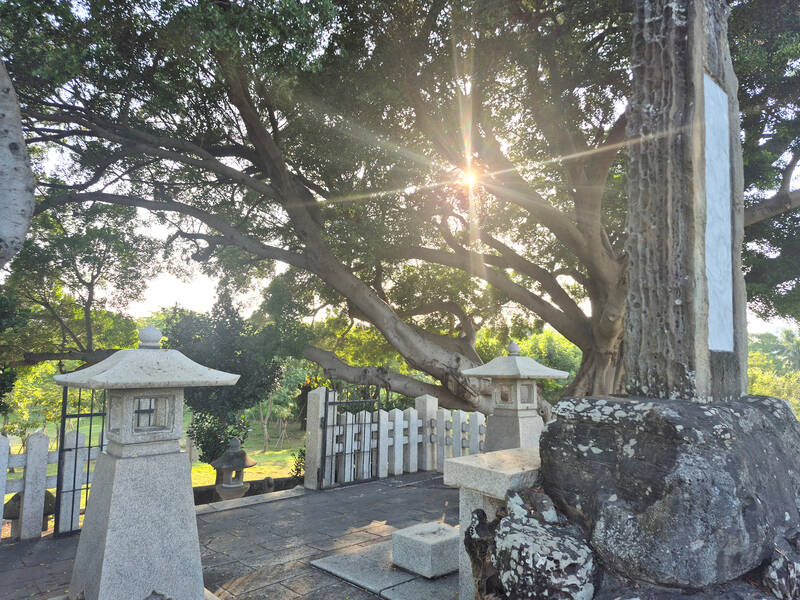
Photo by Tyler Cottenie
The “Ecological Walkway” takes visitors around the new detention ponds that several egrets have already decided to call home, and among nectar-rich plants that have attracted numerous species of butterflies. The newly planted trees still have some filling out to do, but this area is already far more beautiful and ecologically diverse than 10 years ago. One final item worth noting on the sign is the “pavilion.”
It would be a grave mistake to visit the park without taking a walk over to this spot. Perched conspicuously up on a hill behind one of the detention ponds in the shade of two enormous banyan trees, this “pavilion” is actually a tomb dating back to 1938, and one of only three that was spared during the dismantling of the former cemetery.
THE TOMBS
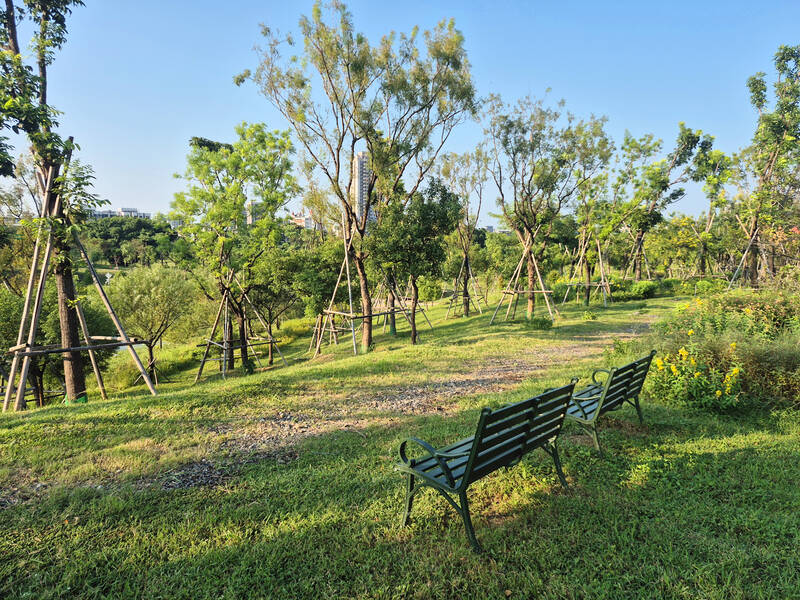
Photo by Tyler Cottenie
Surrounded by a low, ornamented concrete wall, with a central staircase flanked by three pairs of stone lanterns, the tomb is distinctively Japanese in its style, and is likely one of the best-preserved examples still remaining in Taiwan.
It is visually stunning in its symmetry, beautifully framed by the banyans and provides an excellent view of the surrounding cityscape from the top, next to the tall stone monument. It was preserved not only for its aesthetic value but also for its historical significance.
Originally the tomb of Japanese businessman and longtime Kaohsiung (Takao) resident Sugimoto Otokichi, it later became the repository for the remains of approximately 3,000 Japanese. After World War II, Japanese graves scattered throughout the country were subject to abandonment and vandalism, so three locations were selected and the remains of Japanese from the colonial era were relocated to these locations.
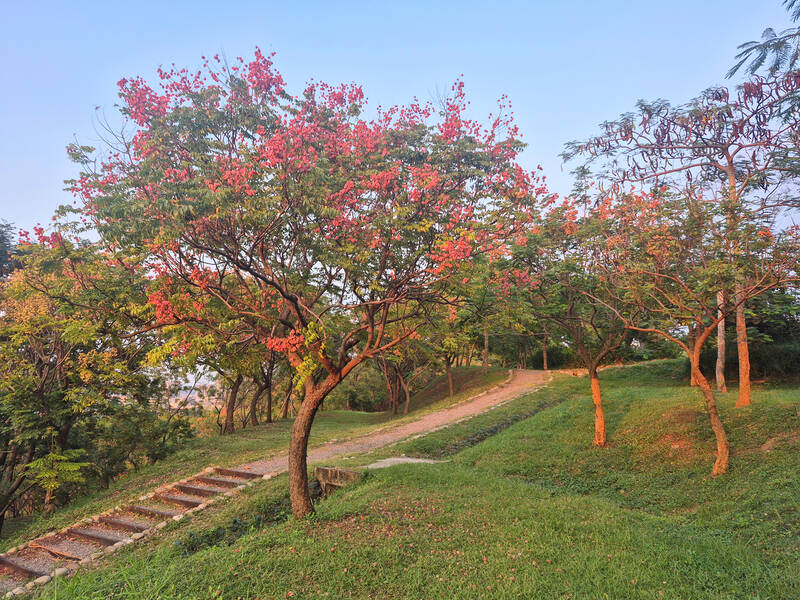
Photo by Tyler Cottenie
The Sugimoto family, in keeping with Otokichi’s reputation as a man of justice, allowed his spacious tomb to become the designated repository for southern Taiwan. Over 50 years later, the remains were moved to a columbarium along with those in the rest of the cemetery, but the tomb’s structure was preserved.
Two other tombs of identical style were also preserved from the old cemetery and are easily accessible near the main road. One is right next to the second roadside parking lot from the south and belonged to Taiwanese businessman and local credit union co-founder Huang Ching-yun (黃慶雲). Much smaller in scale but equally well preserved, this tomb represents the inclination of some Taiwanese to adopt the customs and aesthetics of their colonizers.
The final tomb is directly east of the nearby incinerator’s smokestack, at a bend in the road. Slightly larger in scale, this one belonged to Japanese businessman Otsubo Yoichi and is notable for having been moved here from another location during the Japanese era.
GETTING THERE
Using public transit, take Bus Red 33 from the Aozihdi MRT stop, get off at the Benguan Rd. (Funeral Interment Management Office) stop, and walk north along the freeway to Dingjin 1st Lane, which takes you to the park’s south entrance. Alternatively, you can take Bus Green 2 from the Cultural Center or near any light rail stop on Dashun Road counterclockwise up to Minzu Road. Get off at the Jixian Park stop and walk south on Dafeng St. to the park’s north entrance. By scooter or car, approach from Benguan Road and then turn to follow the east side of the freeway to Dingjin 1st Lane to enter the park, or continue further north to a large parking lot and then walk up to the park entrance.
However, the easiest way may be to visit as a side trip from Kaohsiung Green Park, and it is recommended to combine these two into one excursion. Look for the marked trails down from Holes 13, 14 and 17.
Shuanghu Forest Park is open 24 hours a day but has no toilet facilities. The adjacent Kaohsiung Green Park has plenty, but the opening hours are 5am to 6pm in winter.
The Nuclear Safety Commission (NSC, 核安會) on Sept. 24 approved the re-operation plan that Taiwan Power Co (Taipower, 台電) filed in March for the Ma-anshan Nuclear Power Plant in Pingtung County, after three rounds of review and 589 comments. Taipower now has to carry out the work in the plan and its own inspections on ageing, radiation and seismic resistance, then report back to the commission for review and on-site checks. Minister of Economic Affairs Kung Ming-hsin (龔明鑫) has named 2028 as the earliest restart. The NSC has given no date. THE DEBATE No challenge has been identified as to whether Ma-anshan
Oct. 12 to Oct. 18 After 11 years in prison on Green Island, Yen Shih-hung (顏世鴻) was finally due for release when a camp guard asked him for NT$20,000 to help pay his bride price. Yen refused. The next day, officials deemed that he had “failed to improve his thinking” and ordered him to undergo further political reeducation on Siaoliouciou (小琉球), where prisoners were also subjected to forced labor. He spent another 19 months there before regaining his freedom in January 1964. Yen’s punishment stemmed from his joining the Taiwan Provincial Student Affairs Committee

Cognitive warfare, says the Ministry of National Defense (MND), is the People’s Republic of China’s (PRC) use of “political, economic, cultural, military and legal means, with the intent to divide internal unity and undermine social stability” in Taiwan. Last week offered several examples. PRC media in October last year reported that the Chongqing Municipal Public Security Bureau had opened an investigation into Democratic Progressive Party (DPP) Legislator Puma Shen (沈伯洋), the DPP’s mayoral candidate for Taipei in next month’s election, for “Taiwan independence” activities. This was a cognitive warfare ploy, designed to unsettle the targeted person and to establish the idea

In pandemic preparedness work, scientists like to focus on the technical challenges: identifying pathogens, diagnosing infections, understanding their effects and developing vaccines and treatments. Each step promises progress through human innovation, investment and planning. The WHO, for example, brings experts together to identify and prioritize emerging disease threats and collect the evidence needed to prepare for them. But preparedness depends on more than scientific innovation. As the past week has shown, politics is the elephant in the room in all of this. No one could have predicted we would be talking about pneumonic plague, and that the death of a single


 RSS
RSS