

The comical bit of parachute journalism by Simon Shuster in the Atlantic last week under the title “Will Taiwan Just Give Up?”, drew much attention for its numerous minor errors, largely forgivable, its total lack of understanding of Taiwan and its history and its strange, pro-China interpretations, including taking Chinese Nationalist Party (KMT) Chairwoman Cheng Li-wun (鄭麗文) seriously. The laughter and indignation that essay generated among Taiwan aficionados is an indicator of how far Western journalism on Taiwan has come. Twenty years ago, it would have been another piece for the pile. Today, it is an obvious outlier.
Shuster’s piece was a one-off. Lost in the hilarity around it, however, was a truly obnoxious piece of parachute journalism last week that gave us an example of how the soft power of the People’s Republic of China (PRC) and its framings continue to shape media presentations: Wei Lingling’s (魏玲靈) “At Taiwan’s Temples, a Glimpse of What China Could Have Been” in the Wall Street Journal. WSJ’s editors should be ashamed of this one.
Wei’s Taipei-centric piece artfully uses the temples of Chinese folk religion to present Taiwan as an “alternative China.” That approach has been out of place for two decades, with good reason: it’s nonsense. Taiwan is not “what China could have been.” To claim so is an attempt, in prose, to annex Taiwan to China, appealing to a “preserver” trope that frames Taiwan as a “preserver” of “Chinese tradition” when it is a settler culture that has a completely different history and traditions of its own. In reality, temples carry local social meanings that resonate with the lived experience of locals, as a sharp friend of mine remarked when he read this piece. Those meanings date back centuries.
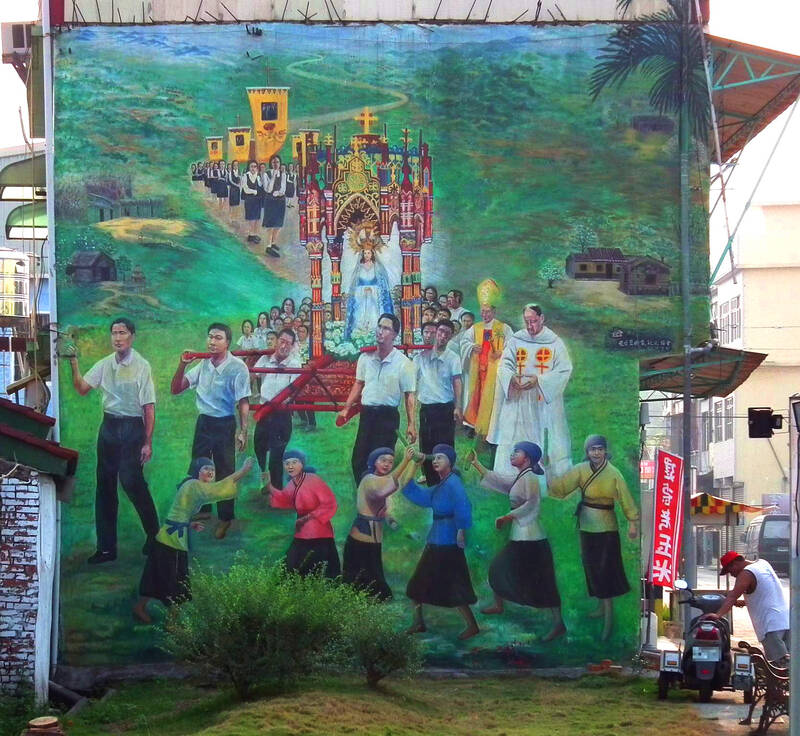
Photo: Michael Turton
LONGSHAN TEMPLE AND TAIWAN’S DEMOCRACY
The story for Wei begins at Taipei’s Longshan Temple, an ironic choice. The temple has been the site of numerous historical events over its nearly three centuries of existence, but all that is gone from Wei’s piece. Most notably, it sits in one of the oldest areas of Taipei, long a hotbed of Taiwanese nationalism.
Democracy activists in 1986 held a famous sit-in to protest decades of martial law, earning the temple the sobriquet “sacred ground for the opposition movement.” When democracy and free speech activist Deng Nan-jung (鄭南榕) killed himself in 1989 as the police closed in, supporters erected a shrine to him in Longshan Temple and mourned him for a month.
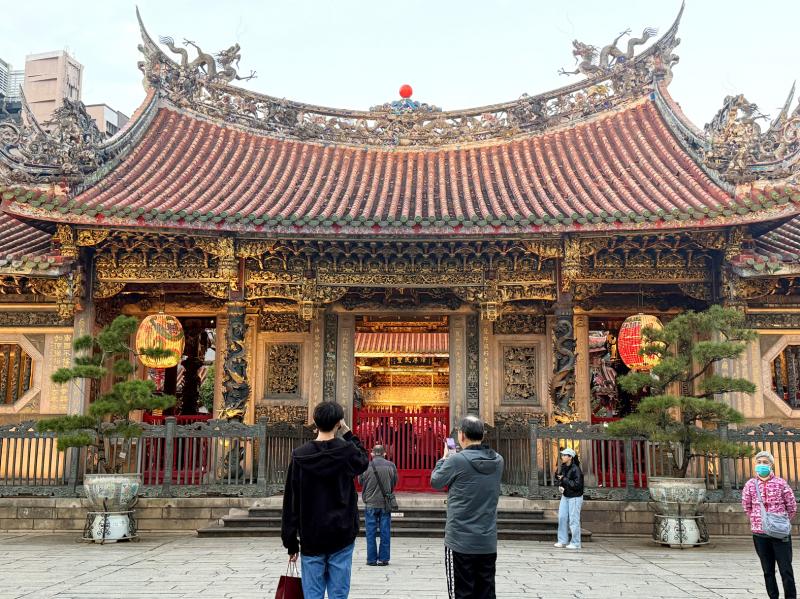
Photo: Wang I-sheng, Taipei Times
The particular local and social identity of Longshan Temple — its long association with Taiwan democracy — vanishes in Wei’s hands. In fact, “democracy” itself is deep-sixed. The word is never used in the piece despite its centrality to modern Taiwanese religious experience. The source of all this difference is thus withheld from the reader’s purview.
A large, rich body of scholarship on the interplay of religion, democracy and identity tells this story (see Ting Guo’s paper “Religion and Official Politics in Contemporary China, Hong Kong and Taiwan,” Religion Compass, March, 2026, for an excellent round up of the research). All that is swallowed up by the China-centric concept of “separation.”
In fact, the KMT controlled and shaped religion in Taiwan in the same way as the Communist Party in China, because — as in China — religion is an important source of local identity and site of resistance to the murderous Leninist authoritarians running things (hint: what was the purpose of the old KMT Committee for the Revival for Chinese Culture?). The rich, critical local history of Longshan Temple instead resolves as pious images of people praying.
“More than seven decades of separation between [China] and Taiwan have not only produced different governments, but also populations with different inner lives,” Wei writes.
The idea of “separation” is a tell that the writer is pro-PRC, as are the silence on democracy and on the 50 years of Japanese colonial rule. Just flip the “separation” claim. Assuming they were under the same government, would the lived and practiced religious experience be the same? Would they have the same inner lives? We have over 200 years of Manchu rule of the western settler part of Taiwan to comprehensively disprove that.
TELLING OMISSIONS
Because the piece is China-centered, it simply omits things that are not Han Chinese, as if they never existed. Christianity appears only in a quoted remark to Wei. Where are the Muslims and Mormons, the True Jesus Church and Yi Guan Dao?
The syncretic and creative religious traditions of Taiwan’s indigenous communities, especially in border areas, is also unexamined. It would strongly complicate the idea of “separation” and “alternative China” if Wei had posted a picture of the fabulous Catholic mural in Wanluan Township (萬巒) in Pingtung County with its melange of local religious elements, or the temple in Tainan with the skulls of dead animals hung by its altar I stopped at several years ago.
One wonders what Wei would made of the famous Shinto shrine in Taichung where Japanese war dead are interred, with a dedication from former president Lee Teng-hui (李登輝). Indeed, Shinto shrines are tucked away in the hills of southern and eastern Taiwan, and are still treated with reverence by indigenous people. The choice of China-centrism also forecloses the possibility of situating Taiwanese religious experience as one expression of local religion in the vast Chinese settler diaspora across southeast Asia.
Missing too are the rich exchanges between religious groups in the People’s Republic of China (PRC) and Taiwan since the end of martial law and the advent of democracy in the late 1980s. The seven decades of “separation” in the WSJ piece is entirely an artifact of Wei’s invention. In the real world, it is more like a four-decade interregnum. The lack of convergence between religion in Taiwan and PRC religion since 1987, despite a wealth of exchanges, should have given Wei much food for thought. That lack shows how “separation” for Wei means political control, not communications. Rich, regular exchange networks simply don’t matter.
MAZU WORSHIP
Another element gone rogue from Wei’s presentation is the PRC’s use of religion as a vector of influence in Taiwan. Scholarly and pundit commentary on the use of Mazu worship by the PRC to infiltrate and influence Taiwan is entirely missing, nor is there any comment on the role of local temples as critical nexuses of organized crime, business and local politics. Tourism, a major shaper of religious facilities, practice and display in Taiwan, is absent. Where are the strippers, shamans speaking in tongues and men slashing each other with watermelon knives? Were they just the wrong social class for “separation”?
Clearly, a key move of Wei’s presentation is to avoid localizing Taiwanese religion. Even when she writes about local earth god shrines, she reminds the reader that these are the same gods and rituals on the other side of the Strait, thus claiming a uniformity of religious experience (and of Chineseness!) in the PRC that exists only as a propaganda dream of the Chinese Communist Party.
The insistence on “separation” and the presentation of Taiwan as “separated Chinese” are components of the unsubtle Han ethnonationalism and expansionism that colors this piece. The fact that Wei was able to put this story about Taiwan in a major US paper of record shows how PRC propaganda continues to shape stories about Taiwan and China in the US media, a critical aspect of PRC soft power.
“In Taipei’s crowded temples, a Chinese-born reporter witnesses what was lost” says the piece. Alas, nothing was lost, because there was never a moment when it existed.
Taiwan isn’t China, and it never was.
Notes from Central Taiwan is a column written by long-term resident Michael Turton, who provides incisive commentary informed by three decades of living in and writing about his adoptive country. The views expressed here are his own.
Drones are widely recognized as a critical weapons technology of the future. Because of this, the pro-China Chinese Nationalist Party (KMT) and the Taiwan People’s Party (TPP) appear to be obstructing their development. One approach to handling this obstruction is to circumvent it by building robust drone capabilities across a wide swathe of the population. Taiwan is doing just that, but more is needed. The Penghu County Government on Monday said it was testing flying drones on routes from Magong City (馬公), the county seat, to Jibei Island (吉貝嶼). Because all of the inhabited islands lie within 40km of Magong,

For a time, it became popular to describe the tactics of the People’s Republic of China (PRC) in encroaching on sovereignty and militarizing islands in the South China Sea as “salami slicing.” Those slices have been getting chunkier. The People’s Liberation Army has been increasing its navy and air force activities in the region. The Chinese Coast Guard has likewise been ramping up their activities, and the civilian paramilitary People’s Armed Forces Maritime Militia has been backing up the navy and coast guard with alarming swarming maneuvers. The PRC claims most of the South China Sea through its U-shaped 10-dash

For most train journeys, where you are going is the main consideration. On the Shanlan train (山嵐號) in eastern Taiwan, however, it’s not the “where” but the “how” that matters. On this pricey but meticulously crafted train journey running between Hualien and Taitung County’s Chihshang (池上), what you’re paying for isn’t to get from Point A to Point B, but rather a sensory, aesthetic and cultural experience. On the platform, the train stands out vividly next to the other Taiwan Railway carriages. Its exterior is painted in a yellow-green gradient intended to blend harmoniously with the ripening rice paddies of the East

Picture humanity in a boat being swept down a raging river, praying there is no Niagara Falls ahead. Or imagine standing with the pioneering physicists in 1942 before they triggered the first self-sustaining nuclear fission chain reaction beneath a Chicago stadium. These were two of the analogies used this week by Robert Trager, an expert in the nascent field of AI governance, to describe the perilous but potential-filled moment the world stands at with accelerating artificial intelligence. Trager, the director of the Oxford Martin AI Governance Initiative, was speaking in the week OpenAI claimed the technology had crossed the threshold known as


 RSS
RSS