

The Chinese Nationalist Party (KMT)-controlled legislature in February 2006 established the National Communications Commission (NCC). One of the purposes of the NCC was to circumvent the control of the Government Information Office (GIO), long the KMT’s tool for overseeing the local media, by the administration of Democratic Progressive Party (DPP) president Chen Shui-bian (陳水扁).
The NCC’s commissioners were originally apportioned according to the ratio of party control of the legislature. However, the Council of Grand Justices later ruled that agencies required greater coordination with the Executive Yuan, which then began sending a list of expert nominees for approval by the legislature.
That commission system was revived by the KMT and its sock puppet, the Taiwan People’s Party (TPP), in the recent drone funding bill. The Act on Strengthening Defense Autonomy and Developing the Unmanned Vehicles Industry (強化國防自主暨無人載具產業發展條例) was passed on Aug. 27 to great media fanfare.
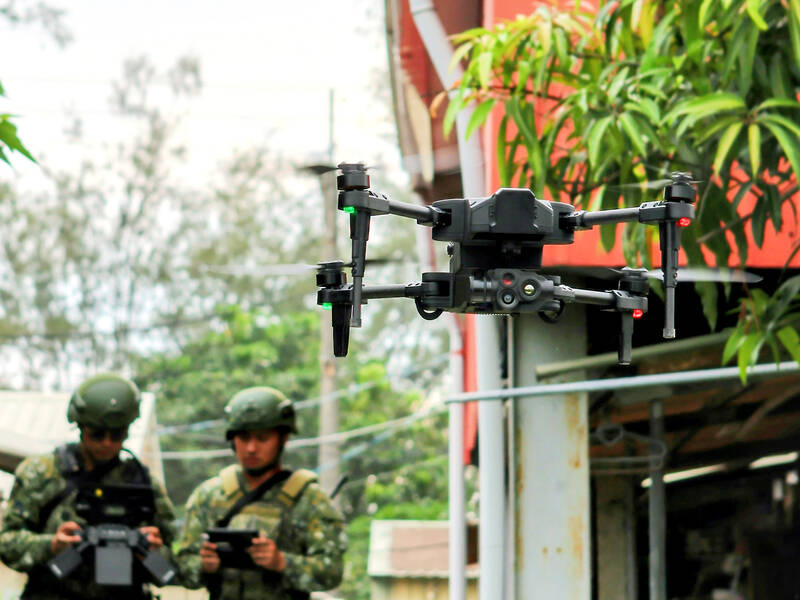
Photo: Yen Hung-chun, Taipei Times
Many commentaries were cautiously approving, but noted that by requiring the drone procurement budget to be included in the annual budget, procurement may fail to become stable and regular. Observers also pointed out the apparent unconstitutionality of the legislature adding budget items to the regular budget.
Some analysts worried that the KMT could hold up the government budget as it did this year, introducing delays into drone procurement, which would force drone makers out of the business or at least, out of government contracting. However, the bill’s most critical proviso was neglected in much of the international commentary.
NCC REDUX?
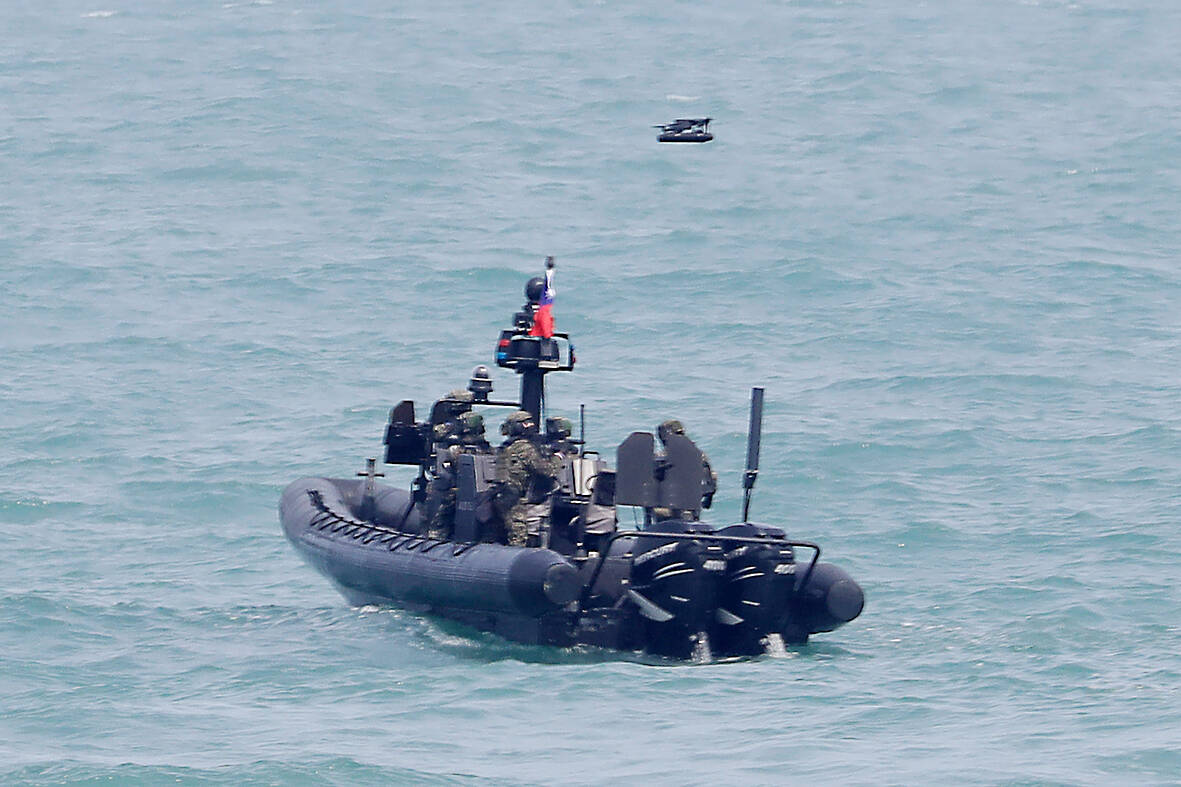
Photo: AP
The bill requires the Executive Yuan to establish a “National Uncrewed Vehicle Industry Development Strategy Special Committee.” That special committee is to be responsible for coordinating industrial policies and reviewing industrial development guidelines (including funding needs and financial resource planning). The bill mandates that more than half of the committee members must be nominated by the various party caucuses in the Legislative Yuan.
That is the same basic structure as the NCC. The special committee also appears to have many of the same coordinating functions as the NCC.
As a sharp commentary by legislative staffer Gahon Chiang (江佳紘) this week observed in this paper, this would allow “caucus-nominated members to participate directly in an Executive Yuan policy coordination and review mechanism.”
Photo: Reuters
A Ministry of Economic Affairs (MOEA) news report observed that if the Legislative Yuan caucus delays the process of nominating committee members, or if nominated members obstruct the committee’s proceedings, the committee may be unable to convene or review drone industry development guidelines. This implies that if the special committee becomes dysfunctional, drone development will grind to a halt. The MOEA’s comments did not consider a third possibility: defunding (more of which below).
The KMT playbook is simple: delay, deny, defund. That is exactly what has happened under the current administration of President William Lai (賴清德). The KMT-controlled legislature since July last year has refused to confirm new NCC commissioners. The terms of the last three commissioners’ expired on July 31. As an excellent commentary at Global Taiwan Institute (GTI) on the NCC’s woes observed: “Starting from August 1, the lack of commissioners prevents the NCC from holding even advisory meetings.”
This year’s budget passed by the legislature slashes the NCC budget for administrative operations by 56 percent, according to the GTI piece. This means the NCC has vastly reduced ability to pay for utilities, rent and maintenance. The GTI commentary notes that the NCC’s dysfunctionality affects more than the media because the NCC also has authority over communications equipment for emergency vehicles, along with radio devices, including radars, mounted on ships and aircraft and installed on Taiwan’s islands. The transportation safety and national security implications of this are obvious.
The KMT can easily focus its NCC playbook on the new special committee for drone development. If the presidency remains in DPP hands, it can fail to confirm new committee members and allow current members’ terms to expire (it passed an amendment to the NCC banning third terms or extended terms for NCC committee members). It can slash the committee’s funding to hinder its work.
This also works if the central government flips to the KMT. The drone budget’s special committee will then become a hindrance to drone development, safely out of sight of the public.
KMT ASSAULT ON GOVERNANCE
The other aspect of the KMT playbook revealed by the special committee on drone development is the party’s assault on governance. The proposed committee would overlap legislative and executive responsibilities instead of legislative oversight clearly distinguished from the central government, with the concomitant degradation of central government authority. In fact, as several commentaries have described, mechanisms and processes within the central government to carry out the committee functions already exist and function smoothly. Hence, an “oversight” committee dependent on the legislature’s goodwill can have only one function: gunking up the process.
A commentary for the Australian Strategic Policy Institute’s (ASPI) Strategist said: “Yet the Kuomintang (KMT), Taiwan’s largest opposition party, did make concessions.”
The Ministry of National Defense was permitted to retain authority over the extra spending, and local content rules were rendered less stringent, according to the commentary. The reason it made those concessions should now be clear: as long as the KMT controls the legislature, they don’t matter.
The NCC and the special committee on drone development are related in another way. As the GTI report makes clear, NCC dysfunction itself can paralyze drone development because it is responsible for regulating radio frequencies, on which drone development depends.
“Even with three commissioners, the NCC struggled to maintain operations,” GTI reports. “Now, with none, its functions are impaired to the point that drones cannot clear manufacturing or import review.”
Control of either the NCC or the special committee gives the legislature the ability to severely impair drone development. Thus, the KMT-controlled legislature has given itself a broad toolkit to block drones, a critical national security necessity.
Drones are also an important industrial domain like bicycles, electronics and textiles, the kind of rapidly changing, constantly upgrading industry that Taiwan’s nimble small and medium-sized companies are especially good at. Based on its past experience in related technologies, Taiwan should become a major player in the drone field. For countries like the US attempting to develop non-Chinese supply chains for critical national security technologies, Taiwan’s drone industry is a must.
Former KMT vice chairman Andrew Hsia (夏立言) last month attended the opening of a cross-strait civic group exchange summit in Beijing. According to a former official of the People’s Republic of China (PRC), the summit was intended to promote “Chinese national and cultural identity” among Taiwanese, to turn them into “righteous Chinese who protect the nation’s fundamental interests together.”
Whose interests are the righteous Chinese in the KMT promoting with this carefully constructed drone bill?
Notes from Central Taiwan is a column written by long-term resident Michael Turton, who provides incisive commentary informed by three decades of living in and writing about his adoptive country. The views expressed here are his own.
The flooding in Kaohsiung after the recent torrential rains has become an issue for mayoral candidates of both major parties. Chinese Nationalist Party (KMT) Kaohsiung mayoral candidate Ko Chih-en (柯志恩) brought in hydraulic-engineering professor Lee Hong-yuan (李鴻源), who called for comprehensive flood control measures on the Dianbao Creek (典寶溪), according to local media. Ko attacked the Democratic Progressive Party (DPP) for being behind on flood control measures, but as the city administration observed, there are many weaknesses in how the government can mitigate extreme rainfall. Nor is the river entirely under the management of the city. The low-lying Dianbao River

Taiwan Power Co (Taipower, 台電) chairman Tseng Wen-sheng (曾文生) uses a sports metaphor to describe the density of electricity demand. A household is a ping-pong ball, ordinary industry a baseball and a science park a bowling ball. A data center is a shot put. Taiwan is preparing for the shot puts. Four new combined-cycle units at Hsinta (興達) and Taichung (台中), with combined capacity of about 5.2GW, are scheduled to begin supplying or testing on the grid by the end of this year. The Energy Administration’s (能源署) plan adds about 25.98GW of gas-fired capacity between this year and 2035, predominantly fueled

Wait. President Volodymyr Zelenskyy, Ukraine’s war chief, holding a puppy? Yes, and it’s no accident. In a collision of dog lovers, sports and ongoing war with Russia, the Ukrainian president was seen on video Tuesday as never before — cuddling and cooing over a floppy, 3-month-old American pit bull terrier, handed to him by US former boxer Terence Crawford. The cute and fluffy scene in Zelenskyy’s office in Kyiv was the latest volley in a deadly serious battle of visuals that runs in parallel to Ukraine’s fight against Russia’s brutal four-year invasion. Crawford, a longtime supporter of Ukraine and a devotee of the
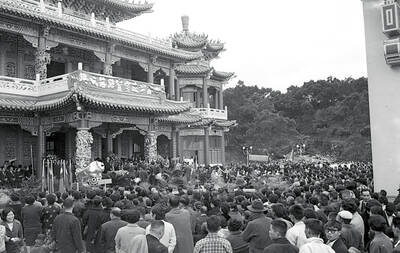
Aug. 31 to Sept. 6 More than 3 million people visited Taipei’s Zhinan Temple (指南宮) in 1973, making it Taiwan’s second-most visited scenic area that year. Built in 1891, the temple had been a tourist destination since the Japanese colonial period, when visitors had to initially take a ferry across the Jingmei River before climbing a winding trail up Houshan (猴山). Its popularity was reflected in popular media. The 1932 tune New Song of the Black Cat and Black Dog (新烏貓烏狗歌) depicted two lovers who prayed at the temple for their marriage. The man


 RSS
RSS