

Would you pay £20 (US$27) a month for the chance of making a friend, on the understanding that an algorithm — not you – gets to decide who you’ll meet?
Driven by the decline of “third spaces” such as youth centers and pubs, an increase in remote working and rising loneliness — 40 percent of adults aged 16 to 29 feel lonely “always, often or some of the time,” according to the Office for National Statistics — paid social events are now in vogue.
“There hasn’t been anything that feels authentic to helping people meet people,” says Nicola Gunby, a co-founder of Cliq, an online platform and app that aims “to bring people together through shared interests and real-world experiences.”
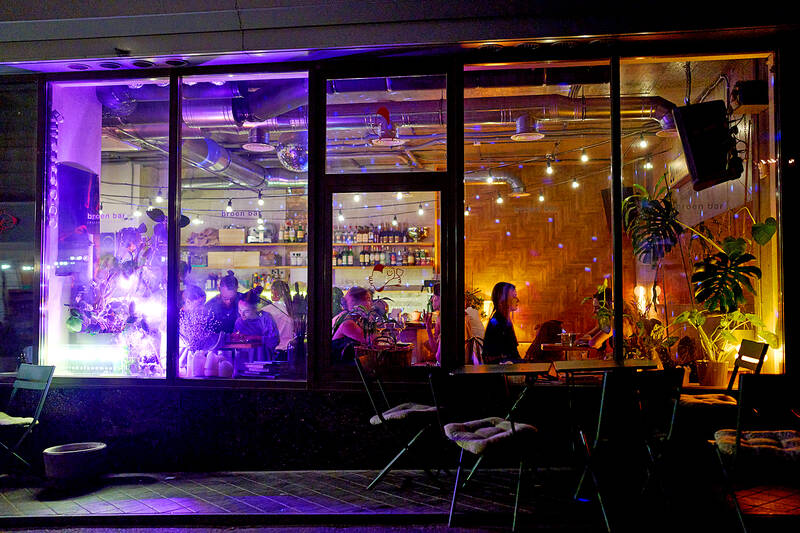
Photo: AP
The mechanics are fairly simple: platforms such as PLY (it stands for People Like You) and Agora match people using information such as their interests, lifestyle habits and profession. Then, typically, an algorithm decides which events a user should attend, as opposed to free alternatives, such as the Meetup platform, that leave that choice with members.
The ideal outcome for participants is showing up, making some new connections and leaving with plans to meet up again.
But as these clubs spread across UK cities — typically charging from nothing at all to £20 a month — the question for anyone considering joining, is the same as you would ask about any subscription: what are you actually paying for, and is it worth it?
At PLY, memberships tend to start at £19.99 a month, giving members access to exclusive events and discounts with other businesses, falling to about £9.99 a month for longer commitments.
“When you do things for free, people often don’t turn up,” says Karen Harris, the founder of PLY, of its membership model. “People need someone who’s committed, who’s looking to maintain friendships and taking it seriously.”
According to Harris, the majority of PLY’s customers sign up for longer-term memberships — a reflection of both the lower cost and of how long a friendship takes to build. On average, she says, it takes three events “to find your person.”
Other clubs offer a mix of pay-as-you-go and subscription options. This is Agora’s model as it makes things more accessible, argues its founder, Sahil Shirazee.
In the two years since its launch, the club has hosted more than 300 events and claims to have helped form hundreds of friendships.
For some of those looking to make new friends, flexibility is important.
“A membership fee would make me feel pressured into attending so many events every month,” says Charlotte Johnson, 29, from Hertfordshire, who is a Cliq user.
Paying per event “encourages me to go if I’ve paid for it” while leaving her free to not attend those that aren’t of interest to her.
Johnson says that “what really surprised me was I got more than expected.” She highlights a recent brunch event that included things such as a take-home goodie bag. She has since signed up for a pottery event.
“Everyone’s there for the same, if not similar, reasons,” she adds, “which takes a lot of the fear out of meeting strangers.”
If participants don’t click with anyone within a month of joining, some of the platforms, including PLY, offer a money-back guarantee.
Not everyone is convinced that paying for friendship is something to celebrate.
Shirazee admits he still gets asked why people should have to pay to meet each other at all. But, he says, if you want to solve problems such as loneliness, and create meaningful communities as quickly as possible, “you need to make sure the people who want to crack this issue are able to not only get compensated, but grow.”
Harris rejects the idea that people are “paying for access to strangers.”
“You’re paying for a system, for structure, that makes connections much better,” she says. Free socialization, she argues, usually relies on the presence of a host or facilitator, whereas at PLY events, “interaction is peer-to-peer, without a facilitator moving you forward.”
Free events haven’t disappeared, though — and continue to be the preferred option for some.
“I tend to choose free events most of the time because I can’t always afford to pay for social activities,” says Giovanna Giusi, a primary school teacher.
The 28-year-old says she appreciates having access to a mixture of free events, such as hikes or walks, and paid events. This allows her to “be part of a community even when money is tighter.”
She says the paid events “make it possible to offer experiences that couldn’t realistically happen for free, such as workshops with instructors, private classes or activities that need a venue.”
“People always say they want more community and more opportunities to meet others, but it’s easy to forget that organizing those communities still takes time, work and money,” Giusi says.
Whether paid socialization becomes the norm is, for now, an open question.
Despite it being the foundation of their business model, the organizers say they hope not.
“In the long run, I don’t want Agora to exist,” Shirazee says, because “meeting people is so natural” it shouldn’t rely on an algorithm. But in the meantime, after establishing a “proper base” in London, he is already planning to expand to different cities next year.

When we recall the 1990s, we usually identify them as the time of great transitions, from authoritarianism to democracy, and the public’s shift to acknowledging a Taiwanese identity. But another transition occurred, one that we take for granted and hardly notice anymore. The 1980s opened with the massacre of members of the family of democracy activist Lin I-hsiung (林義雄). While Lin was in detention, on Feb. 28, 1980, persons still unknown broke into the Lin family home despite round-the-clock police surveillance. Lin’s mother and two of his three daughters were slain. His eldest daughter survived multiple stab wounds. The following year
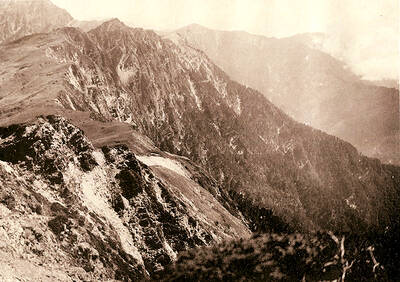
Aug. 24 to Aug. 30 Three pairs of chopsticks, stuck upright in the ground like incense, have become one of the most curious details in the story of three university graduates who disappeared on Qilai Mountain (奇萊) in 1972. The case remains unsolved today. Despite an extensive two-month search, the three men’s bodies were never found. The incident came just a year after five National Tsing Hua University students died on the mountain on July 25, 1971, after being unexpectedly caught in a typhoon, prompting serious concerns about hiking safety. Tunghai University graduate Chiu Kao (邱高) and Fu Jen Catholic

The Taiwan People’s Party (TPP) is facing some difficulties, and there are some tensions in their alliance with the Chinese Nationalist Party (KMT). However, though these problems are real, the local press is blowing them out of proportion and hyping too much out of context. Take, for example, a poll released by Z.media on Wednesday of 1,070 adults with a sampling error of ±3 percentage points. It showed support for the TPP dropping to 6.3 percent, an all-time low on their historical chart and 4.2 percent lower than their May poll and 11 percent from a year earlier. This led

They were born Taiwanese, educated as Japanese and drawn into the war effort for an empire that was eventually defeated. Under the Chinese Nationalist Party (KMT) regime, when Japanese became the enemy, they mostly kept those memories to themselves. Of the six men and women interviewed in depth for The Day the War Ended (終戰那一天), three have since died, while the others are nearing 100. Their stories are therefore all the more urgent to preserve, offering an invaluable glimpse into what Taiwanese went through during a period of great change. With Taiwan’s current representative to Finland, Freddy Lim (林昶佐), narrating


 RSS
RSS