


A roughly 40-hour sea journey on a dinghy with a dying phone. Detention in South Korea. That’s just part of what Chinese dissident Dong Guangping (董廣平) endured to escape his native country. He arrived late last week in Canada, a destination he had eyed for more than a decade.
Dong had been locked up in China several times, including for his activities commemorating the 1989 crackdown on pro-democracy protesters in Beijing’s Tiananmen Square and past efforts to flee.
“It’s like living in a cage. Very suffocating,” he said, referring to the lack of freedom of expression in China.
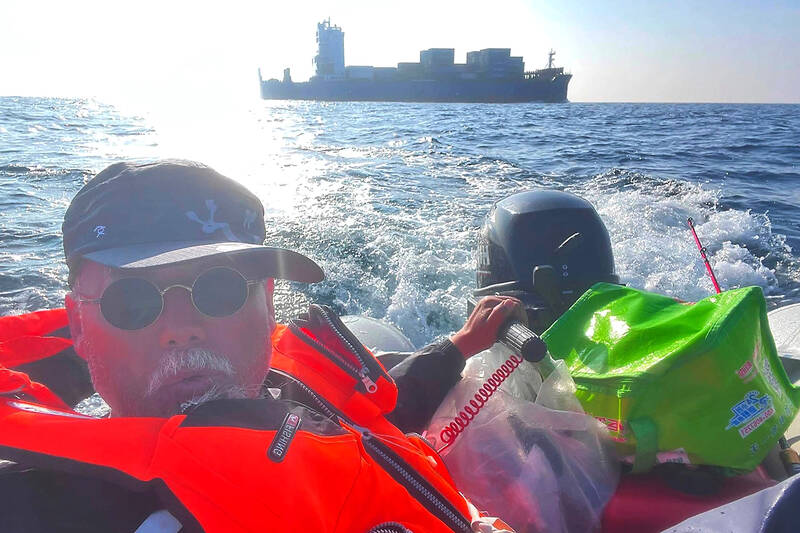
Photo: Dong Guangping, via AP
After his release from prison, the 68-year-old dissident said he was unable to receive retirement benefits or renew his passport and was under constant police monitoring.
China’s Foreign Ministry said the government handles the entry and exit of its citizens in accordance with the law and that Chinese citizens must abide by the Constitution and the law.
Dong attempted to flee at least three previous times: in 2015 to Thailand, where authorities deported him back to China; in 2019, when he tried to swim to a Taiwanese island off China’s east coast; and in 2020, when he reached Vietnam, only to be deported back again.
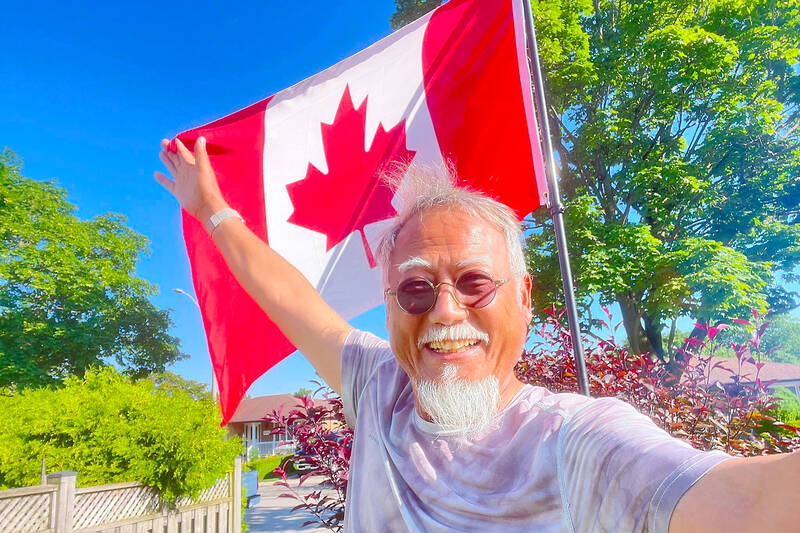
Photo: Dong Guangping, via AP
Last month, he tried again.
Dong says he shook off the fear of death.
In the early hours of May 24, he set off in a gray rubber dinghy fitted with an engine from Weihai, a coastal city in eastern China’s Shandong province, under fine weather. He was eyeing Japan, confident that the government there would not send him back to China.
But the next day brought fog. When he noticed his phone, which he relied on for GPS navigation, was on its last bar, he became terrified. His power bank also died. He quickly switched to his contingency plan — South Korea.
Dong recalled that dread ran deep because his tiny boat might capsize if the winds and waves picked up. But he had no way to return and shook off the fear of death.
“Living conditions back in the country are so terrible that being alive is little different than being dead. So there is no point fearing death,” he said. “If you move forward, there’s a chance at life.”
In the evening, he saw lights in the distance and moved toward them. The first vessel could not hear his cries for help and left. Later, he encountered a fishing boat that agreed to pull him on board. He asked the fishers to call the police to help him.
The South Korean coast guard detained him for allegedly violating the country’s immigration law. They sought a warrant to formally arrest him, but a court refused, saying it’s “difficult to recognize sufficient grounds and necessity” for his arrest.
FROM REFUGEE CENTER TO CANADA
Dong was later sent to a refugee center in Incheon, a port city near Seoul. Earlier this month, the UN refugee agency contacted him via video call, he said.
A refugee center manager later asked about his height, weight and his eye color. He was worried at first but it turned out to be a good sign. His lawyer told him it was at the request of the Canadian diplomatic mission, he said.
About a week later, Dong boarded a flight and he arrived in Toronto Friday. He was still unclear what legal procedures were involved in his move, but guessed it was based on cooperation between the South Korean and Canadian governments and the UN agency.
“I feel very surprised, extremely surprised. It’s like still in a dream. It’s very fast,” he said.
He believed the resettlement status in Canada that his family secured in 2015, before Thai authorities deported him back to China, was still valid.
The Canadian Embassy in South Korea declined to comment on Dong’s case. South Korea’s Foreign Ministry said the country handled the case “in accordance with law and principle,” but did not specify Seoul’s role in arranging Dong’s transfer to Canada. The UN refugee agency declined to comment on individual cases for reasons of confidentiality and protection.
A FRESH START
Dong vows to press on with his activism Dong said he feels at home after arriving in Toronto, saying he finally tasted freedom for the first time in over a decade.
“There’s not even a hint of fear,” he said.
He hopes to make a living, possibly by being a truck driver or an Uber driver.
But the joy doesn’t help Dong let go of the deportations by the Thai and Vietnamese authorities.
In 2015, Dong and his family went to Thailand to seek refugee status from the UN refugee agency, but Thai authorities later arrested him and returned him to China, according to Amnesty International. His ex-wife and daughter managed to settle in Canada.
The activist fled to Vietnam in 2020, but was sent back in 2022. He was jailed each time he was returned to China. He said he plans to consult a lawyer to see if he can sue both Thailand and Vietnam.
For Dong, the fight is far from over. He also plans to press on in his call for China’s democratization.
In the late 1990s, the former police officer distributed leaflets with his articles on topics such as the Tiananmen crackdown. He was imprisoned for three years in 2001 for inciting subversion of state power.
He also spent more than eight months behind bars over his participation in a memorial for victims of the crackdown after being arrested in 2014, he said.
“My ultimate goal is for China to achieve constitutional democracy,” he said.
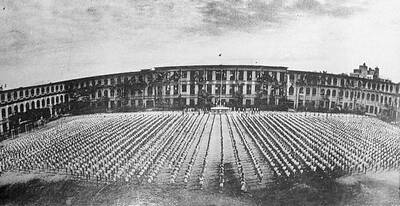
June 29 to July 5 The daily morning flag raising ceremony at Laosong Elementary School (老松國小) was once a sight to behold, with thousands of students lined up on the main field. Boasting a record 11,110 students in 1966, the school wasn’t just the most populous primary institution in Taiwan — most sources claim it was the world’s most attended. At a time when students had to pass entrance exams to attend junior high, Laosong became a magnet school due to its high advancement rate. According to news reports, 12 buses transported students to the campus in Taipei’s Wanhua District

“You have several different internship experiences across different industries,” the interviewer told Hazel Lin (林敏淳). “But they are still internships, not jobs. Why should we hire you? What are you actually capable of?” It was a blunt question. It is also the question increasingly faced by many young Taiwanese workers trying to enter the AI economy, which is a key factor in transforming Taiwan into an indispensable global “AI island.” Lin studied international business, worked in marketing, supply-chain coordination and sustainability events, received a Master’s degree in customer relationship management in Germany and was completing an applied AI training program in Taiwan.

“Restarting” cross-strait dialogue, contends Chinese Nationalist Party (KMT) Chair Cheng Li-wun (鄭麗文), is the only way to avoid “Taiwan becoming the next Ukraine.” Presenting Taiwan negatively as the “next Ukraine” has become a staple of pro-KMT and pro-China discourse. The alignment of “Taiwan as Ukraine” with People’s Republic of China (PRC) trope needs unpacking. It is part of a package of narratives that serve a variety of PRC propaganda needs. Restarting talks? We don’t have government to government talks because the PRC rejects them. We can have talks any time the PRC wants, it just doesn’t want to. Indeed, it is
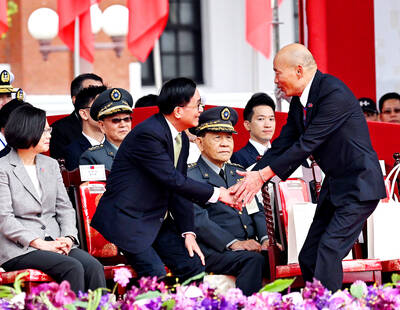
For a nation facing a potentially existential military threat from an aggressive, hostile neighbor, Taiwanese have a curious relationship both politically and culturally with the armed forces that stand between them and invasion. That needs to change, but historical baggage is hard to shed. In 1993, a Democratic Progressive Party (DPP) lawmaker made some disparaging remarks about military veterans. Outraged, a Chinese Nationalist Party (KMT) lawmaker flipped over a table and came at him in a rage, fists swinging. The DPP lawmaker was hospitalized as a result. Video of the incident is available on YouTube. Today’s violence in the legislature


 RSS
RSS