


“Restarting” cross-strait dialogue, contends Chinese Nationalist Party (KMT) Chair Cheng Li-wun (鄭麗文), is the only way to avoid “Taiwan becoming the next Ukraine.”
Presenting Taiwan negatively as the “next Ukraine” has become a staple of pro-KMT and pro-China discourse. The alignment of “Taiwan as Ukraine” with People’s Republic of China (PRC) trope needs unpacking. It is part of a package of narratives that serve a variety of PRC propaganda needs.
Restarting talks? We don’t have government to government talks because the PRC rejects them. We can have talks any time the PRC wants, it just doesn’t want to.
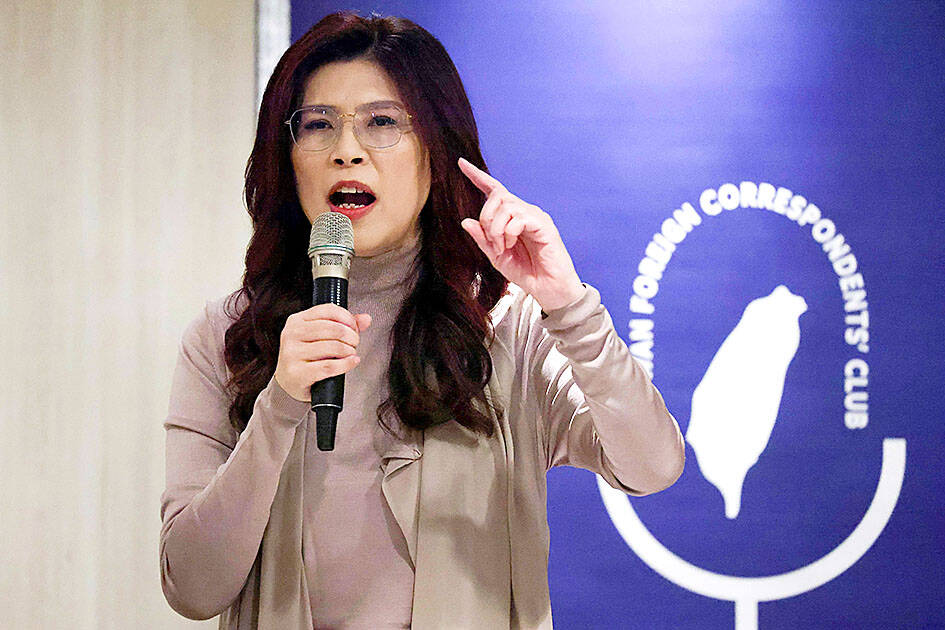
Photo: AFP
Indeed, it is hard to look at its obdurate insistence that Taiwan accept it is part of China as a precondition for talks, and not conclude that preventing talks is why the PRC insists on that precondition.
After all, if the PRC truly wants a negotiated solution, there is a simple one at hand: give up its claim to Taiwan. The PRC doesn’t actually want a “negotiated solution” which implies that each side gets something it wants. It wants a coerced solution in which it is able to annex Taiwan at minimal cost to itself, and Taiwan gets nothing. Calls for a “negotiated solution” function as euphemisms for a coerced surrender.
BLAMING THE US
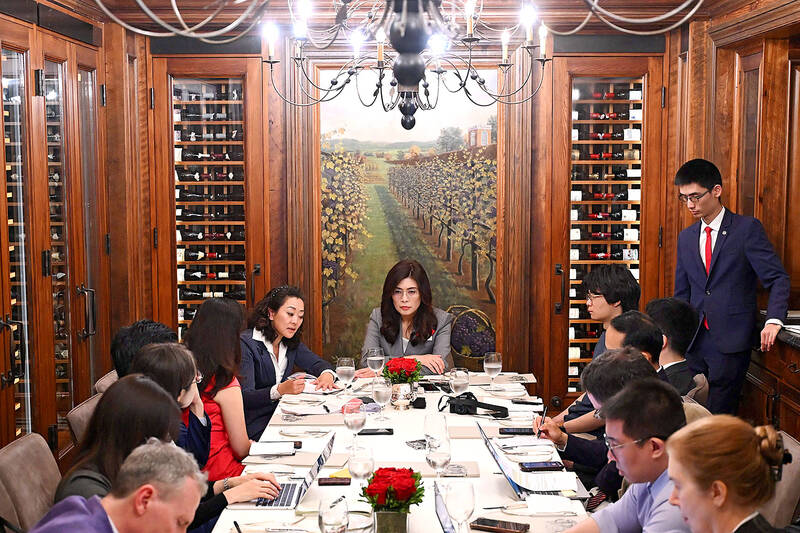
Photo: AFP
What does it mean for Taiwan to be the next Ukraine? Comparisons between them are common. In the propaganda of the PRC and Russia and their supporters on the far right and far left, the Russian invasion of Ukraine was caused by the intervention of the US. Hence, the destruction there is solely the fault of the US and its allies. Cheng herself said last year in an interview with Deustche Welle that “the core reason the war broke out and continues today is NATO’s repeated eastward expansion.” That is nonsense, but it illustrates how she positions Taiwan in the Taiwan-Ukraine comparison: as the victim of the US and its allies.
Observe her use of the agent-less term “broke out” rather than forthright acknowledgement that Russia attacked Ukraine. That is the same way she treats the PRC threat. Like the PRC itself, she never uses words like “invade” or “attack.” Cross-strait relations are a “choice between peace and war”, she has said, though she never states out loud why war is the other prong of that choice. Instead, she speaks of Taiwan’s defense and negotiations. By removing the PRC threat from her discourse, she attempts to make people opposed to her seem unreasonable. How could anyone be opposed to peace and dialogue?
This type of presentation is a common pro-PRC move, since it shifts the onus of action onto Taiwan and Washington by implying that the PRC has no agency of its own. It can’t help itself, it will have to go to war. Since the only nations with true agency are Taiwan and the US, they must change their policies.
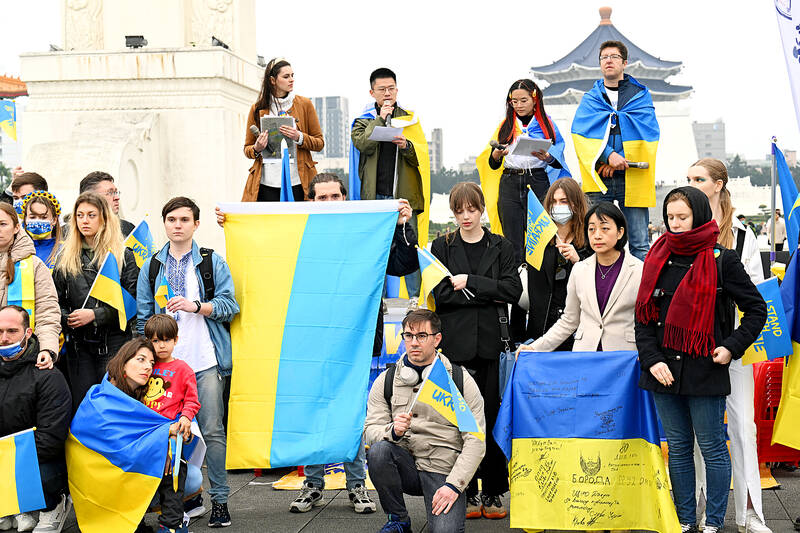
Photo: Tien Yu-hua, Taipei Times
When Cheng warns against becoming the next Ukraine, she is not saying she fears Taiwan will be wrecked in a war. Instead, she is quietly following the far right/left line that the US is the cause of the problems in the Taiwan Strait (many on the left make this belief explicit). In effect she is saying (absurdly) that dialogue with the PRC will stop the US from sending Taiwanese to their graves. The illogic is clear: if the US is the problem, how can talking to the PRC solve it?
NO DETAILS
One reason her claims never contain details is because they would make the lunacy and internal contradictions of her positions crystal clear. After all, if she were interested in making sure that Taiwan does not become “the next Ukraine,” she’d be talking to the PRC, not Taiwan or the US. Only the PRC is a threat to Taiwan.
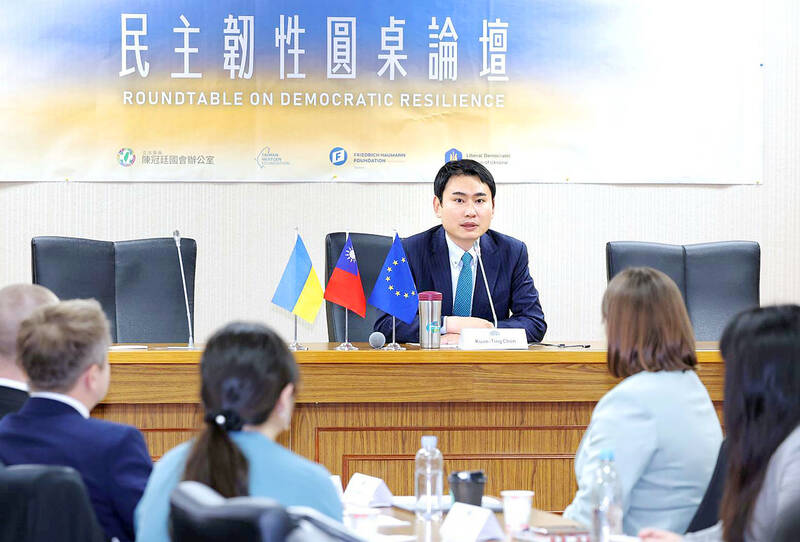
Photo: Fang Pin-chao, Taipei Times
A twist on Cheng’s noises that Taiwan is “becoming the next Ukraine” is that Ukraine is an independent state. That is the coded side of her warning. Of course, her “China policy” is accepting the fictional 1992 Consensus (the PRC, not KMT version) and rejecting Taiwan independence. “Both sides of the Taiwan Strait belong to the same great Chinese nation,” Cheng has said.
The PRC has never accepted the KMT’s “one China, two interpretations” version of the 1992 Consensus, insisting that the 1992 Consensus means only that Taiwan is part of the PRC. Thus, “accepting the 1992 Consensus” in Cheng’s hands is just a euphemism for surrender. Her warnings about making Taiwan another Ukraine in reality are warnings to insiders not to let Taiwan go.
This positioning of Taiwan as a potential Ukraine has another alignment with PRC concerns. Several scholars have contended (before Trump became president) that US Taiwan policy was becoming more “Ukrainized,” that is, more clear in its commitment to defending Taiwan. In this view, Beijing’s ability to take Taiwan faces greater uncertainty.
When Cheng speaks of Taiwan as Ukraine, she is expressing PRC expansionist fear of the US commitment to Taiwan. Speaking to outsiders, Cheng may sound like she is expressing pious fear of mass civilian death in war. To insiders, Cheng is saying that the PRC should not permit Taiwan to become for China what Ukraine has become for Russia: a rock on which ethnonationalist imperialism will break.
PROPAGANDA FODDER
In Foreign Affairs in March, Cheng wrote that “deterrence without better communication channels increases tensions by forcing either acquiescence or escalation without providing potential off-ramps.” As always with Cheng, no details of this missing “off-ramp” are given, nor what “better communication channels” might be.
“Defense spending alone cannot create peace,” she says, approvingly quoted by pro-PRC commentators. Yet, we have had peace for the last eight decades because of US defense spending, and we remain at peace. Perhaps someone should ask Cheng to explain, in detail, why the current situation is not “peace.” That should be quite illuminating.
In recent years some PRC watchers have been contending that the leadership in Beijing has become impatient with Taiwan’s rejection of its “peace” overtures and is thus leaning towards a military solution. Cheng’s “peace” verbiage provides more propaganda fodder for this shift. Isn’t rejecting Cheng the same as rejecting the possibility of peace with the PRC?
Much of the analysis of Cheng’s trip to the US saw it as aimed at her domestic position, with many observers seeing it as the first step of a presidential run. President Cheng of “Taiwan as Ukraine”? Someone should tell her what happened to the last president of Ukraine who supported the ethnonationalist imperium next door.
Notes from Central Taiwan is a column written by long-term resident Michael Turton, who provides incisive commentary informed by three decades of living in and writing about his adoptive country. The views expressed here are his own.
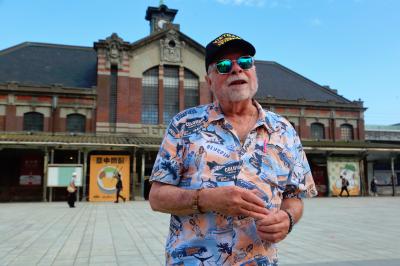
I was 18 and a naive US Air Force airman when I first set foot on Taiwan in 1968. I left as a more mature, somewhat wiser 23-year-old. Despite transitioning to an adult in those important, formative years, I didn’t think much about coming back. Until recently. Last month, I returned to Taiwan for the first time in 53 years. It was not even remotely like the country I left in 1973. When I departed, Taiwan was a slow-moving, impoverished developing nation under martial law. Outside of the cities, people in conical bamboo hats hand-tilled expansive rice fields that dominated the countryside.
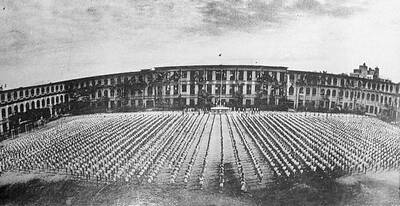
June 29 to July 5 The daily morning flag raising ceremony at Laosong Elementary School (老松國小) was once a sight to behold, with thousands of students lined up on the main field. Boasting a record 11,110 students in 1966, the school wasn’t just the most populous primary institution in Taiwan — most sources claim it was the world’s most attended. At a time when students had to pass entrance exams to attend junior high, Laosong became a magnet school due to its high advancement rate. According to news reports, 12 buses transported students to the campus in Taipei’s Wanhua District

“You have several different internship experiences across different industries,” the interviewer told Hazel Lin (林敏淳). “But they are still internships, not jobs. Why should we hire you? What are you actually capable of?” It was a blunt question. It is also the question increasingly faced by many young Taiwanese workers trying to enter the AI economy, which is a key factor in transforming Taiwan into an indispensable global “AI island.” Lin studied international business, worked in marketing, supply-chain coordination and sustainability events, received a Master’s degree in customer relationship management in Germany and was completing an applied AI training program in Taiwan.
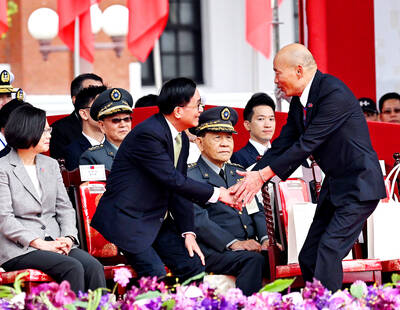
For a nation facing a potentially existential military threat from an aggressive, hostile neighbor, Taiwanese have a curious relationship both politically and culturally with the armed forces that stand between them and invasion. That needs to change, but historical baggage is hard to shed. In 1993, a Democratic Progressive Party (DPP) lawmaker made some disparaging remarks about military veterans. Outraged, a Chinese Nationalist Party (KMT) lawmaker flipped over a table and came at him in a rage, fists swinging. The DPP lawmaker was hospitalized as a result. Video of the incident is available on YouTube. Today’s violence in the legislature


 RSS
RSS