


This year marks the 15th year since the infamous Economic Cooperation Framework Agreement (ECFA) came into law in 2011. In 2020, when I looked at the 10 years since the agreement was inked, ECFA had already been forgotten, its effects melting away. Today it is ancient history.
Proponents of ECFA claimed in the run-up to its signing that Taiwan would be isolated like North Korea. In fact, just the opposite has occurred. At present, Taiwan has a global top five stock market, sizzling economic growth, record foreign investment, and booming chip and AI tech spheres. Export orders have now risen for 16 straight months as of last month. Unemployment is under 3.5 percent, with demand for services creating new jobs riding the economic boom. Meanwhile, investments of Taiwanese firms in the People’s Republic of China (PRC) have been falling, this year accounting for less than 1 percent of all foreign investments of Taiwanese firms.
Isolation without ECFA? Taiwan’s dazzling economic performance has raised the nation’s profile, with experts and commentators highlighting its importance to the global economy. Many analyses have pointed to how a PRC invasion of Taiwan would wreck the global economy. An ironic effect of the PRC’s obsession with annexing the island is that it has focused even greater international attention on its successes.
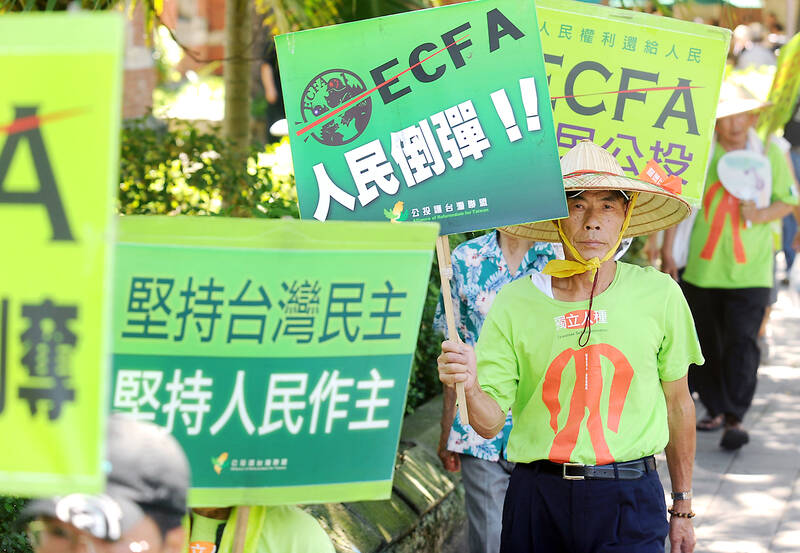
photo: Liao Chen-hui, taipei Times
Furthermore, speakers from the pro-PRC parties in Taiwan have fallen more or less silent on the alleged economic benefits of greater integration with the monster across the Taiwan Strait. Taiwan’s rise, coupled with the PRC’s obvious economic distress, has eviscerated the “sign or die!” pressure that was common in the early 2010s, that constant leveraging of Taiwanese fear of being weeded out that preceded ECFA.
ECONOMIC BENEFITS?
On her trip to the PRC, Chinese Nationalist Party (KMT) Chair Cheng Li-wun (鄭麗文) discussed the economic benefits of annexing Taiwan to the PRC, while at home the KMT has been focusing on the gains for particular groups like farmers. When was the last time anyone heard serious calls for a cross-strait common market from Taiwan? (Cheng may have been broadly hinting at something similar when she proposed something like the EU for Taiwan and China). Nowadays, advocates of annexing Taiwan are more likely to base their arguments on “Chineseness” rather than economic growth.
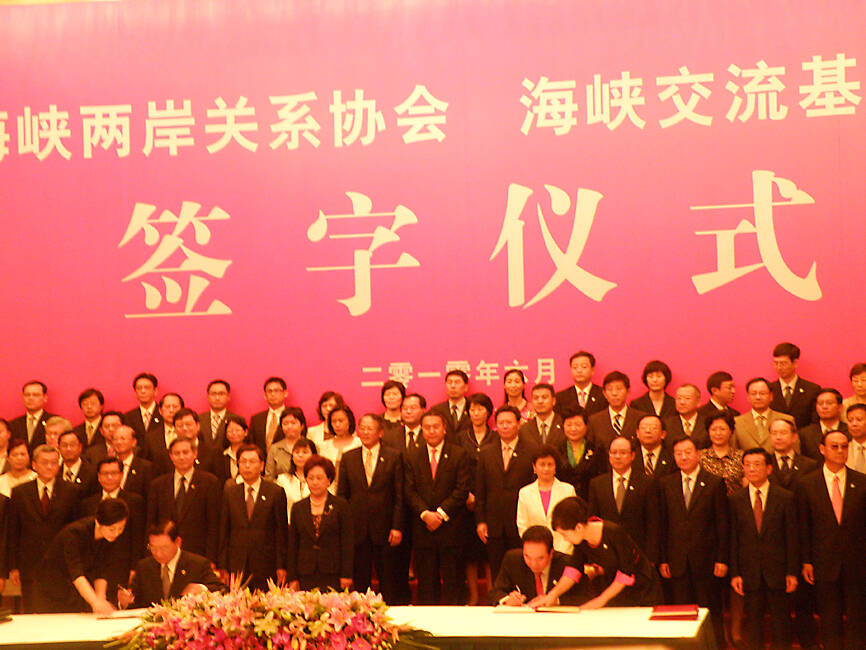
photo: Chen Hsiao-yi, Taipei Times
During the debates prior to its signing, the Ma Ying-jeou (馬英九) administration attempted to portray objections to ECFA as a low-class Taiwanese yokel behavior. “If you support ECFA, you will graduate from ‘local’ to ‘high-class,’ stated the Taipei Times in a 2010 editorial slamming the administration for its class-based attacks on opponents. The editorial instanced a comic from 2009 that featured two stereotypical characters: Yi-ge (一哥), a middle-aged man from Tainan who speaks Mandarin with a thick Taiwanese accent and opposes the ECFA, and Fa-sao (發嫂), a “sharp-minded Hakka career woman with a dashing educational background who supports the deal.”
Apparently those “betel-nut chewing locals” can create quite an economy at home when they put their minds to it.
SUPPRESSING INDUSTRIALIZATION
In 2022, American Affairs Journal published a remarkable piece on how the PRC has killed industrialization in the developing world (“The long, slow death of global development,” David Oks and Henry Williams). The problem, they observe, is clear: “despite attempts to find alternative models of economic development, there is no widely replicable strategy to develop a country — simply put, to turn it from poor to rich — that does not involve an economy becoming highly industrialized.”
The rise of East Asia, especially the PRC, has suppressed industrial development in developing nations. It has done this in two distinct ways. First, it has deindustrialized them via the massive outpouring of subsidized industrial growth, especially in the PRC. This effect is visible to all. Less remarked on is the other effect of PRC growth: the increasing the demand for commodities for its factories reoriented the economies of developing countries on commodity production and away from industrial production.
Without industry, can they even be considered “developing” countries? “Thus most ‘developing’ countries are in a worse structural position than they were a few decades ago”, the authors lament. People often marvel at Brazilian agricultural exports to China, but as Oks and Williams point out: “Had Brazil’s per capita GDP continued to grow at its 1970–75 average rate for 25 more years, it would have been richer than France and the United Kingdom by 2000.”
Imagine what ECFA and the follow-on services pact would have done to the Taiwan economy. Where would the “Taiwan” AI and tech boom now be taking place?
A 2010 Taiwan News editorial observed that “one of Taiwan’s most critical socio-economic problems is the fact that since nearly half of Taiwan’s export orders are actually produced in the PRC, even if the funds are received in Taiwan, nominal economic growth no longer necessarily leads to increases in either employment or wages.”
Today that is more or less still the case, though Vietnam now claims a larger share of the actual production. Still, high-end, high value production takes place in Taiwan, keeping the economy afloat. Without political barriers to the relocation of that production to the PRC, what would deep integration of the two economies have meant for Taiwan’s advanced industry?
Remember, Taiwan produces hardly any globally interesting commodities, and its traditional industries are already slowing eroding.
FURTHER LOSSES PREVENTED
As I wrote in 2014, “The goal of ECFA was always political and economic: to hollow out Taiwan’s productive industries and gut its economy, since that is a powerful resource for Taiwan independence and democracy.”
If the reader doubts this, an appendix of the agreement had a provision specifically forbidding stopping the flood of imports from PRC by using anti-dumping, anti-subsidy, national security or cultural reasons. ECFA was obviously intended to kill the Taiwan economy.
Critics have complained that “decoupling” is overblown. There is a certain amount of truth in that. But there is no question that internal changes in the PRC (reduction in government policies that favored Taiwan factory owners, for example), combined with the defeat of Taiwan’s further integration with the PRC and the southbound investment policies of subsequent administrations, have prevented further loss of factories to the PRC, especially those involved in high-value manufacturing.
Political barriers also helped keep production in Taiwan. Chip production would have moved to the PRC long ago, if it were not for legal walls intended to keep advanced chip technology out of Chinese hands.
Don’t forget that the KMT’s China policy under Ma involved moving industries into the PRC while bringing tourists into Taiwan. These two policies were “two sides of the same minted-in-Beijing coin: dulling working-class opposition by throwing tourist dollars at it while hollowing out the local economy,” as I wrote in 2011.
What saved Taiwan’s economy? No question: the election of successive Democratic Progressive Party (DPP) politicians to control of the central government.
Let us hope that continues.
Notes from Central Taiwan is a column written by long-term resident Michael Turton, who provides incisive commentary informed by three decades of living in and writing about his adoptive country. The views expressed here are his own.
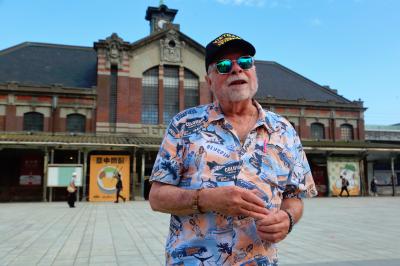
I was 18 and a naive US Air Force airman when I first set foot on Taiwan in 1968. I left as a more mature, somewhat wiser 23-year-old. Despite transitioning to an adult in those important, formative years, I didn’t think much about coming back. Until recently. Last month, I returned to Taiwan for the first time in 53 years. It was not even remotely like the country I left in 1973. When I departed, Taiwan was a slow-moving, impoverished developing nation under martial law. Outside of the cities, people in conical bamboo hats hand-tilled expansive rice fields that dominated the countryside.
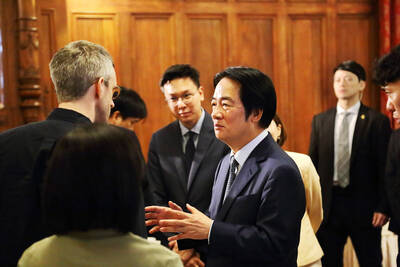
The last time Taiwan’s foreign correspondents were invited to a special briefing with a sitting president was in 2015. That was two presidents ago under Ma Ying-jeou (馬英九). But Thursday morning, President William Lai (賴清德) welcomed the nation’s international press corps warmly, speaking specifically to the theme of press freedom. Lai addressed Taiwan’s foreign press corps saying, “You live, work and report in Taiwan.” “Thank you for your professionalism and upholding the spirit of press freedom,” he continued. “As you engage in your work of journalism, you let the world see Taiwan.” The timing of this event, hosted by the Taiwan Foreign
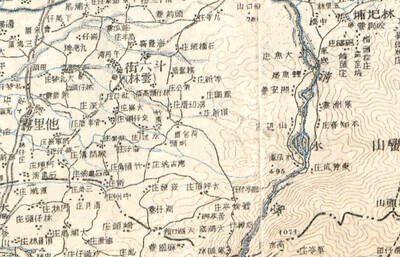
June 22 to June 28 “There are no good civilians within Yunlin’s jurisdiction,” declared Yunlin subprefecture head Yunoshin Matsumura before launching a bloody suppression campaign. Between June 19 and June 22, 1896, thousands of unarmed villagers were killed. Official reports recorded 4,947 houses burnt down in 55 settlements spanning today’s Douliu (斗六), Dounan (斗南), Gukeng (古坑), Tapi (大埤), Cihtong (莿桐), Linnei (林內) townships, as well as Jhushan (竹山) in Nantou County. Angukeng Village (庵古坑), located near the resistance’s mountain headquarters, suffered the heaviest destruction, with 505 households affected. Even Japanese accounts noted the
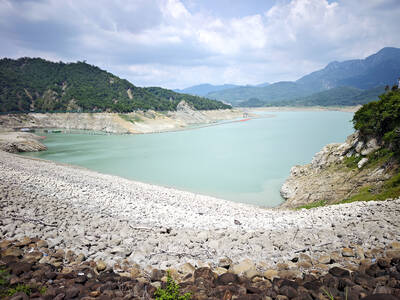
The rarest media reports involve things that work. It is not news that the traffic lights function normally or medicines are dispensed routinely from hospital pharmacies. Trains come and go on time with nary a peep from the media. Only when systems fail do reporters rush to the scene. The first half of the year saw the worst drought in 75 years in Taiwan. The Water Resources Agency (WRA) said that reservoirs south of the Hsinchu-Yilan line this winter received between 7 and 37 percent of the rainfall they received during the same period last year. Rainfall at reservoirs in Hsinchu


 RSS
RSS