


With all the vitriol and hyperbolic attacks on President William Lai (賴清德), it might be tempting to assume he is a controversial and divisive president. Depending on the poll and the question asked, he is either slightly above water or slightly below, with roughly 45 percent backing him and 45 percent opposed.
His predecessors Chen Shui-bian (陳水扁) and Ma Ying-jeou (馬英九) were — and remain — far more controversial. A curious bipartisan consensus has arisen around Chen; no one wants to talk about him, and everyone across the political spectrum wishes he would shut up and go away.
Ma remained relevant and influential in the Chinese Nationalist Party (KMT) after leaving office. He is credited by many as the leading figure behind the movement in the party to block his successor as party chair, Johnny Chiang (江啟臣), from removing the “1992 consensus” from the party platform in 2020.
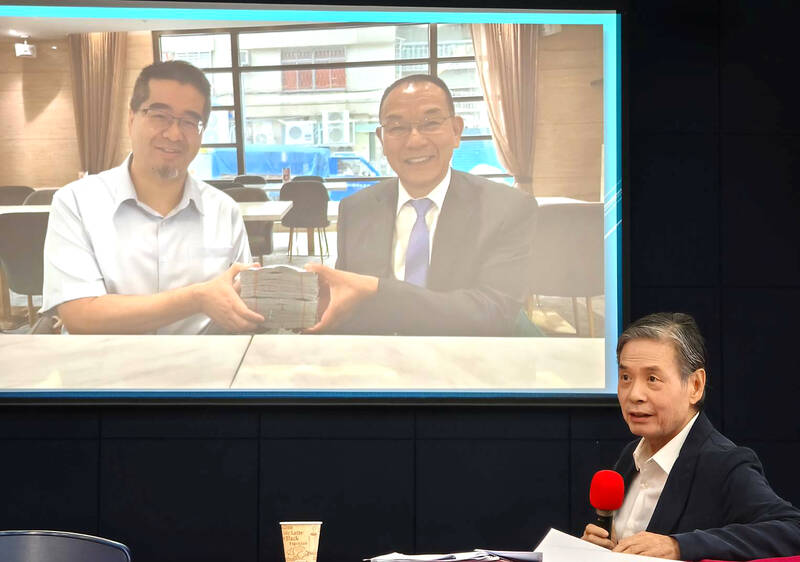
Photo: Wang Yi-sung, Taipei Times
Recently, Ma’s power and influence in the party has been slipping. This was visible during last year’s recall rallies, when Ma was brought on stage in the early evening among the middleweights in the party, not near the climax when the power players took the stage. He visibly shuffled and his voice was feeble and muffled, a far cry from the days when he held his head high, his eyes bright and brought adoring crowds to their feet.
What Ma’s historical legacy will be is still an open question. His legacy within the KMT will likely be stronger than with the public at large, but by how much?
Ma is also full of contradictions. Is he a hero? Yes. Is he a villain? Yes. It depends on the context and who is being asked.
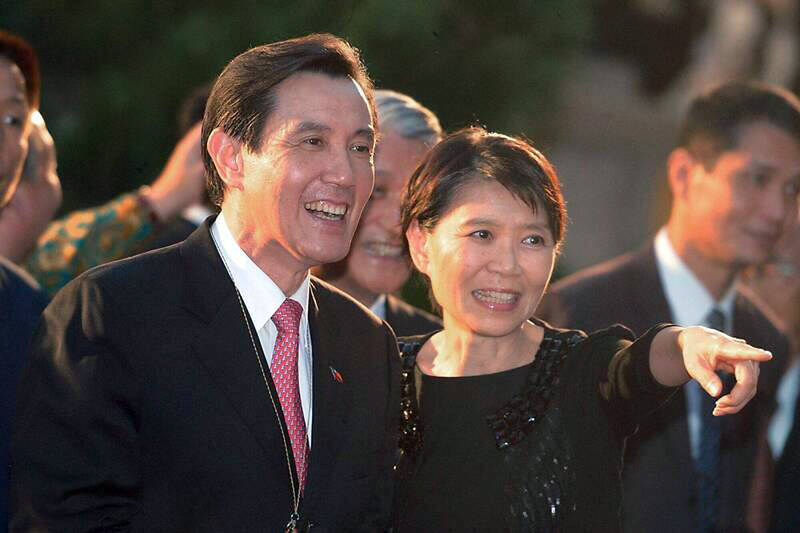
Photo: TT file photo
Most would agree his anti-corruption campaign when he was justice minister was heroic, and he targeted many politicians, including within his own party, which is why he was sacked. Most would also agree his handling of the Typhoon Morokot disaster was horrendous. On other issues, the judgment depends on political alignment, especially on relations with China and his slow strangling of the defense budget to below two percent of GDP.
He was elected by the biggest landslide in Taiwan’s history in percentage terms in 2008, and won reelection by a comfortable margin in 2012. He also reached the lowest poll ratings of any president, famously hitting a trust rating of 9.2 percent in one poll and an approval rating of 9.7 in another poll, though both were outliers and most polling had him in the upper teens or lower twenties.
In a 2020 Taiwanese Public Opinion Foundation poll, respondents were asked to give a score from 0 to 100 to all the leaders for their contribution to the country’s overall development. Ma came in second to last at a rating of 64.8, ahead of only former dictator Chiang Kai-shek (蔣介石), though caretaker president Yen Chia-kan (嚴家淦) was not included. Chen did little better, only garnering 65.6.
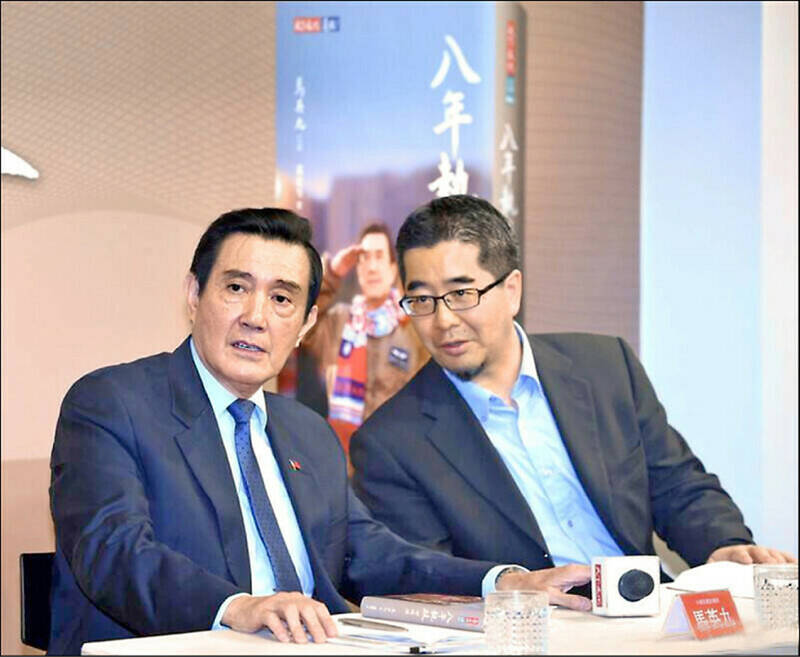
Photo: Liao Chen-huei, Taipei Times
PALACE DRAMA
The palace drama at the Ma Ying-jeou Foundation is a wild story and could have repercussions within the KMT. The foundation was created by Ma in 2018 to provide a platform for public policy discussion on issues such as youth development, culture and cross-strait relations.
The core issue is whether the 75-year-old Ma is suffering from dementia or not.
According to Ma and his supporters, two former members of his team at the foundation were engaged in a conspiracy to embezzle large sums of money. In the other camp, Ma approved everything but forgot, and is on a paranoid delusional crusade as his power slips away.
Short of a medical exam, from the outside we cannot know for sure. Dementia is also complicated.
I spent two separate months helping care for my grandfather as he slipped away. My heroic aunt bore the worst of it, but my two short months was a sad, demoralizing experience.
The tricky part about dementia, especially in the early stages, is that he would slip in and out of lucidity. Over time it got worse, and he grew increasingly paranoid, which is common in dementia cases.
Ma has admitted he has issues with short-term memory, but that is common at his age and does not necessarily mean he has dementia.
In February, former foundation CEO Hsiao Hsu-tsen (蕭旭岑) and former deputy CEO Wang Kuang-tzu (王光慈) left the foundation amid rumors of a power struggle. Hsiao had been appointed as one of four vice-chairmen of the KMT by current Chair Cheng Li-wun (鄭麗文). Some speculate Ma may have resented Cheng stealing his key aide.
Regardless, Ma then accused Hsiao and Wang of embezzling money. Hsiao was more public in his responses, and suggested Ma may have simply “forgotten many things,” which was widely interpreted as suggesting Ma has dementia.
A committee was formed to investigate the charges. Ma also brought on board former National Security Council secretary-general King Pu-tsung (金溥聰), a colorful character nicknamed “the knife.”
Then Ma’s eldest sister authorized a lawyer to petition a court for a declaration of commencement of assistance and to act as the family spokesperson, which was publicly endorsed by Ma’s wife, Chou Mei-ching (周美青). Ma expressed “shock and regret” at the statements. King and Ma released a video defending Ma’s mental state, though some accused King of “manipulating” Ma, with little evidence.
Then the investigative committee released their findings and cleared both Hsiao and Wang. However, the committee said the investigation was “anything but smooth,” claiming it was unable to obtain complete records from the foundation or get all relevant individuals to sit for interviews. They also said King claimed to be authorized by Ma to handle the case, but never presented a letter of authorization, the committee said.
DARK TURN
What the committee was told was darker than financial impropriety. Wang told the committee that she had been diagnosed with depression and anxiety disorder, had attempted suicide twice, was relying on sedatives and was experiencing recurring nightmares in which Ma strangled her. She recounted a physical altercation in Shanghai that left her unconscious on the return flight to Taiwan and having been forced to kneel on another occasion. She described hiding from Ma, including under desks and in bathrooms to avoid being alone with him.
Then Wang’s mother wrote in an open letter to the former president that she will file a legal complaint accusing the organization of workplace bullying.
Ma denies all of this. King produced a photo of Hsiao being handed a bundle of cash allegedly worth NT$1 million (US$31,795) by the Xiamen Taiwan Businessmen Association chairman, claiming it as proof. Hsiao denied it, and asked if he was pocketing the cash, why would he take a photo of it? The New Taipei City Government ordered the foundation to hand over relevant data and documents so they can investigate the claim.
On May 29, the foundation filed criminal complaints against Hsiao and Wang, accusing them of breaches of trust and embezzlement.
There is speculation that this will harm the KMT’s chances at the ballot box in November. So far, that seems unlikely. However, if Hsiao — as the KMT vice chair — is found guilty, that will create headaches for the party.
Much remains unclear, but regardless, this entire saga is very bizarre and a very strange addition to Ma’s legacy.
There may be one positive result out of this mess. As a recent Taipei Times editorial pointed out: The Ministry of Health and Welfare estimated in 2024 that 7.99 percent of people aged 65 and older were living with dementia. That number is expected to rise.
As the editorial said: “Hopefully, the case will raise public awareness of the issue and spark meaningful discussions on how to foster greater understanding of dementia in Taiwanese society.”
Donovan’s Deep Dives is a regular column by Courtney Donovan Smith (石東文) who writes in-depth analysis on everything about Taiwan’s political scene and geopolitics. Donovan is also the central Taiwan correspondent at ICRT FM100 Radio News, co-publisher of Compass Magazine, co-founder Taiwan Report (report.tw) and former chair of the Taichung American Chamber of Commerce. Follow him on X: @donovan_smith.

If a leisurely afternoon of high-end dining and watching the scenery roll by from the comfort of a plush armchair sounds like a good time to you, consider a trip on the Sea Breeze (海風號). This culinary, cultural and scenic experience is the perfect setting for a date, a celebratory outing with a small group of friends or a relaxing solo ride. The price tag is steep, especially if you consider the short distance the train actually covers over the 3.5-hour journey. But what you’re paying for on the Sea Breeze isn’t transportation; it’s the comfort, the service, the exclusivity, the
Taiwan’s renewable shortfall is a problem of execution, not resources. Japan’s long-cycle, joined-up energy planning is the model worth studying — but what Taiwan can borrow is the institutional machinery, not the politics. When Nvidia CEO Jensen Huang (黃仁勳) used his visit to Taipei last month to warn that the country needs far more electricity, he was naming a constraint its own planners already know well: Taiwan Power Co (Taipower, 台電) expects demand from the semiconductor and artificial intelligence (AI) sector alone to exceed 5 gigawatts (GW) by 2030. The harder question is not whether to build more capacity but which
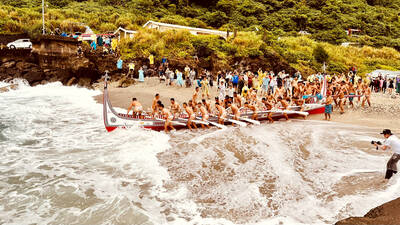
June 15 to June 21 According to legend, a giant from Orchid Island (Lanyu, 蘭嶼) named Si Mangangavang once built a large tatala canoe capable of carrying 16 people. He set sail southward to the Batanes in the Philippines, where he traded with the local Ivatan people. One of the goods they coveted was cowhide, which the Tao people of Orchid Island used to make armor. Through continued trade, the Tao and Ivatan forged close ties, and Si Mangangavang became good friends with a Batanes giant named Si Vakag. This story, collected in a 1998 book by ethnologist Yu Guang-hong (余光弘)
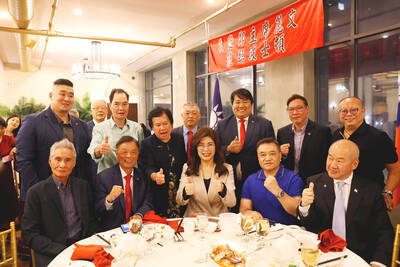
One of the wildest things about the reception of Chinese Nationalist Party (KMT) Chair Cheng Li-wun (鄭麗文) in the international media is the way her words are presented without being contextualized, let alone challenged. The Financial Times, for example, interviewing her during her visit to New York, said that she blamed the halt to exchanges between Taiwan and the People’s Republic of China (PRC) for raising tensions. “There has been no dialogue, so you can see that the situation is almost on the brink of war,” the Financial Times quoted her as saying, without any hint that the PRC, not


 RSS
RSS