


They were four years old, 15 or only seven months when they were sent to Auschwitz-Birkenau, Bergen-Belsen, Buchenwald and Ravensbruck. Some were born there.
Somehow they survived, began their lives again and had children, grandchildren and even great grandchildren themselves. Now in the evening of their lives, some 40 survivors of the Nazi camps tell their story as the world marks the 80th anniversary of the liberation of Auschwitz-Birkenau, the most notorious of the death camps.
In 15 countries, from Israel to Poland, Russia to Argentina, Canada to South Africa, they spoke of victory over absolute evil.
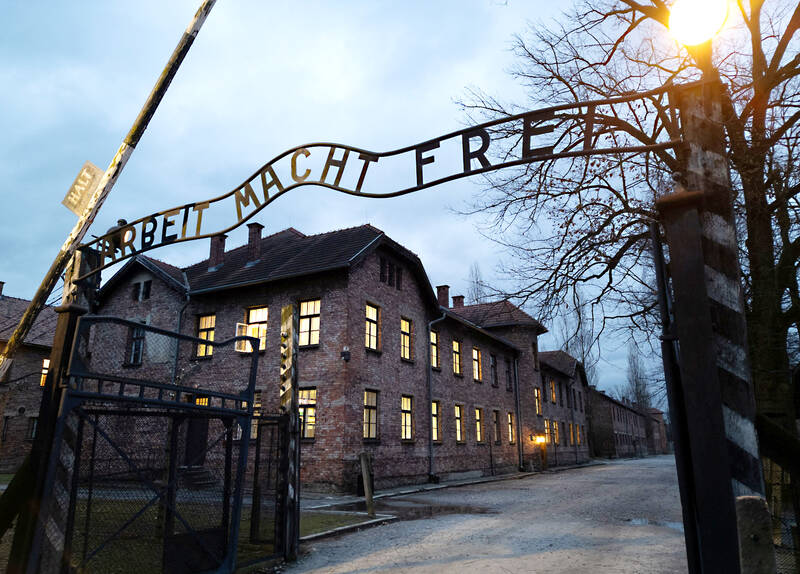
Photo: Reuters
Some spoke publicly for the first time, others have long recounted the horrors visited upon them. Many wondered what would be remembered when they were gone.
“I am part of the very last generation,” said 86-year-old Evelyn Askolovitch, who was four when she was taken from her home in France to the camps and survived Bergen-Belsen.
“How did the world allow Auschwitz?” asked 95-year-old Marta Neuwirth from Santiago, Chile. She was 15 when she was sent from Hungary to the largest and most notorious Nazi death camp in occupied Poland.
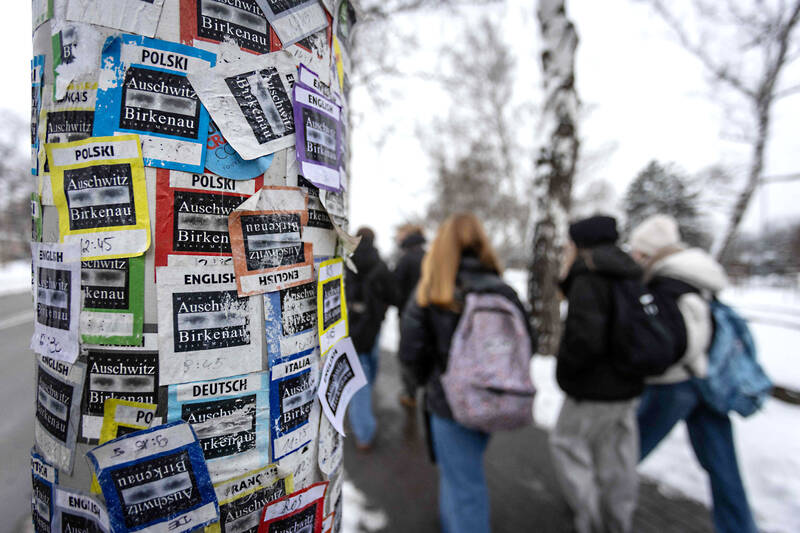
Photo: AFP
Around one million Jews as well as Roma and members of the Polish resistance were murdered there between 1940 and its liberation by the Red Army on Jan. 27, 1945. Most went straight to the gas chambers as soon as they arrived.
Six million Jews in total were slaughtered.
“Even now I don’t know why they hate us so much,” said 97-year-old Gyorgyi Nemes, who survived Ravensbruck and Flossenburg camps in Germany and Mauthausen in Austria.
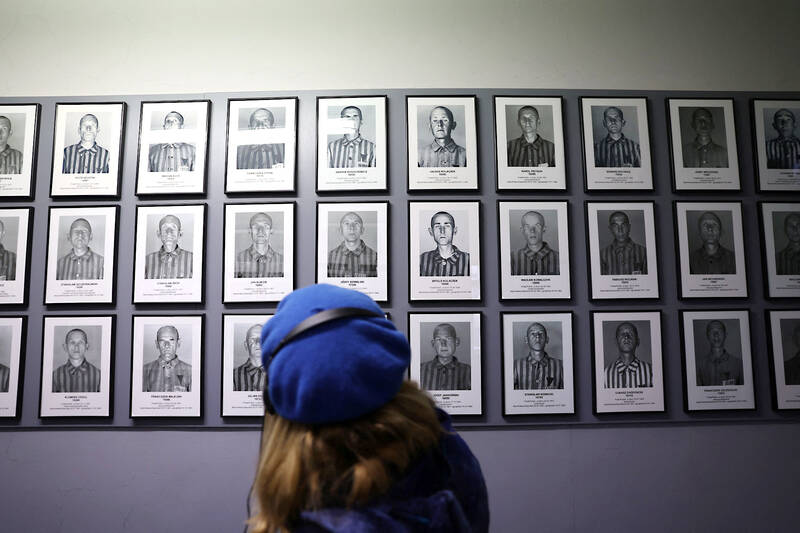
Photo: Reuters
NO ONE WANTED TO HEAR
All have had to try to make sense of life after watching their parents go to the gas chambers, their brothers and sisters die of hunger or exhaustion, or discover at the end of the war that their families had been wiped out.
“It is too difficult to talk about, too hard,” Julia Wallach, who is nearly 100, said. The Parisian was dragged off a lorry destined for the gas chamber in Birkenau at the last minute.
But hard as it is to relive the horrors, she insisted she would continue to give witness.
“As long as I can do it, I will do it.” Beside her, her granddaughter Frankie asked, “Will they believe us when we talk about this when she is not there.”
That is why Naftali Furst, a 92-year-old Israeli Auschwitz survivor born in Bratislava, has been going to Germany, Austria and the Czech Republic for years to tell his story “so the younger generations never forget what happened.”
It is also why Esther Senot, 97, braved the Polish winter last month to go back to Birkenau with French high school students. She was keeping a promise she made in 1944 to her dying sister Fanny, who asked her with her last breath to “tell what happened to us... so that we are not forgotten by history.”
“We shouldn’t have died for nothing,” echoed 97-year-old Eva Shainblum in Montreal, who at 16 was deported to the same enormous death camp next to Auschwitz from what is today Romania. Almost all of her family were exterminated.
What we now forget is that for years no one wanted to hear about the Shoah.
It took until Dec. 7, 1970 and a remarkable act of contrition by German Chancellor Willy Brandt, who knelt in front of a monument to the victims of the Warsaw Ghetto Uprising and begged forgiveness for his people, utlimately helping to create a space for their suffering to be heard.
NOT A SCREAM
The shock of their arrival in the camps, the horror of the selections, the brutality of the SS and the cold efficiency of industrial mass murder still haunt the survivors.
Many were already traumatised by their nightmarish journey to the camps inside locked cattle trucks “like animals.”
“There were about 80 of us, women, children and old people with just a bucket. No water or even a bit of bread,” said Albrecht Weinberg, 99, who still lives in Germany.
“When we arrived [at Auschwitz], prisoners in uniforms with sticks shouted ‘Out! Out!’ The old people fell out of the wagon — there was a heap of them on the ground — and the young came out on top of them.”
The old, the fragile and the children were sent straight to their deaths, the rest became slave laborers.
“They separated us, women and children on one side, men on the other side. It was a long platform, and at the end of it was a table with several SS soldiers,” recalled 100-year-old Hungarian-born Canadian Ted Bolgar. The soldiers “looked at you and waved you right or left. We had no idea what it meant. But we found out later.”
Marta Neuwirth, who sorted the clothes taken from inmates at Auschwitz, saw columns of naked women arriving “day and night” from convoys that “arrived from everywhere.”
“They made them throw their clothes on the ground. They weren’t worried, they thought they were going to have a shower... there wasn’t a scream. It was calm. They went big and healthy straight to the ovens.”
Ted Bolgar’s sister and mother were gassed as soon as they arrived, “then burned at night.” He and his father were sent the other way during the selection when he told them he was an electrician, doomed to become slaves at the mercy of the SS butchers and their underlings.
“The work was so hard... so brutal that sometimes three people died of exhaustion in one day,” said Albrecht Weinberg, who worked burying cables under Auschwitz.
Not to mention the hunger. Pole Marek Dunin-Wasowicz, 98, who was held in the Stutthof camp, said there were “weeks when I ate nothing. I passed out from hunger.”
And then there were the medical experiments. Romanian-born American Sami Steigmann became a human guinea pig in the Mogilev-Podolsky camp near the border between today’s Ukraine and Moldova.
“I’m in constant pain every single second,” said the 85-year-old, who has long lived in poverty.
“I used extremely powerful, addictive medication, but about 45 years ago, I decided to learn to live with the pain, but without the medication.”
SLEEPLESS NIGHTS
Hirsz Litmanowicz was sent at age 11 with his brother to Auschwitz-Birkenau. Later transferred to Sachsenhausen in Germany, they tested hepatitis B vaccines on his skeletal body.
His brother was not chosen for the experiemnts and died in the camps.
“I wasn’t even able to say goodbye or hold him to me,” said the Polish-born Peruvian, overcome with emotion.
Now 93, and a grandfather of six and great grandfather of eight, he admitted that he “feels the pain of what I endured more now than in the past. I don’t sleep at night.”
“I had a twin sister,” said Polish-born Canadian Pinchas Gutter, 92. They were both sent to Majdanek camp when he was 11. He was separated from Sabrina the moment they stepped into that “apocalyptic hell.”
“She started running towards my mother, and she hugged her... She had this beautiful blonde braid.”
That beautiful braid is now the only visual memory he has of Sabrina, who was gassed with her mother.
“It is extremely hurtful to me,” the old man said.
It was her mother’s heroic strength which saved Prague-born Israeli Eva Erben, 84, who was also in Theresienstadt before being sent to Auschwitz.
“She talked about what we would do when he went home; what we would buy, what shoes we’d have, what clothes we’d wear when we visited people, and how we would have our teeth repaired.”
She died in the snow on the “death march” to Germany and Austria when the Nazis emptied the camps as the Soviet army approached.
ANTI-SEMITISM RETURNS
Like many of the remaining survivors, Nate Leipciger said, “I did not expect that it would be so important to talk about the Holocaust 80 years later but it has become so because of the terrible rise in anti-Semitism around the world.”
Many survivors are frightened by the rise of the far-right across Europe, especially the Alternative for Germany (AfD).
“These are dark times,” said Erich Richard Finsches, 97, horrified by the historic victory of the Freedom Party (FPOe) in his native Austria. He believes that voters are being duped just as they were by Austrian-born Adolf Hitler in the 1930s. Pinchas Gutter worries that the Holocaust “will get drowned out” by the weight of history, or by the constant stream of social media, adds Eva Shainblum.
“For decades they said we talked about it too much... but the more generations pass the less they seem to know about what happened,” said Hungarian Judit Varga Hoffmann, 97, who survived Auschwitz.
Seeing her Roma culture and language fade adds to the suffering of Vienna-born Rosa Schneeberger, who was sent to the Lackenbach “gypsy” camp in Austria at age five.
“The Sinti are disappearing,” said the 88-year-old.
“Most died during the war” and there are not enough survivors to keep the community going, she said.
STANDING UP
Despite everything, the survivors hold to hope and a faith in life that sustained them through the worst a human can endure.
You can only be awed listening to Nemes, who said, “I buried my husband 10 years ago, but I have a son, a daughter-in-law and my family... I’m the luckiest person in the world.”
Or 103-year-old Ella Blumenthal, who lost her whole family — 23 people — in the Holocaust.
“It was a miracle we came out alive. We weren’t gassed and I’m still here. So it’s an art, I am telling you, to survive.
“We must pass the torch to the young,” said Marek Dunin-Wasowicz, who was in the Polish resistance, and survived the death marches at 15 to testify 75 years later in the trial of the SS guard Bruno Dey, one of the last of its kind.
The young “are the only hope”, he said.
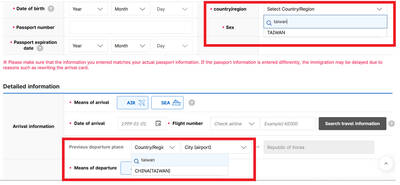
Jason Han says that the e-arrival card spat between South Korea and Taiwan shows that Seoul is signaling adherence to its “one-China” policy, while Taiwan’s response reflects a reciprocal approach. “Attempts to alter the diplomatic status quo often lead to tit-for-tat responses,” the analyst on international affairs tells the Taipei Times, adding that Taiwan may become more cautious in its dealings with South Korea going forward. Taipei has called on Seoul to correct its electronic entry system, which currently lists Taiwan as “China (Taiwan),” warning that reciprocal measures may follow if the wording is not changed before March 31. As of yesterday,
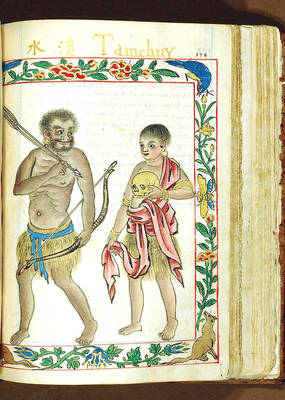
The Portuguese never established a presence on Taiwan, but they must have traded with the indigenous people because later traders reported that the locals referred to parts of deer using Portuguese words. What goods might the Portuguese have offered their indigenous trade partners? Among them must have been slaves, for the Portuguese dealt slaves across Asia. Though we often speak of “Portuguese” ships, imagining them as picturesque vessels manned by pointy-bearded Iberians, in Asia Portuguese shipping between local destinations was crewed by Asian seamen, with a handful of white or Eurasian officers. “Even the great carracks of 1,000-2,000 tons which plied
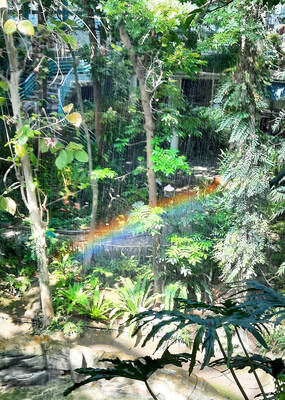
It’s only half the size of its more famous counterpart in Taipei, but the Botanical Garden of the National Museum of Nature Science (NMNS, 國立自然科學博物館植物園) is surely one of urban Taiwan’s most inviting green spaces. Covering 4.5 hectares immediately northeast of the government-run museum in Taichung’s North District (北區), the garden features more than 700 plant species, many of which are labeled in Chinese but not in English. Since its establishment in 1999, the site’s managers have done their best to replicate a number of native ecosystems, dividing the site into eight areas. The name of the Coral Atoll Zone might
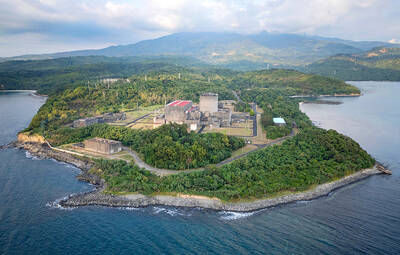
Nuclear power is getting a second look in Southeast Asia as countries prepare to meet surging energy demand as they vie for artificial intelligence-focused data centers. Several Southeast Asian nations are reviving mothballed nuclear plans and setting ambitious targets and nearly half of the region could, if they pursue those goals, have nuclear energy in the 2030s. Even countries without current plans have signaled their interest. Southeast Asia has never produced a single watt of nuclear energy, despite long-held atomic ambitions. But that may soon change as pressure mounts to reduce emissions that contribute to climate change, while meeting growing power needs. The


 RSS
RSS