


Eight months after President Xi Jinping (習近平) pledged to bring 50,000 US students to China to stabilize ties, Beijing has made its largest outreach yet. For some Americans, the most progress came in surprising moments outside the official program.
Groups affiliated with the Chinese government welcomed some 220 young Americans to a weeklong bonding festival in the southeastern province of Fujian last month. But while many US attendees said they were grateful to visit the world’s No 2 economy, several criticized the youth festival as scripted and lacking open dialogue.
With ties between the two superpowers tense over Beijing’s support for Russia’s war in Ukraine and the tally of US tariffs on Chinese exports growing, sessions on tree planting and puppet shows failed to address the biggest issues, two US attendees said.
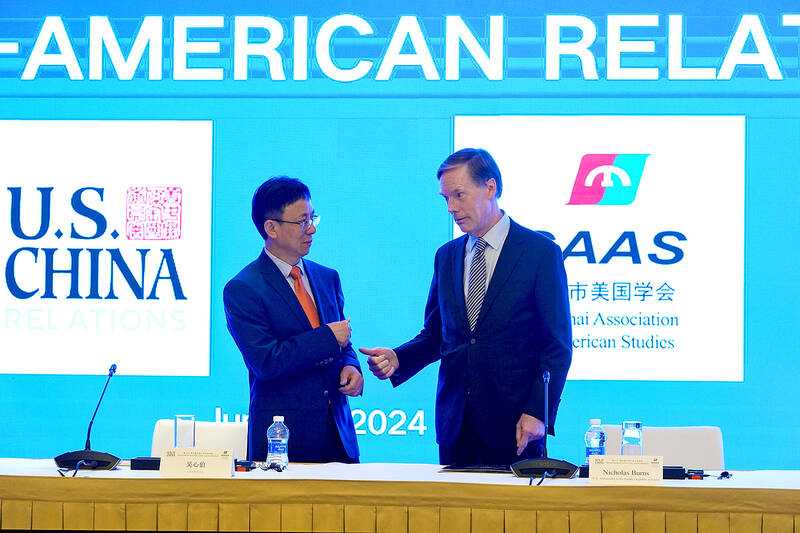
Photo: AP
CURATED’ ATMOSPHERE
That “curated” atmosphere left Tory Knowles, 27, who is studying Chinese in the US, with a “fear there was something I wasn’t seeing.” For him, the greatest insights came when he visited a nightclub in Fuzhou city, some 40 kilometers from the isolated campus.
“Everybody was so hip and looked like they were out of a << The choreographed festival exemplified the challenges facing Xi’s push to reboot people exchanges, which he called the foundation of healthy US ties at a California summit with President Joe Biden last November. Just 900 Americans are currently studying in China, down from about 15,000 a decade ago. The Center for China and Globalization, a policy research group in Beijing, puts that number slightly higher at around 3,000 based on a wider definition that captures visiting non-degree students. Communist Party officials must balance boosting those numbers with maintaining control over the flow of foreign ideas into China. Beijing’s Great Firewall blocks sensitive outside comments from the nation’s internet, while overseas films and books are tightly censored, keeping a cloak of secrecy around many American perspectives. One Chinese participant, who declined to be named speaking about private matters, said attendees from their country had been instructed to avoid discussing sensitive topics at the youth festival. Instead, Chinese participants time and again asked if their guests knew the story of Kuliang, a mountainside village near the event’s camp where an American community first settled some 150 years ago. That repetition seemed staged, according to two US attendees. China’s Foreign Ministry said young people from both nations should decide for themselves what to discuss, when asked about chatter being scripted. “It’s important that both sides are able to talk about uncomfortable and difficult issues,” said Rana Mitter, ST Lee chair in US-Asia relations at the Harvard Kennedy School. “Understanding there will be differing viewpoints between China and the West, and leaning into them, is the heart of genuine dialogue.” Some Americans saw signs Chinese people were open to a freer exchange of ideas. Liam Rinehart, 22, a University of Southern California graduate of international relations and economics, said he had “illuminating” conversations with students at the prestigious Tsinghua University in Beijing, in a trip he tagged onto the festival. “The Chinese students asked whether the right to protest could bring any real benefit to American society,” Rinehart said. “We replied: ‘Yes, the civil rights movement. That’s a pretty big one,’” he added, referring to the US fight for racial equality. Such exchanges are a rarity. As the festival took place, Washington’s top diplomat in Beijing Nicholas Burns complained that Chinese security officials had interfered in US embassy and consulate efforts to host some 60 public events since November. INTERFERING Chinese citizens were “threatened” against attending a reception on LGBTQ+ rights at his residence last month, the envoy added. Beijing has dismissed gay rights as a Western-influenced concept, in yet another sign of deepening divisions with the US. American student Victoria Ng was left confused after talking to Chinese students about Beijing’s environmental policies during the festival, the location of which she described as slightly surreal due to the “ambient music playing at all times outside.” “My main question was, ‘Do the citizens of China have any disagreements when policy is enacted?’ And everyone has said, ‘No,’” Ng said. “It’s just unfathomable to me,” she added, noting how in the US climate policy has become highly politicized. While the week’s roundtables focused on resilience in daily life and digital entrepreneurship, political tensions were never too far away. A Chinese fighter jet screeched across the Fujian sky one evening, a reminder of the charged environment around the Taiwan Strait, which hugs the coastline of the province. One US participant, who asked not to be named for fear of reprisals on future trips to China, said they were conscious the gathering was taking place close to both Taiwan and the South China Sea, two major military flashpoints between Beijing and Washington. The person also wondered if other Americans present — who came from varied backgrounds — were concerned how their attendance might be used in Chinese state media. The US delegation featured a musical quintet from Pennsylvania, a rhythmic gymnastics and dance group from Oregon, along with students and professionals who ranged in age from teenagers to their late 30s. The event organizers said their program was designed to create a “relaxed” atmosphere for the American guests. “Maybe they think we try to brainwash them,” said Shen Xin, secretary general of the Chinese People’s Association for Friendship with Foreign Countries, which is funded by the government in Beijing. “So what we do is just let them enjoy themselves, so they can put down their burdens and get rid of stereotypes.” Among the 300 Chinese students, Chen Beilin was one of a handful selected from the host province where Xi built his political career in the 1990s. The 22-year-old asked American participants what would stop them from studying in the Asian nation. “Most think there are still many historic problems, like COVID and many other political matters,” she said. It will take a “long period of time” for hostilities to ease but the festival was a good start, she added. There are other obstacles to future ties. The US has issued an advisory urging its citizens to “reconsider travel” to China, citing Beijing’s “arbitrary enforcement of local laws, including in relation to exit bans and the risk of wrongful detentions.” In 2020, Donald Trump terminated the Fulbright program that for decades brought US scholars to China. His potential reelection in the November presidential vote could see ties between the world’s two largest economies flare up again. American student Ng said a highlight of her week was leaving campus to explore the nearest city — after spending 90 minutes trying to call a taxi without access to China’s ride-hailing apps. “They can’t chaperone us into being friends,” she added. “We have to kind of do that by ourselves.”
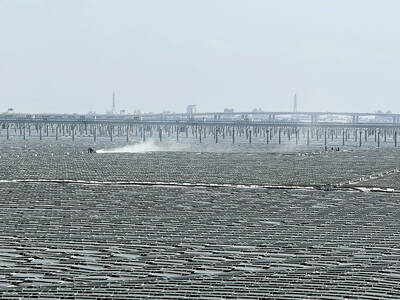
The arithmetic is straightforward and uncomfortable. By the end of 2025, Taiwan had committed itself to a 50-30-20 electricity mix — half natural gas, 30 per cent coal, 20 per cent renewables. The Ministry of Economic Affairs’s (MOEA) own monthly energy reports tell a different story. Natural gas reached 47.8 per cent of generation last year. Coal stood at 35.4 per cent, comfortably above its target ceiling. Renewables came in at 13.1 per cent, well short of the 20 per cent Taipei had pledged a decade earlier. Installed renewable capacity reached roughly half of the 12 gigawatts (GW) the government
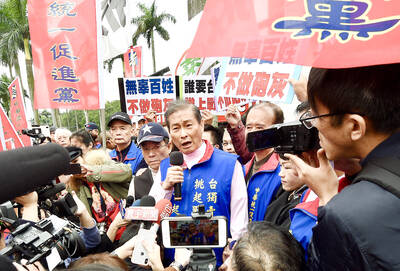
There are shadowy cabals plotting to sell out Taiwan to be annexed by China, by invasion if necessary. Fortunately, they are buffoons. In 2019, former Bamboo Union gangster and founder of the China Unification Promotion Party (CUPP), Chang An-le (張安樂, colorfully known as “White Wolf”), led a protest at the Legislative Yuan against comments made by then-premier Su Tseng-chang (蘇貞昌) that in the event of an attack by China, he would never surrender, but would protect the nation by fighting to the end, even if he only had a broom. Chang had party members bring a wooden casket that they
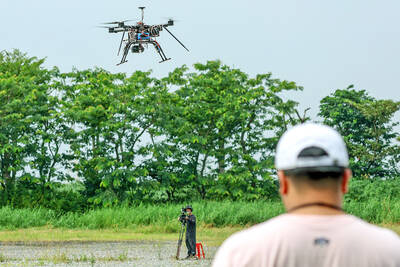
Taiwan’s drone exports are taking off, fuelled by the war in Ukraine, as Taiwanese companies seek a stake in the fast-growing global market for unmanned aerial vehicles (UAV). Low-cost drones used for reconnaissance and strikes are in high demand as governments around the world boost defense spending in the face of intensifying conflicts. A relative new player in the increasingly competitive industry, Taiwan’s pitch is to be an “Asian hub” for the production of UAVs and components free of Chinese materials, or “non-red.” That means its UAVs can be up to three times more expensive than their Chinese competitors, like the world’s biggest
It seems every few days one bumps into one of those “real man” comments in which Taiwan is urged to “face reality” or similar, and “make a deal,” with the speaker implying that soon it will be too late. “Deal” advocates always present themselves as having a superior grip on reality, and the manly ability to make the “hard choice.” Their testosterone-laden language often echoes that of Taiwan sellout advocates. Note that such commentary always specifies a process (“make a deal, work with, make progress”), never the end state of what occupation by a violent authoritarian colonialist state will entail. In


 RSS
RSS