


The first time I traveled to Pingtung County’s Tjuvecekadan (老七佳 “Old Cijia”), I was greeted by a locked gate and a sign written in old, peeling paint forbidding entry to unescorted outsiders. Behind the gate, the road to the village disappeared around a curve. After the long drive out, not being able to even catch a glimpse of the old slate houses, let alone walk among them, was a major disappointment. What lay behind that gate remained a mystery for years, until the right contact finally helped me arrange a visit last year. After visiting the village, the locked gate actually makes sense, and is part of a very successful model for sustainable tourism.
CENTURIES OF HISTORY
Our trip began with an hour-long van ride along (and through) the Cijia River, across a new suspension bridge (to replace one destroyed by Typhoon Morakot), then further up along a dirt road. After passing by the infamous locked gate, we then disembarked in a large flat clearing in front of the village. Nowadays, this plaza is a parking lot and Internet hotspot (there is no reception in the village itself), but it has an interesting history.
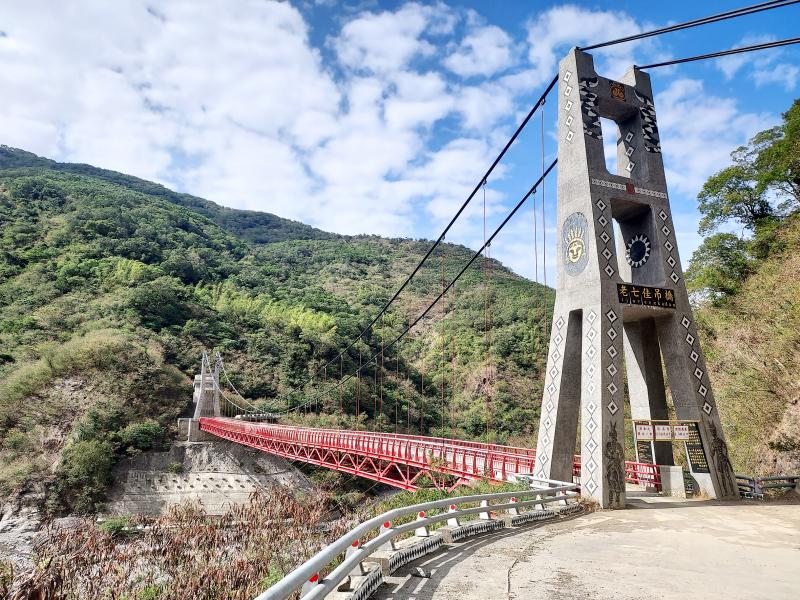
Photo: Tyler Cottenie
Decades ago, the Japanese built a police station on this spot, and the station’s brick water tower and flagpole base are still there. In earlier times, enemy skulls from headhunting missions were placed on display here as a warning to outsiders. Perhaps the first non-Formosan outsiders to arrive at this place were the Dutch, who were attempting to open a cross-island route to the east coast for gold mining. The village, recorded as “Toutsikadangh,” appears in their records from 400 years ago. That this village has survived a minimum of four centuries of typhoons, earthquakes and landslides is a testament to the wisdom of the original founders in selecting a site for their settlement.
Moving beyond the plaza, the whole village came into view: row upon row of dark slate houses, resting on terraces carved into the mountainside and interspersed with paths, walls and lush green vegetation. Coming from the concrete and corrugated steel of urban (or agricultural) Taiwan, this is an entirely different world. Although we were eager to explore the village right away, we were asked to first sit down for lunch. Once again, this was far removed from the typical Taiwan experience.
PAIWAN FOOD, DRINK AND CULTURE
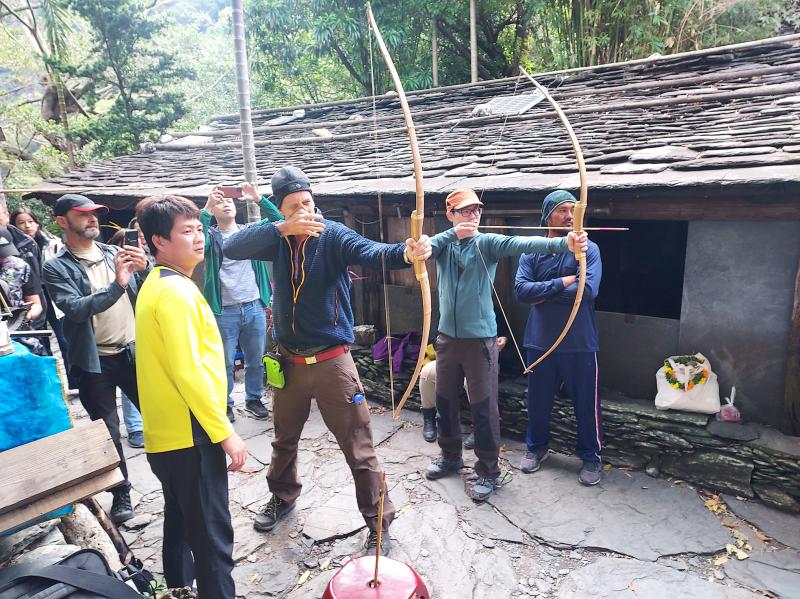
Photo: Tyler Cottenie
The lunch spread was beautifully presented and prepared with care by one of the villagers. Most of the food came right from the mountain, including meat supplied by hunters and fishermen, and vegetables from their mountain garden, some of which were even certified organic. Several dishes included a native herb (Zanthoxylum ailanthoides), known in Chinese as “prickly onion” (刺蔥), that added an exotic fragrance to each dish where it was it used.
During this lunch, we were also introduced to the locally made millet wine and Paiwan customs regarding alcohol. The drink is fermented with both millet and rice, which remain in the finished product and can be drunk together with the wine. Before taking the first drink of the day, one should dip the fingers of the right hand into the wine and flick an offering of wine into the sky, toward the ground and to the side, thanking the heavens, the earth and one’s ancestors respectively.
A plank with spaces for two drinks is often used, with one person designating someone else they would like to toast. After they both drink from the plank at the same time, the toastee then becomes the toaster, selecting another member of the group. This continues ad infinitum or until the entire clay pot of millet wine is gone. Our group was congratulated for being one of the only ones to ever finish off an entire pot; whether or not this is something we should be proud of I’m still not sure.
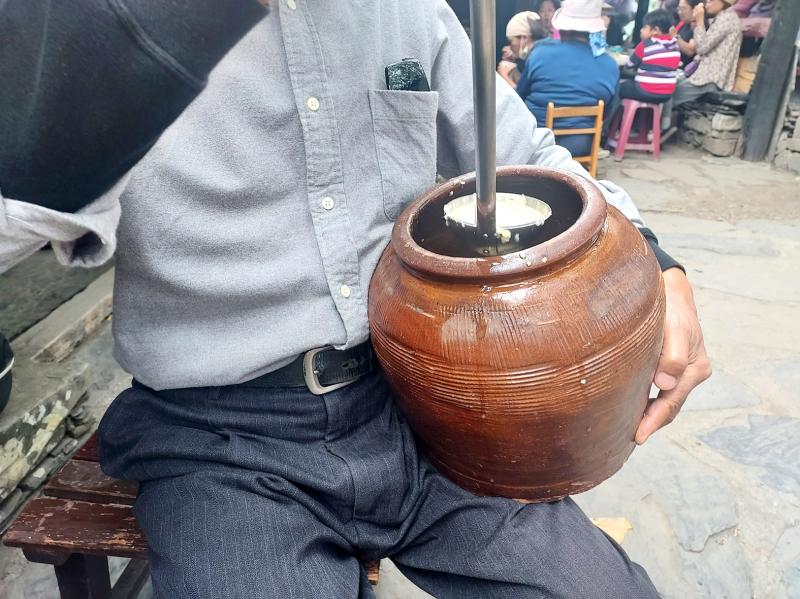
Photo: Tyler Cottenie
After eating and drinking far too much, we were taken around the village by our entertaining and knowledgeable guide, Saive. We started in the house belonging to her and her husband, Tjangkus, where we learned about the construction of slate houses. The essential feature found in every house is the monolithic “ancestral spirit pillar” that supports most of the weight of the roof. It is a large upright stone in the middle of the house, partially buried and topped with an inset wooden beam for added ceiling height. The walls are made of pieces of slate carefully stacked without mortar, and the roof is covered in similar pieces of slate as shingles, weighted down by rocks and logs to prevent slippage. In Tjuvecekadan, they use round white rocks, for two reasons: it makes for a beautiful contrast with the dark grey of the slate, and from far away the rocks’ similarity to skulls may have served to intimidate outsiders.
The houses are lit by skylights, which, in the past, were simple holes in the roof that could be covered or uncovered by a movable piece of slate depending on the weather. Roof work was never done by women, as traditionally women wore skirts but no underwear, and being up that high might infringe on their modesty. When asked if the men wore underwear for roof work, the guide replied that they did not and, with a glint in her eye, suggested that young women looking for a husband were known to pay special attention to the view through the skylights during these times. We also saw the exterior of a chief’s house, featuring ancient carvings depicting village life in the past (complete with the now-extinct clouded leopard and the abandoned practice of headhunting).
In the evening, we were treated to an even larger spread of local food, including the chef’s own creation incorporating pigeon peas. The millet wine made another appearance, as did stronger, more familiar stuff that came in a bottle. After everyone had been thoroughly fed (and thoroughly toasted), the celebration continued into the night with a barbecue, and more drinking, singing and dancing. This was hospitality taken to an entirely new level.
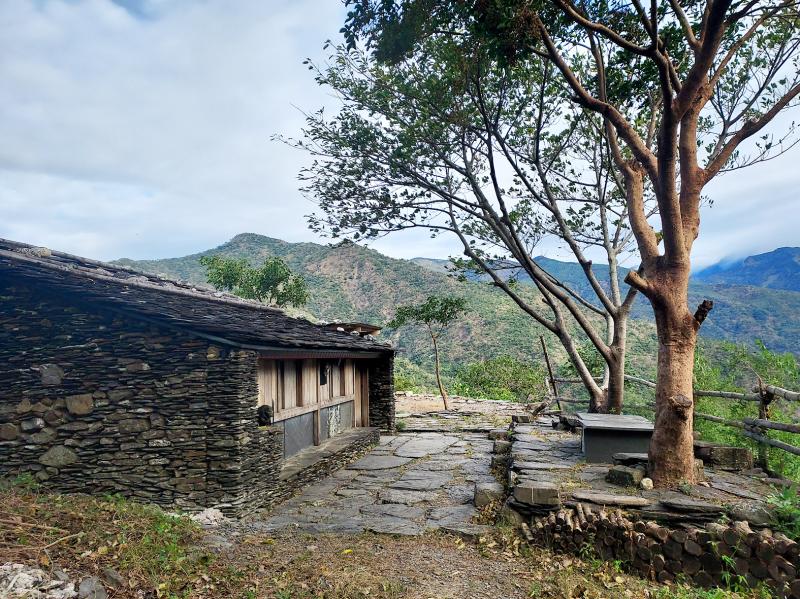
Photo: Tyler Cottenie
SUSTAINABLE TOURISM
Eventually, we retired to our accommodations for the night, inside a slate house belonging to local resident, Calivat, where a candle had been lit for us. Although the village has a road leading to it, the villagers have consistently refused Taipower’s offer of electrical lines. They have decided to place more importance on preservation than on modernizing or on making a quick buck by bringing in as many tourists as they can. There are no gift shops here; in fact, there is nothing to spend money on at all.
Visitor numbers are thus capped at 50 per day, the gate remains locked to outsiders, and the funds taken in from tourists are redirected toward village preservation. This includes rebuilding ruined houses, and encouraging houses that have incorporated tarps, steel or other modern materials to revert to traditional materials. At the lowest point, only 12 intact houses remained, but now there are 50 again. The preservation and authenticity of this site is an unmitigated success, and the hospitality is second to none. For an authentic Aboriginal tourist experience away from the crowds, look no further than Tjuvecekadan.
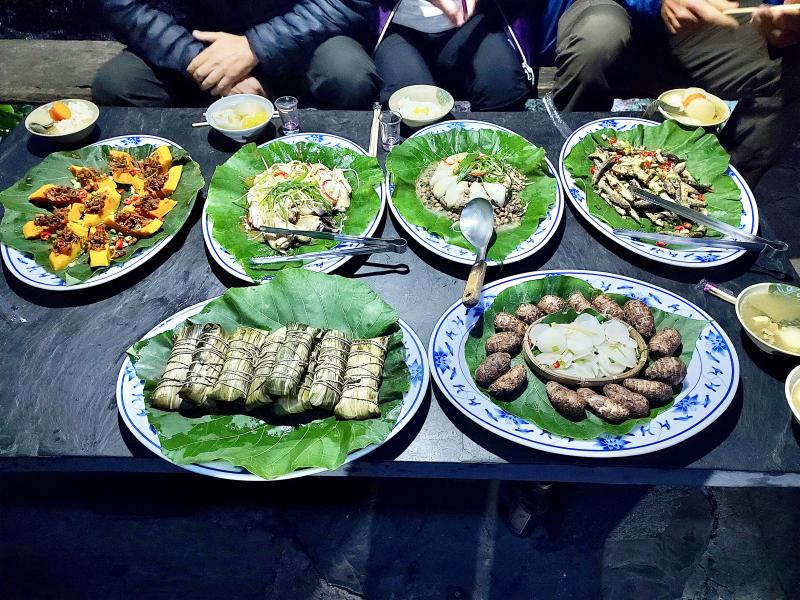
Photo: Tyler Cottenie
Day trips and overnight visits can be arranged through the village cultural association’s Facebook page at www.facebook.com/vecekadan/ (Chinese only). For tours in English, contact Blue Skies Adventures in Kaohsiung at www.facebook.com/BlueSkiesTaiwan.
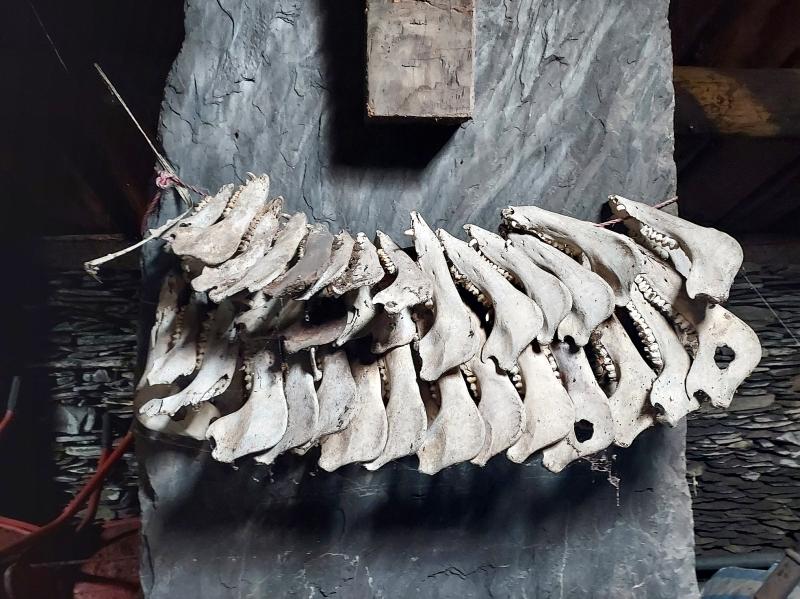
Photo: Tyler Cottenie
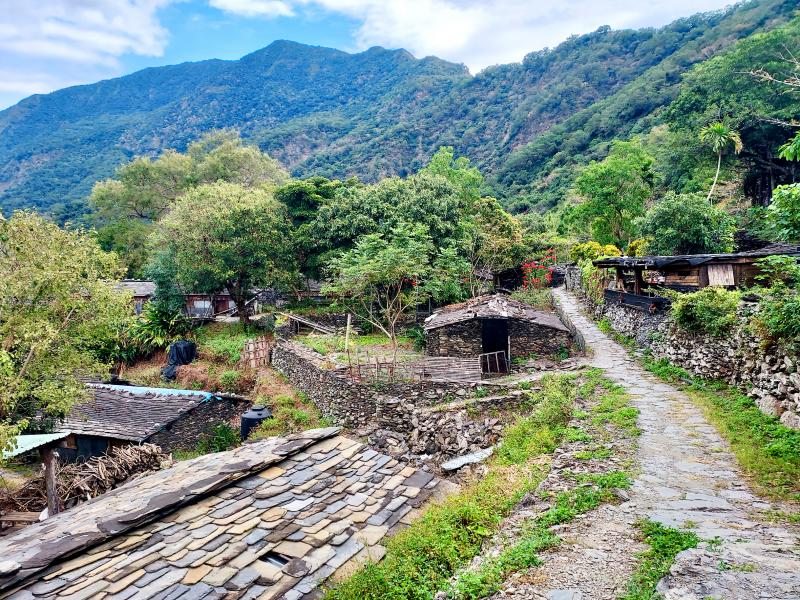
Photo: Tyler Cottenie
May 18 to May 24 Gathered on Yangtou Mountain (羊頭山) on Dec. 5, 1972, Taiwan’s hiking enthusiasts formally declared the formation of the “100 Peaks Club” (百岳俱樂部) and unveiled the final list of mountains. Famed mountaineer Lin Wen-an (林文安) led this effort for the Chinese Alpine Association (中華山岳協會). Working with other experienced climbers, he chose 100 peaks above 10,000 feet (3,048m) that featured triangulation points and varied in difficulty and character. The list sparked an alpine hiking craze, inspiring many to take up mountaineering and competing to “conquer” the summits. A common misconception is that the 100 Peaks represent Taiwan’s 100 tallest

Yesterday, the Democratic Progressive Party (DPP) nominated legislator Puma Shen (沈伯洋) as their Taipei mayoral candidate, the Chinese Nationalist Party (KMT) put their stamp of approval on Wei Ping-cheng (魏平政) as their candidate for Changhua County commissioner and former legislator Tsai Pi-ru (蔡壁如) of the Taiwan People’s Party (TPP) has begun the process to also run in Changhua, though she has not yet been formally nominated. All three news items are bizarre. The DPP has struggled with settling on a Taipei nominee. The only candidate who declared interest was Enoch Wu (吳怡農), but the party seemed determined to nominate anyone

In a sudden move last week, opposition lawmakers of the Chinese Nationalist Party (KMT) and Taiwan People’s Party (TPP) passed a NT$780 billion special defense budget as a preemptive measure to stop either Chinese leader Xi Jinping (習近平) or US President Donald Trump from blocking US arms sales to Taiwan at their summit in Beijing, said KMT heavyweight Jaw Shaw-kong (趙少康), speaking to the Taipei Foreign Correspondents Club on Wednesday night in Taipei. The 76-year-old Jaw, a political talk show host who ran as the KMT’s vice presidential candidate in 2024, says that he personally brokered the deal to resolve

“China wants to unify with Taiwan at the lowest possible cost, and it currently believes that unification will become easier and less costly as time passes,” wrote Amanda Hsiao (蕭嫣然) and Bonnie Glaser in Foreign Affairs (“Why China Waits”) this month, describing how the People’s Republic of China (PRC) is playing the long game in its quest to seize Taiwan. This has been a favorite claim of many writers over the years, easy to argue because it is so trite. Very obviously, if the PRC isn’t attacking Taiwan, it is waiting. But for what? Hsiao and Glaser’s main point is trivial,


 RSS
RSS