


The label “date movie” hasn’t traditionally been applied much to documentaries but filmmakers Betsy West and Julie Cohen have twice now made non-fiction films of trailblazing female icons that also happen to be portraits of loving, supportive marriages.
In RBG, the 2018 Oscar-nominated bio-documentary of Ruth Bader Ginsburg, the filmmakers lingered over the encouraging role of her longtime husband, the lawyer Martin D. Ginsburg. Their latest, Julia, which premiered Sunday at the Toronto International Film Festival, is likewise about a pioneering 20th century woman, the adventurous TV chef Julia Child, whose ascent was tenderly and enthusiastically advocated for by her husband, Paul Child. He even wrote a sonnet for her.
“For never were there foods, nor were there wines / Whose flavor equals yours for sheer delight / O luscious dish! O gustatory pleasure! You satisfy my taste buds beyond measure.”
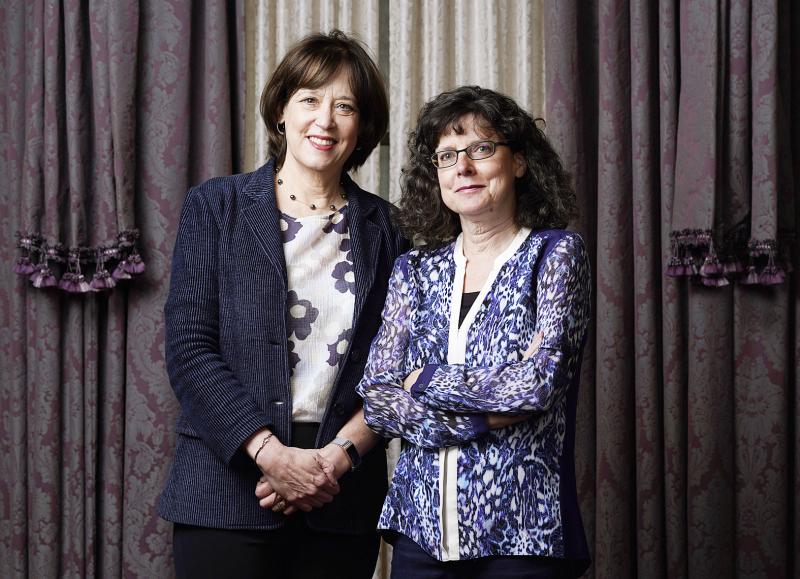
Photo: AP
“Feminist love stories are our genre,’’ Cohen says in an interview alongside West. “RBG was a great date movie. Julia is a slightly more expensive date movie because it really needs to be the movie and then a good dinner.’’
Julia, which will be released on the US on Nov. 5, is an affectionate and flavorful tribute to a beloved culinary figure. The film surveys a life that found fame relatively late. Child was nearly 50 by the time her debut cookbook Mastering the Art of French Cooking was released in 1961. Her career on TV, beginning with an omelet on Boston’s WGBH, came the year after. There and beyond, Child was a charismatic, 188cm-tall exception to a male-dominated cooking world and a carefree antidote to the force-fed image of the TV-dinner cooking ‘50s housewife.
Her husband, a former diplomat, contentedly took a background role. In The French Chef Cookbook, Julia Child wrote: “Paul Child, the man who is always there: porter, dishwasher, official photographer, mushroom dicer and onion chopper, editor, fish illustrator, manager, taster, idea man, resident poet, and husband.’’
Julia is only set partly among the pots and pans (and heaps of butter) that made Child famous. (The filmmakers even built a replica of her kitchen to make and photograph some of her best-known dishes.) But the heart of Julia may lie outside the kitchen in capturing her larger life and passions. Over time, she spoke more openly about her political beliefs. She became a champion for Planned Parenthood.
Child wrote a letter in 1982 that was sent to Planned Parenthood donors. It read: “Few politicians will take the risk of publicly supporting either contraception or abortion — and who is ‘for abortion’ anyway? We are concerned with freedom of choice.’’
“What Julia did at the time was pretty risky. This was not a time when celebrities or celebrity chefs were going out of their way to take positions that were controversial,’’ West says. “Julia was very confident in her beliefs and determined to bring her celebrity to something she truly believed in.”
For West and Cohen, Julia is only part of their output following RBG, a blockbuster documentary that collected more than US$14 million in ticket sales. Their My Name Is Pauli Murray, profiles a pivotal but sometimes overlooked activist and writer who helped lay the legal framework for both the civil rights and women’s rights movements. Ginsburg credited Murray, who was Black and gender neutral, with inspiring her argument in the 1971 Supreme Court case Reed v. Reed, in which the court recognized women as victims of sex discrimination for the first time.
“There is just a huge landscape of women out there whose stories haven’t been adequately told,’’ says West. “It’s frankly an opportunity for us to tell these stories.’’
West and Cohen had worked in documentary film in various capacities before RBG dramatically raised their profiles. Often, they’ve enjoyed themselves along the way. At the National Board of Review Awards in 2019, they performed planks on stage as tribute to the Supreme Court justice’s workout routines.
“We’re hugely fortunate that RBG got the attention that it did because it sort of opened up some doors,” says Cohen. “It’s a sad and discouraging fact that some of these historical stories of women aren’t as well known or as understood as they should be. But our perspective as documentary filmmakers is that it’s kind of like a gold mine.’’
It’s an ongoing project. Cohen and West are currently editing another documentary about an extraordinary American woman they expect to release next year.
They won’t say who their subject is this time, except to say that she’s alive. And, yes, Cohen promises, this film, too, features what she calls a great feminist love story.
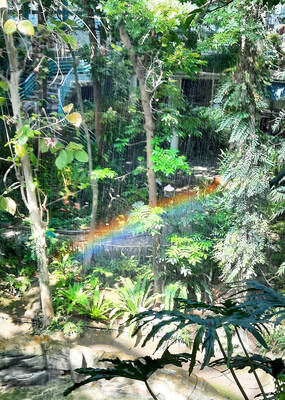
It’s only half the size of its more famous counterpart in Taipei, but the Botanical Garden of the National Museum of Nature Science (NMNS, 國立自然科學博物館植物園) is surely one of urban Taiwan’s most inviting green spaces. Covering 4.5 hectares immediately northeast of the government-run museum in Taichung’s North District (北區), the garden features more than 700 plant species, many of which are labeled in Chinese but not in English. Since its establishment in 1999, the site’s managers have done their best to replicate a number of native ecosystems, dividing the site into eight areas. The name of the Coral Atoll Zone might
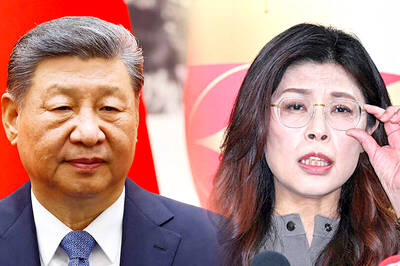
On Monday morning, in quick succession, the Chinese Communist Party (CCP) and the Chinese Nationalist Party (KMT) released statements announcing “that the Central Committee of the Communist Party of China and General Secretary Xi Jinping (習近平) have invited KMT Chairwoman Cheng Li-wun (鄭麗文) to lead a delegation on a visit to the mainland” as the KMT’s press release worded it. The KMT’s press release added “Chairwoman Cheng expressed her gratitude for the invitation and has gladly accepted it.” Beijing’s official Xinhua news release described Song Tao (宋濤), head of the Taiwan Work Office of the CCP Central Committee, as
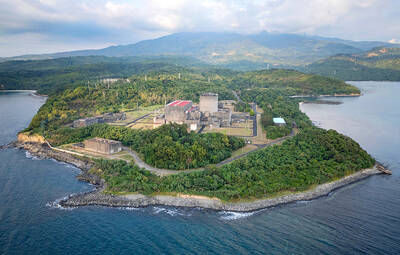
Nuclear power is getting a second look in Southeast Asia as countries prepare to meet surging energy demand as they vie for artificial intelligence-focused data centers. Several Southeast Asian nations are reviving mothballed nuclear plans and setting ambitious targets and nearly half of the region could, if they pursue those goals, have nuclear energy in the 2030s. Even countries without current plans have signaled their interest. Southeast Asia has never produced a single watt of nuclear energy, despite long-held atomic ambitions. But that may soon change as pressure mounts to reduce emissions that contribute to climate change, while meeting growing power needs. The

Last week saw Ko Wen-je (柯文哲), former Taipei mayor and founder of the Taiwan People’s Party (TPP), receive a 17-year sentence for crimes involving political corruption. This was only the opening round: the case is likely to drag on for several more years in appeals. Both the TPP and the Chinese Nationalist Party (KMT) are claiming that the prosecutors are engaging in a political witch hunt, green terror, fascism and so forth. It is easy to see this as a kind of compensation. After all, otherwise they would have to admit that the rather impressive collection of evidence against Ko actually


 RSS
RSS